Recently Visited Section Template
The Recently Visited section template renders users’ recently accessed navigation items as links by default. Administrators can import this section into any PeopleSoft landing page, homepage, or dashboard. The template leverages an application class that extends the DynamicLoader application class, ensuring dynamic and efficient data sourcing.
The recently visited items are available in the Quick Access Bar (QAB) and in the NavBar. In addition to these, PeopleTools enables you to add the recently visited items to a landing page, homepage, or dashboard as a section.
When you plan to use the Recently Visited section, you should note the following:
-
User permissions for the Recently Visited section match those required to view recently used items in QAB and NavBar.
-
If a user does not have access to the recently used items, the section does not appear.
-
If there are no recent items, for example, on the user's first login, the section does not appear.
-
The number of items displayed adheres to the configured limit for recently used items. However, you can specify the number of items to be displayed, which is described later in this topic.
To view the delivered Recently Visited section template, navigate to , and select the corresponding Edit link.
This example illustrates the settings in the delivered Recently Visited section template. You can find definitions for the fields and controls later in this page.
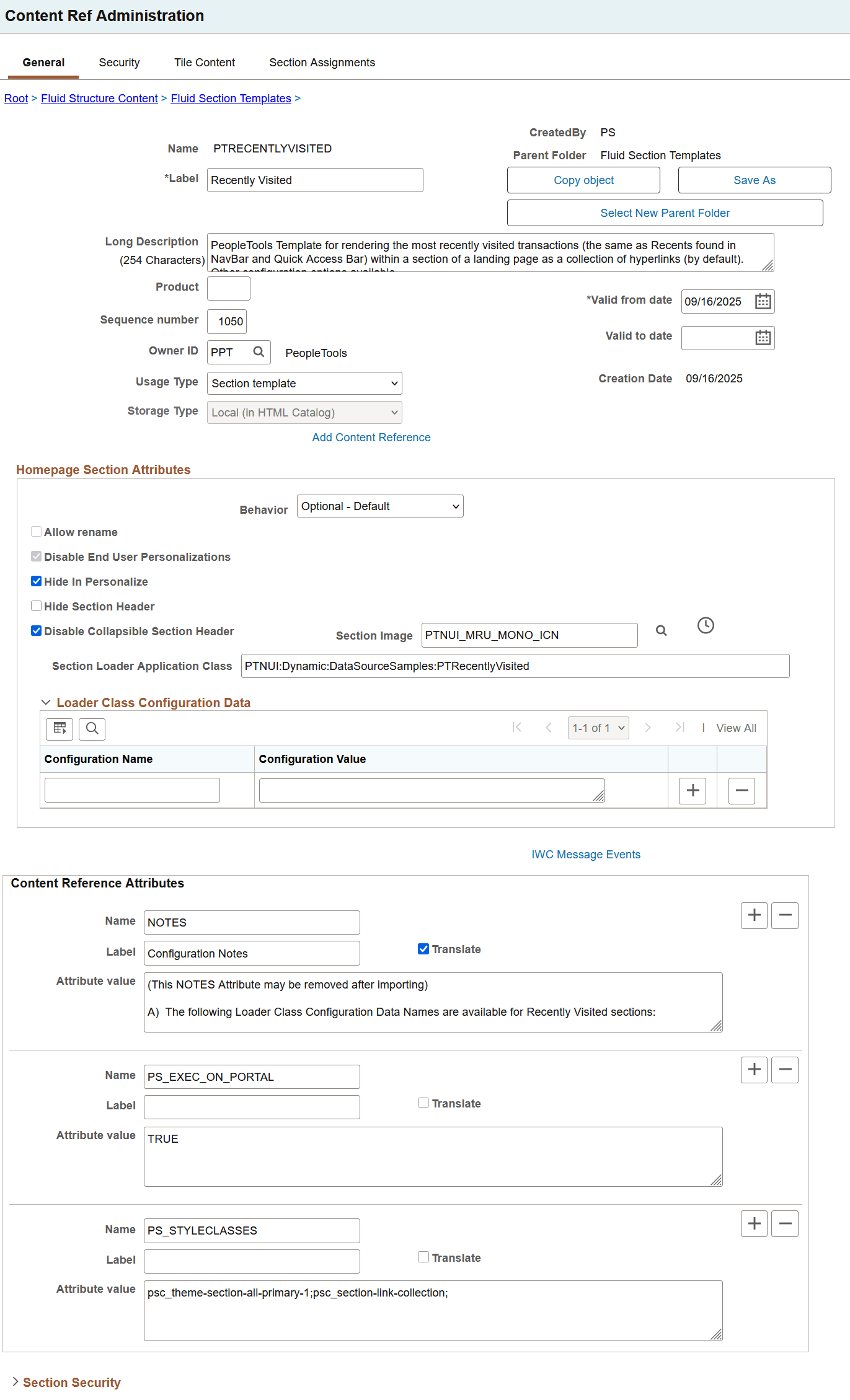
For descriptions of all the fields and controls on the Recently Visited section template page, see Creating a Section Template.
The following table describes the fields that you should take note of and change, if required, after you import this section template to a target landing page, homepage, or dashboard.
| Field or Control | Description |
|---|---|
|
Section Loader Application Class |
Use the PTRecentlyVisited application class to dynamically load the recent items in the section. It is an extension to the base class PTNUI:Dynamic:DynamicLoader. |
|
Content Reference Attributes |
|
|
Loader Class Configuration Data |
Enter configuration data as a name-value pair. See Loading Configuration Data in the DynamicLoader Application Class for more information. |
Examples of the Recently Visited Section
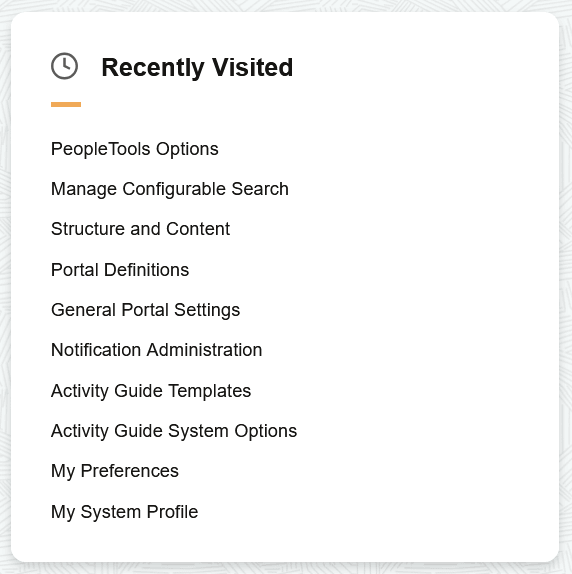
The Recently Visited section with the default settings is rendered as shown in this screenshot.
-
psc_theme-section-all-primary-1
-
psc_section-link-collection
This example illustrates the Recently Visited section with default settings.
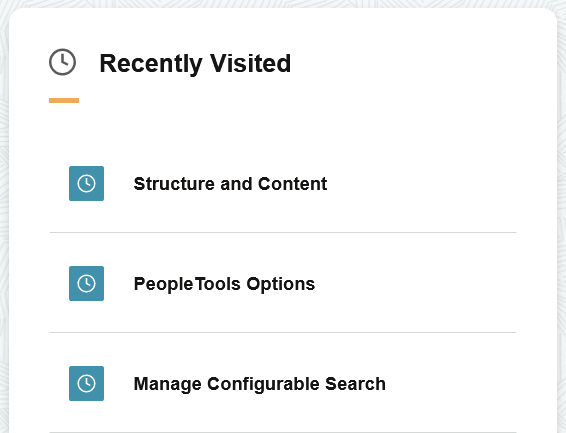
After importing the section template, you may modify the style classes as shown in the following example:
In PS_STYLECLASSES attribute, enter style classes separated by semi-colon (;).
-
psc_theme-section-primary-1
-
psc_theme-tile-transparent
-
psc_section-simple-list-collection
The default image for each of the entries is PTNUI_MRUITEM_ICN, which is same as the image used in QAB. If you want to change the icon used for each entry, you can do that using configuration data, which is discussed later in this topic: Configuration Data for the Recently Visited Section Template .
This example illustrates the Recently Visited section post import with modified style classes.
Configuration Data for the Recently Visited Section Template
The following table contains the complete list of configuration property names and expected values for Recently Visited.
Table 14-1 Configuration data
| Property Name | Value | Description |
|---|---|---|
|
IMAGENAME |
An image name or DEFAULT. |
Enter the name of an image or specify DEFAULT. When you specify DEFAULT, the system uses the same icon that appears in the Quick Access Bar and NavBar for recent items. |
|
TILEPREFIX |
A character string used as the prefix for dynamically created tiles in the section. |
The default value is PTMRU. The value must not exceed six characters and must not contain special characters. Use a unique prefix within a landing page when necessary. For example, if you set TILEPREFIX to MYMRU, a dynamically created tile will have the tile name MYMRU000001. The system increments the numeric portion of the tile name for subsequent tiles; however, the numeric sequence is not guaranteed to begin with 1. Use different prefixes to distinguish multiple sets of recently visited tiles. For example, if you create two recently visited sections that use different tile presentations, assign a different prefix to each section. |
|
MAXRESULTS |
A numeric value greater than 0 that specifies the maximum number of entries to retrieve and display. |
The default value is 0, which indicates that no limit is specified for this property. In this case, the system uses the configured MAXMRU value. When you specify a value greater than 0, the value must be less than or equal to the system setting for the maximum number of recently used items (MAXMRU). If the specified value exceeds MAXMRU, the system uses the MAXMRU value. |