Defining Advanced Settings for Date Facets
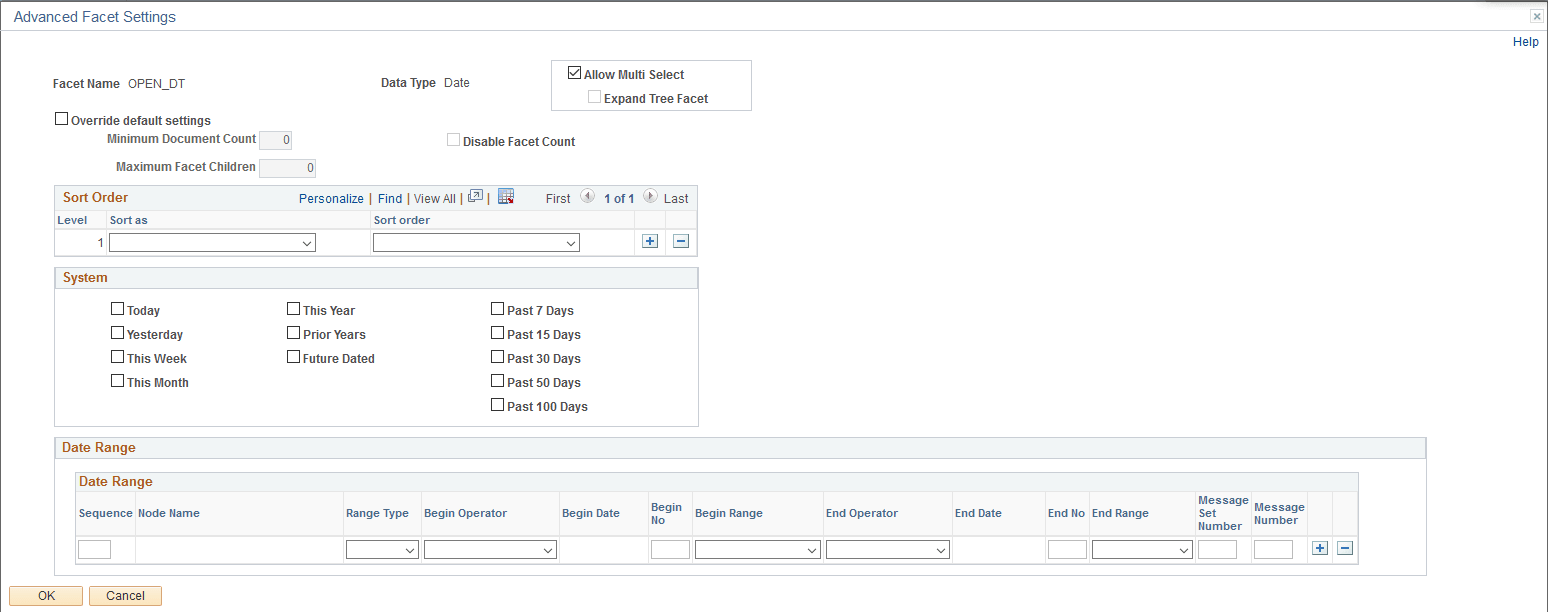
When the search attribute is a date data type, the Advanced Facet Settings page enables you to configure the sort order and ranges.
This example illustrates the fields and controls on the Advanced Facet Settings page (for date data types). You can find definitions for the fields and controls later on this page.
| Field or Control | Description |
|---|---|
|
Allow Multi Select |
By default, all facets enable you to choose multiple facet values on the Global Search results page and the component search results page to filter and narrow down the search results. Select the Allow Multi Select check box to enable multiple facet-values selection in hierarchical facets. If you deselect this option, single select applies to the current facet. Note: Selecting multiple facet values is supported only on fluid search pages; not on classic or classic plus search pages. |
|
Expand Tree Facet |
The Search Options page contains the Expand Tree Facet option to specify the setting at the system level. The default value is collapsed, that is, the Expand Tree Facet check box is not selected. You can use this option to override the setting specified on the Search Options page. |
|
Override default settings |
Select to override the values entered on the Search Options page (). When selected the disabled settings on the page become enabled so that you can override the equivalent values entered on the Search Options page. The override values apply to the current facet only. If not selected, the values entered on the Search Options page apply. |
|
Minimum Document Count |
Set the minimum number of search results (documents) required to display a facet. Default is 1. This property can be overridden by selecting Advanced Settings on the Facets page (, Facets, Advanced Settings). |
|
Maximum Facet Children |
Set the maximum number of children to be returned for each facet node. Default is 100. Options to enter are:
|
|
Disable Facet Count |
Enables controlling the display of the result count (document count) for each facet node. For example, if 15 search results met a facet node’s criteria, (15) appears next to the facet label. Enter Y for Yes or N for No. |
Sort Order
Displays an additional option than the string sort order, Predefined, which displays the facet node, based on the sequence number in which the ranges are defined.
System
This group box provides predefined set of date facet nodes.
| Field or Control | Description |
|---|---|
|
Today |
Displays results with a date for the current day only. |
|
Yesterday |
Displays results with a date of the previous day only. |
|
This Week |
Displays results with a date for the current week only. |
|
This Month |
Displays results with a date for the current calendar month only. |
|
This Year |
Displays results with a date for the current calendar year only. |
|
Prior Years |
Displays results with a date prior to the current year. |
|
Future Dated |
Displays results which are applicable beginning with tomorrow onward. |
|
Past N Days |
Displays results which are applicable for the past N days (current date - N), where N is a predefined number of days (7, 15, 30, 50, 100). |
Date Range
In addition to the predefined system ranges, you can create additional date ranges using the Date Range grid. This allows you to create ranges based on static dates or relative ranges based on the current date.
| Field or Control | Description |
|---|---|
|
Sequence |
Defines the order in which the facets appear. |
|
Node Name |
A read-only field displaying how the facet node will appear to the end user. The value depends on whether the range is fixed or relative. If the range is fixed, then the system derives the facet node from the begin and end values specified for the ranges or by using the message catalog, with the message catalog taking precedence. If the range is relative, then it is required to provide a message catalog entry for the facet node name. |
|
Range Type |
Enables you to create ranges on fixed dates or dates relative to today. Options are:
Note: Custom facet ranges do not support the facet nodes for rolling dates. For example, you cannot predefine a facet for each quarter on a financial year and have it dynamically update every year. |
|
Begin Operator |
The first operator for the range sets the beginning of the range. To set the beginning of the range, you have these options to operate against the beginning facet value specified:
|
|
Begin Date |
Available only for fixed ranges. Set the beginning date for the facet range. |
|
Begin No |
This is the number of days/months/years to be set as the beginning of the facet range as per the selection from the Begin Range drop-down list. |
|
Begin Range |
Set the span of the dates to be included in the range (past or future). Select in the form of:
|
|
End Operator |
The second operator for the range, sets the end of the range. To set the end of the range, you have these options to operate against the end facet value specified:
|
|
End Date |
Available only for fixed ranges. Set the end date for the facet range. |
|
End No |
This is the number of days/months/years to be set as the end of the facet range as per the selection from the End Range drop-down list. |
|
End Range |
Set the span of the dates to be included in the range (past or future). Select in the form of:
|
|
Message Set Number |
Message catalog set number to provide a custom facet node name. |
|
Message Number |
Message number to provide a custom facet node name. |