Advanced Options Tab
Use the Advanced Options tab to specify the information required to connect to multiple portal URLs and to enable persistent variables.
This example illustrates the fields and controls on the Runtime Options dialog – Advanced Options tab. You can find definitions for the fields and controls later on this page.
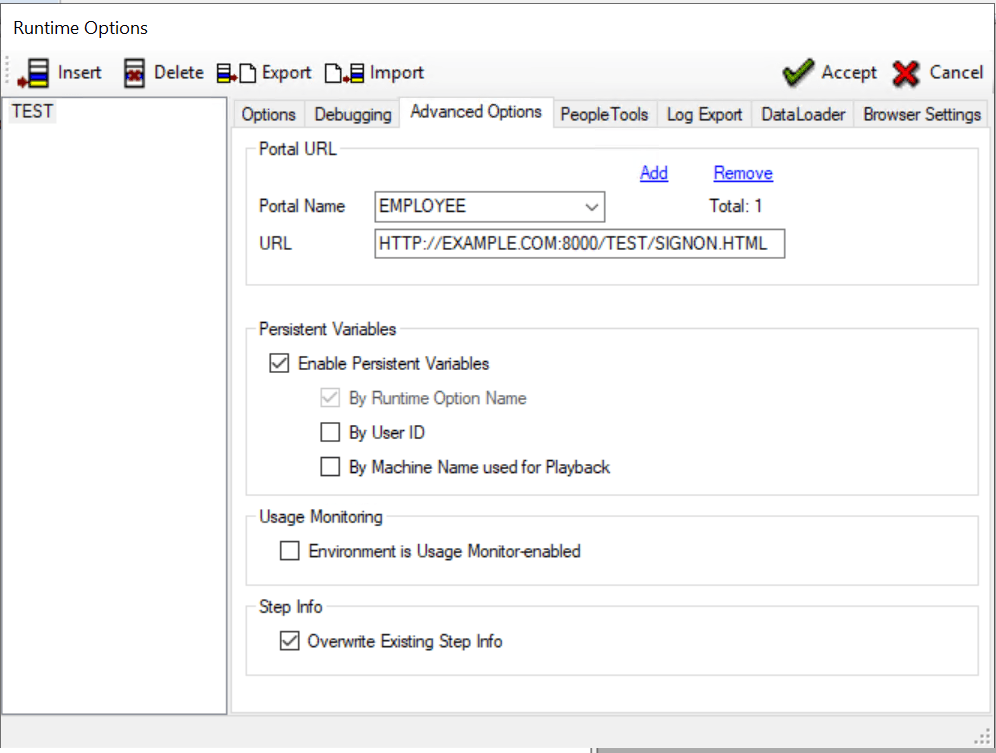
The Portal URL is used to access the component when there is a step in the test to set the browser URL (Browser.Set_URL). See Set_URL. To add a portal URL, click the Add link. To remove a portal URL click the Remove link.
The following fields are on the Advanced Options tab:
| Term | Definition |
|---|---|
|
Add and Remove |
Click to add or remove a Portal definition, then complete the Portal Name and URL fields. |
|
Portal Name |
Enter a valid portal name or select from a list of previously added portal names. Note: The name is saved in upper case. |
|
URL |
Enter the portal URL. The portal URL is entered in the following format: For example: http://myserver.example.com:8010/psp/ps/EMPLOYEE/QE_LOCAL/ Note: The ending backslash / is optional |
|
Enable Persistent Variables |
Select to enable saving and using persistent variables. Selecting this option enables the other fields in this group. |
|
By Runtime Option Name |
This option is automatically selected when you select the Enable Persistent Variables check box. Persistent variables are stored in the database keyed by runtime option name. Persistent variables can also be keyed by User ID, machine name or both. |
|
By User ID |
Select to store and retrieve persistent variables by PTF user ID. |
|
By Machine Name Used for Playback |
Select to store and retrieve persistent variables by machine name. |
|
Environment is Usage Monitor-enabled |
Select this option to enable managed object tracking with usage monitor during test runtime. When this option is selected, PTF passes the test and test case values as parameters to the usage monitor during test runtime when it encounters the Usage Monitor step type. When this option is not selected, if a test includes a Usage Monitor step type, then PeopleSoft Test Framework writes a warning to the log and skips the step. This enables you to run a test on environments with and without usage monitor enabled, without having to modify the test between runtime. Note: The PeopleSoft application must be properly configured for Usage Monitor if you select this option. For more information about configuring Usage Monitor, see Usage Monitor: Enabling Usage Monitor. For more information about the Usage Monitor step type, see UsageMonitor. |
|
Overwrite Existing Step Info |
Select the option Overwrite Existing Step Info which will allow PeopleSoft Test Framework to update step information according to actual data of completed or ongoing tests from the environment. If the option is not selected, then only the missing step information is filled out. For more information on Step Information, see Using Step Information. |