Understanding Node-Oriented Trees
In standard detail trees, the detail values represent data values from a database field, and the tree nodes represent roll-up points for detail values. The nodes have no meaning outside the context of the tree. However, you can also create node-oriented trees.
Node-oriented trees are based on a detail structure, but the detail values are not used. For this type of tree, the tree nodes represent the data values from the database field. The system uses node-oriented trees for special purposes. For example, PeopleSoft HRMS applications use the Departmental Security tree to give users access to information only about employees in their departments.
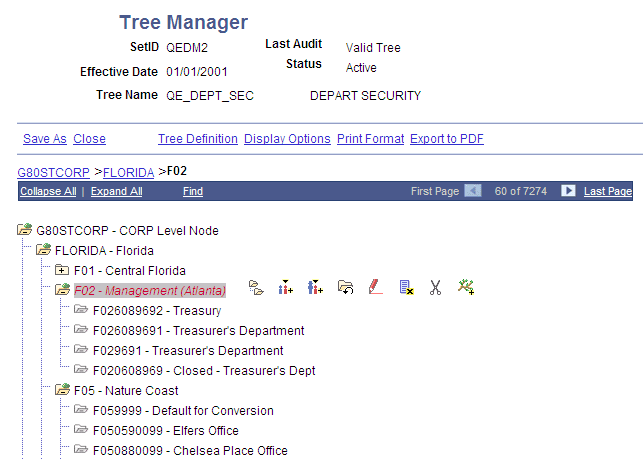
This example illustrates a node-oriented tree.
Note:
In this example, Florida is a node at the top level which has subnodes of Central Florida, Atlanta, Nature Coast, and so on. These nodes in turn have nodes such as Treasury, Treasurers Department, and so on. None of the nodes have leaves.
Node-oriented trees have no leaves, and are sometimes called winter trees. Instead, each node is a possible value of the DEPTID field.