Use Case: Order to Cash
In an order-to-cash process, a retail company orders products from a product manufacturer, which fulfills the order and receives payment.
Overview
For details about the procure to pay use case, see Use Case: Procure to Pay.
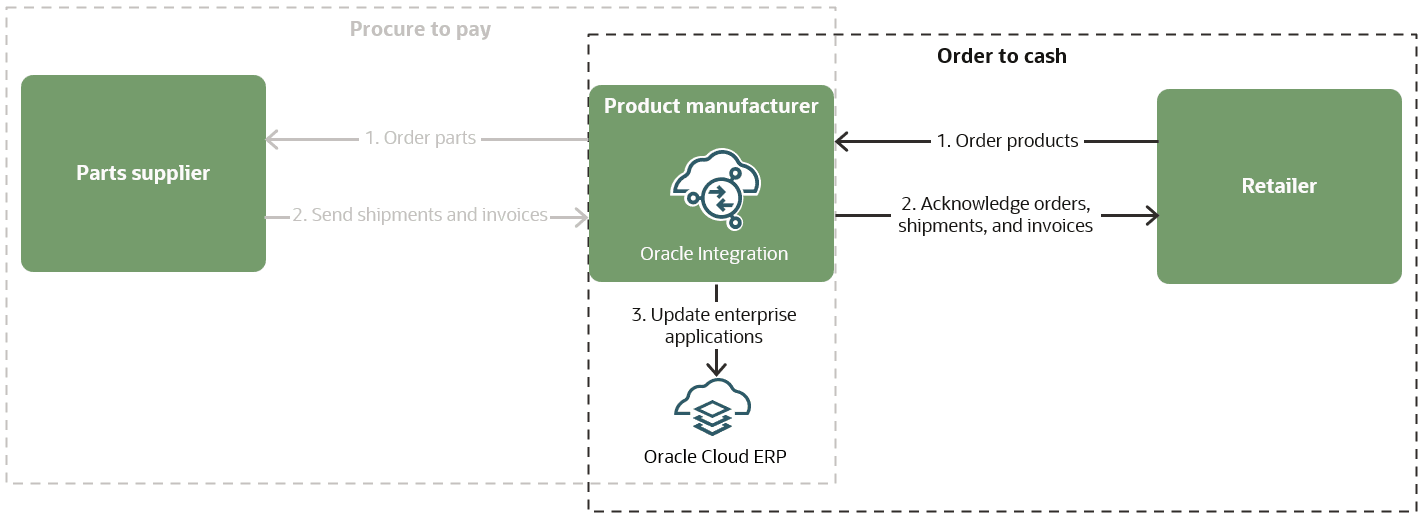
| Step 1: Receive an order | Step 2: Process the order | Step 3: Shipment and invoice | Step 4: Receive payment |
|---|---|---|---|

 Receive an EDI order file from a retailer on File Server An integration sends messages according to the B2B configuration |
Process the order file using an integration, and send a message according to the B2B configuration |
Send shipment and invoice messages according to the B2B configuration |
Receive payment for the order |
Step 1. Receive an order
Your company is a product manufacturer that sells your products to a retailer, which sells them to customers.
-
The retail company uploads an EDI order file to File Server.
-
Integrations created by you and the retailer send the following messages over the AS4 protocol according to the B2B configuration:
Sender Message Reason Retailer
850 Purchase OrderIdentify the items to order
Your company
(After verifying the file and sender)
MDN(Message Disposition Notification)Confirm receipt of the file
Step 2: Process the order
-
A receive integration, which was created based on the trading partner's transport configuration, detects the uploaded file.
-
The receive integration performs the following tasks:
-
Identifies the trading partner and the agreement to process the
850 Purchase Order. -
Parses the
850 Purchase Orderto perform validations. -
Sends the following message over the AS4 protocol according to the B2B configuration:
Sender Message Reason Your company
997 Functional
                                                  Acknowledgment
Informs the retailer whether the validation was successful or experienced an error
-
-
The agreement runs a back-end integration, which was configured for the agreement. The integration performs the following tasks:
-
Translates the file using the B2B schema.
-
Converts the file into the XML format required by Oracle Cloud ERP and uses the Oracle ERP Cloud Adapter to write the purchase order for the incoming
850
                                        Purchase Order
. -
Receives the EDI order file and converts it the format that the ERP system requires.
-
-
An integration sends the following message over the AS4 protocol according to the B2B configuration:
Sender Message Reason Your company
(If the file meets all requirements and your company can fulfill the order)
855 Purchase Order
                                                Acknowledgment
Accept the purchase order
Step 3: Shipment and invoice
-
Your organization ships the order to the retailer.
-
An integration sends the following messages over the AS4 protocol according to the B2B configuration:
Sender Message Reason Retailer
997 AcknowledgmentConfirm receipt of the
855Your company
856 Advance Ship
                                            Notice
Provide the shipment contents and logistics
Retailer
997 AcknowledgmentConfirm receipt of the
856Your company
810 InvoiceSend an invoice for the order
Retailer
997 AcknowledgmentConfirm receipt of the
810
Step 4: Receive payment
The retail company pays you for the order.