Use Live AI Hub for Select AI NL2SQL
Select AI runs natively inside Oracle Autonomous AI Database and Oracle AI Database, both of which can operate as a Live AI Hub. A Live AI Hub can support both local and external data sources (on-premises, cloud, or third-party). Using standard Oracle federation mechanisms such as Database Links, Cloud Links, Table Hyperlinks, and Federated Tables, Select AI generates federated SQL from natural language prompts using metadata across Oracle and non-Oracle systems.
Autonomous AI Database hosts act as a central metadata and processing layer for both local and external data sources. The Live AI Hub controls distributed query processing while external systems remain authoritative for their data.
What Is a Live AI Hub
A Live AI Hub is an Autonomous AI Database instance that runs Select AI on behalf of local or external data sources. It does not contain the external data. Instead, it uses metadata exposed through local database objects (tables and views) that reference remote data sources such as views defined on Database Links or Cloud Links, External Tables over Table Hyperlinks, and Federated Tables to interpret natural language requests and generate SQL that runs across distributed systems. The Live AI Hub can also contain local data in its own schema.
In this architecture, a Live AI Hub:
-
Hosts Select AI
-
Uses the user-specified LLM to interpret intent and generate SQL
-
Coordinates federated query execution
-
Returns outputs for Select AI actions
This approach enables AI-driven analytics across heterogeneous data stores without migrating or duplicating data.
Autonomous AI Database as a Live AI Hub
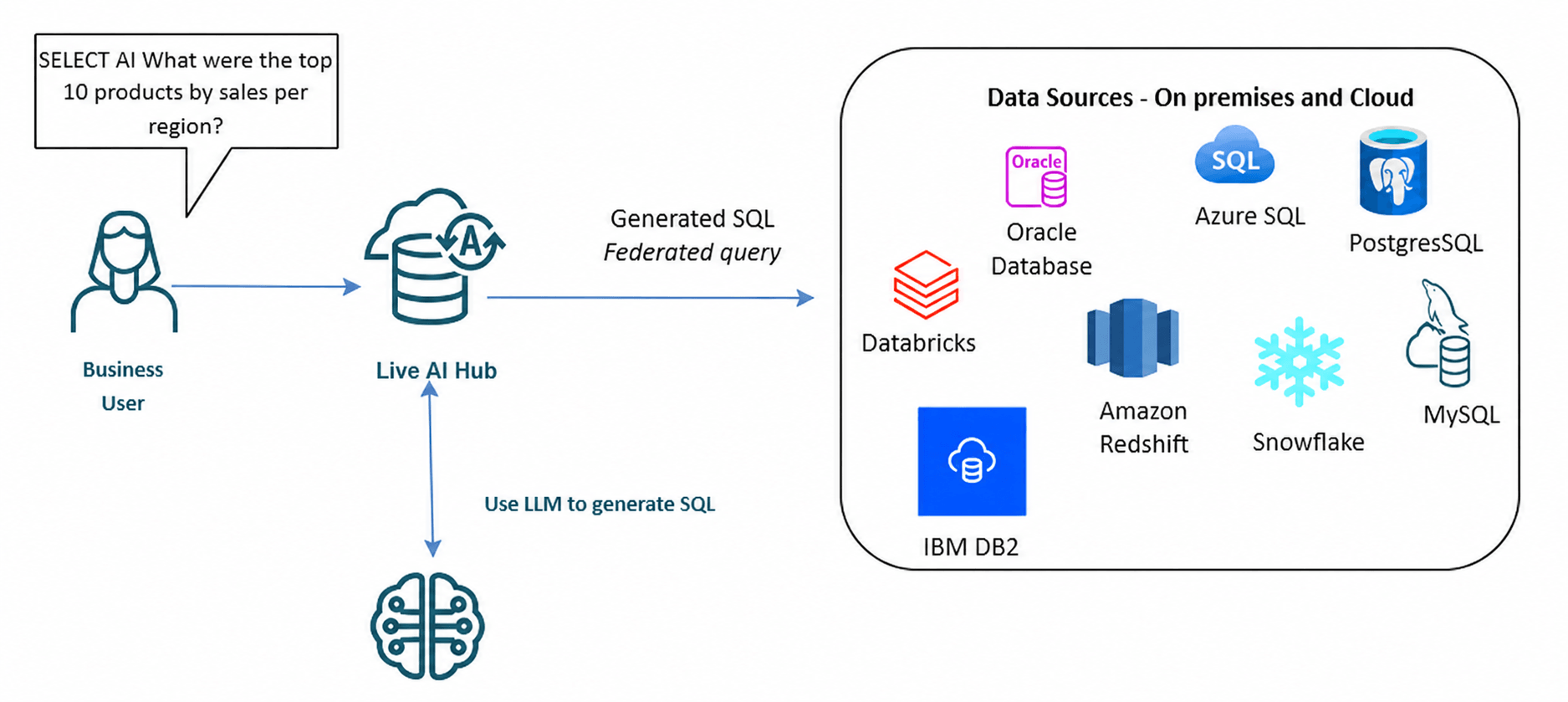
Description of the illustration adb_select_ai_live_ai_hub.png
See Also:
-
Use Cloud Links for Read Only Data Access on Autonomous AI Database
-
Create Federated Tables using Table Hyperlinks by Defining Scope
For example, a natural language query such as “Show pending orders for Acme Corp,” Select AI builds an augmented prompt, sends it to the configured LLM to generate SQL, and a Live AI Hub runs the generated SQL to retrieve customer data from a BigQuery table on Google Cloud and order details from an Amazon Redshift database on AWS. You do not need to write SQL or move data manually. Select AI uses AI profiles and respects existing database roles, security mechanisms, and policies in place to protect data across linked databases. Using a fully managed database with Real Application Security (RAS), Live AI Hub powered by Select AI ensures secure and efficient AI-based data access and analysis.
See:
-
Example: Use Select AI with Database Links to Query Another Autonomous AI Database to explore using Select AI to query data on another Autonomous AI Database instance connected through Database Links.
-
Example: Use Select AI with Database Links to Query Non-Oracle AI Database to explore using Select AI to query data on non-Oracle database connected through Database Links.
-
Example: Use Select AI with Cloud Links to Query Another Autonomous AI Database to explore using Select AI to query data on another Autonomous AI Database instance connected through Cloud Links.
-
Example: Use External Table over Table Hyperlink with Select AI to explore using Select AI to query data on another Autonomous AI Database through Table Hyperlink.
-
Example: Use Federated Table with Select AI to explore using Select AI to query data on another Autonomous AI Database by creating Federated table.
How Select AI Uses a Live AI Hub
You create Database Links or Cloud Links to expose remote tables and views to the Live AI Hub, formerly called AI Proxy Database. These objects appear as mapped schemas inside Autonomous AI Database. For Database Links and Cloud Links, you typically create local views over the remote objects and then specify those views in the AI profile. For External Tables and Federated Tables, the created local table objects can be specified directly in the AI profile. You create local views over these Database Links, Cloud Links, External Tables, or Federated Tables and then specify those views in the AI profile. Select AI reads the metadata from these mapped objects and builds an augmented prompt.
Select AI sends the augmented prompt to the user-specified LLM, which generates SQL that spans local and remote data sources. The Live AI Hub runs the federated query, pushes processing to external systems, and completes joins or aggregations as needed. Results return as standard SQL result sets.
From the user’s perspective, the query behaves as if it runs against a single system.
Database Links and Cloud Links
The Live AI Hub, formerly called AI Proxy Database, uses Database Links and Cloud Links to access external data sources and generate federated SQL through Select AI. Both mechanisms expose metadata to Select AI, but they serve different connectivity and governance needs.
Database Links connect the Live AI Hub to external databases, Oracle and non-Oracle, using direct network connectivity and credentials. They support heterogeneous environments, including on-premises systems, legacy Oracle databases, and third-party databases such as PostgreSQL, MySQL, SQL Server, Amazon Redshift, Snowflake, and others. With Database Links, Select AI reads table and view metadata from remote schemas and generates federated NL2SQL that runs across distributed systems while data remains in its source database. See CREATE DATABASE LINK for more details.
Cloud Links connect one Autonomous AI Database to another in a controlled and secure way. A data owner chooses which tables or views to share and makes them available to other Autonomous AI Databases. Once shared, other databases can find and use this data without setting up usernames, passwords, wallets, or network connections. The data remains read-only and stays in the source database, while the sharing rules are centrally managed. Cloud Links are designed specifically for sharing data between Autonomous AI Databases in a simple and governed manner. See Use Cloud Links for Read Only Data Access on Autonomous AI Database for more details.
In both cases, Select AI relies on exposed local metadata, not physical data movement, to interpret natural language prompts and generate SQL. The Live AI Hub coordinates query execution, while external systems remain authoritative for their data and enforce their own security controls.
Supported External Data Sources
When used as a Live AI Hub, Autonomous AI Database can operate on data stored in a wide range of external systems, including but not limited to:
-
Oracle Autonomous AI Database (including previous versions such as 19c)
-
Oracle AI Database instances
-
PostgreSQL
-
MySQL
-
SQL Server
-
Azure SQL
-
DB2
-
Teradata
-
Amazon Redshift
-
Snowflake
-
Databricks
-
Salesforce
Support depends on network accessibility and the use of Database Links or Cloud Links. See Create Database Links to Non-Oracle AI Databases with Oracle-Managed Heterogeneous Connectivity for a complete list of supported non-Oracle databases.
External Tables Over Table Hyperlinks and Federated Tables
Autonomous AI Database supports accessing data in other Autonomous AI Database through External Tables over Table Hyperlinks and Federated Tables. Both methods provide secure, read-only access across regions without data replication, but they differ in setup and control.
External Tables over Table Hyperlinks use a URL (Table Hyperlink) generated in the provider (source) Autonomous AI Database with DBMS_DATA_ACCESS.CREATE_URL. The consumer (target) Autonomous AI Database then creates an external table referencing this hyperlink using DBMS_CLOUD.CREATE_EXTERNAL_TABLE. This approach offers fine-grained control, letting you expose individual tables or views and manage hyperlink lifetimes directly. It’s best suited for ad-hoc or selective data sharing where administrators prefer explicit control over which objects are accessible. See Use Table Hyperlinks to Create an External Table for more details.
Federated Tables, provide an automated way to access remote Autonomous AI Database data. A federated table is created in the consumer database using DBMS_DATA_ACCESS.CREATE_FEDERATED_TABLE, which automatically manages hyperlink creation and metadata mapping behind the scenes. This method simplifies setup and is ideal for long-term, multi-object, or cross region federation. Federated Tables integrate tightly with Autonomous AI Database governance using registered creation scopes and DBMS_DATA_ACCESS_ADMIN grants, and are designed for production-level, managed access across compartments or tenancies. See Create Federated Tables using Table Hyperlinks by Defining Scope for more details.
In summary, use External Tables over Table Hyperlinks when you need precise, short-term control over shared objects, and Federated Tables when you want a streamlined, scalable, and fully managed cross-database integration for Select AI. In both cases, Select AI relies on exposed metadata, not physical data movement, to interpret natural language prompts and generate SQL. The Live AI Hub coordinates query execution, while external systems remain authoritative for their data and enforce their own security controls.
Primary Use Case
The primary use case for a Live AI Hub, formerly called AI Proxy Database, with Select AI is for natural language to SQL generation using local metadata that results in federated queries.
Federated queries: Your data platform may include on-premises relational databases, Autonomous AI Database, Oracle AI Database, data lakes, legacy systems, or third-party data stores. You can use Select AI to query alongside Autonomous AI Database through Database Links or Cloud Links.
The Live AI Hub coordinates query running while external systems process their data in place. This keeps data in its original location and avoids replication, synchronization, or ETL.
Key Benefits:
-
Keep data in source systems
-
Avoid ETL, replication, and data movement
-
Query Oracle and non-Oracle databases together
-
Extend generative AI and NL2SQL to legacy and cloud systems
-
Use a single Select AI interface across your data sources