Redwood: Manage Sourcing Assignments Using a New User Experience
You can use the Redwood user experience to view, create, duplicate, edit, and delete sourcing assignment sets. The assignment set is the basic data construct that specifies what your supply chain definition is like. Assignment sets link sourcing rules and bills of distribution to specific items, customers, organizations, categories, demand classes, or regions. These assignments determine which sourcing rule or bill of distribution is used to replenish a particular item in a specific context.
The Assignment Sets page enables you to:
- Review existing assignment sets.
- Create, edit, duplicate, and delete assignment sets.
- View the sourcing hierarchy for an item and organization in an assignment set.
The Assignment Sets page can be accessed from Plan Inputs, Supply Plans, Demand and Supply Plans, Replenishment Plans, Sales and Operations Plans, and Backlog Management in the Redwood Supply Chain Planning work area. It can also be accessed from Global Order Promising.
To access the Assignment Sets page:
- Click the More Actions (…) icon and then click View More.
- In the Plan Inputs section, click Sourcing Assignment Sets.
- The Assignment Sets page opens in a new browser tab.
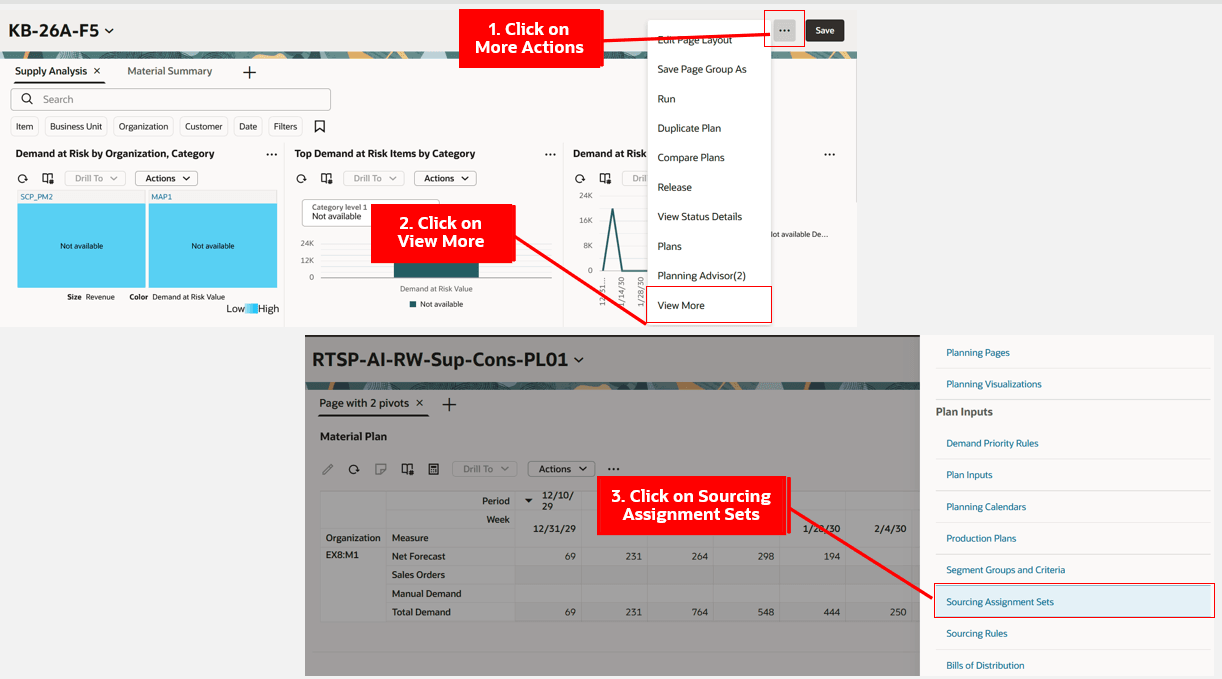
Navigate to Assignment Sets Page
Assignment Sets Page
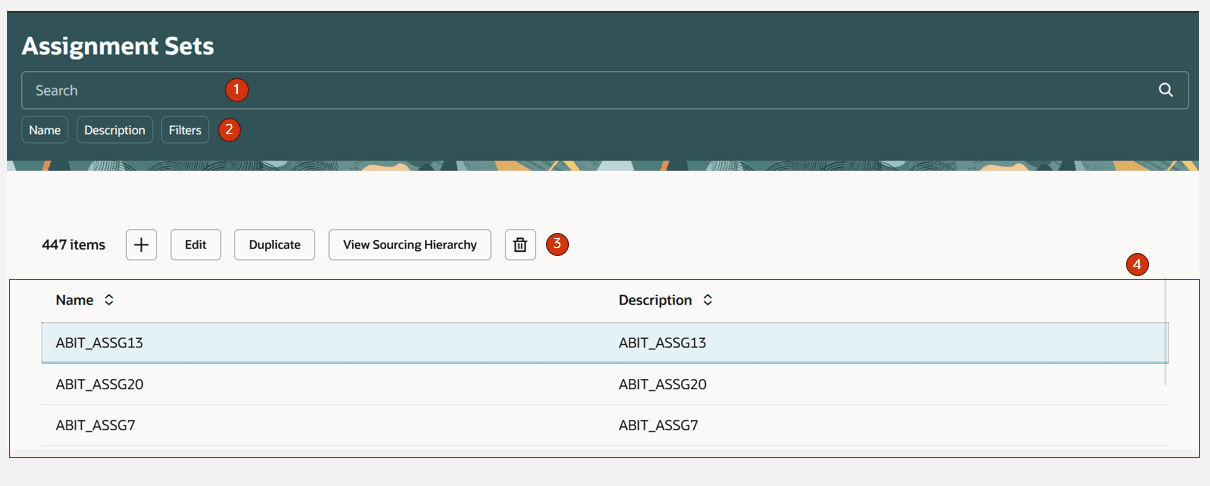
Assignment Sets Page
The Assignment Sets page contains the following:
- Keyword search - Lets you search across the Assignment Sets page. You can search by assignment set name or description. The search is case insensitive and performs a search using the contains operator.
- Suggested filters - Filters the Assignment Sets page by Name and Description column details.
- Action toolbar - Enables you to create, edit, duplicate, or delete an assignment set. Also lets you view sourcing hierarchy in an assignment set.
- Assignment sets - Displays a table showing the assignment sets created on the page or collected using the file-based data import (FBDI) process.
Assignment Sets Actions
Let’s now understand the Assignment Sets page actions.
Create an Assignment Set
- Click the + icon.
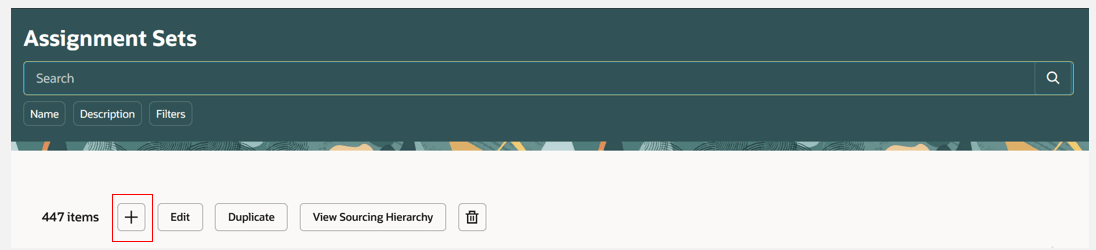
Create an Assignment Set
- A page named New Assignment Set opens in the same browser tab.
- Provide a name, description, and catalog for the new assignment set and enter sourcing assignment details. For information on adding sourcing assignments to the assignment set, see “Assignment Set – Sourcing Assignments Section” later in this document.
- Click the Create button.
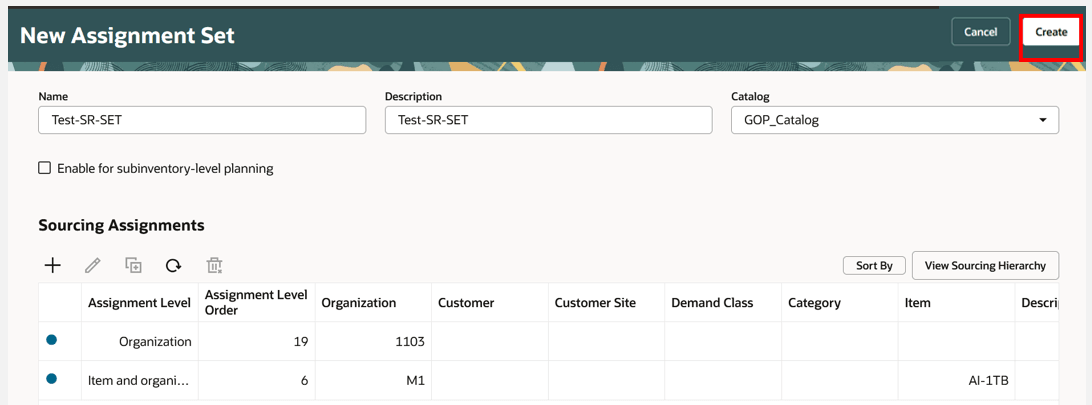
Click Create Button to Create a New Assignment Set
- The assignment set is now created.
Edit Assignment Set
- Select an assignment set and click the Edit button.
- The selected assignment set opens in the same tab in edit mode.
- Make the desired changes to the assignment set and click Save when done.
Delete Assignment Set
- Select an assignment set and click the Delete icon.
- A confirmation message appears. Click Delete to confirm that you want to delete the assignment set.
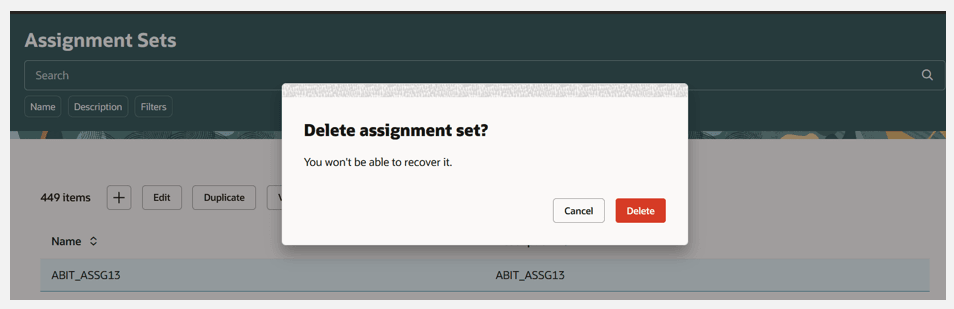
Delete Assignment Set
Duplicate Assignment Set
- Select an assignment set and click the Duplicate button.
- Provide a new name and description in the dialog box and click Duplicate.
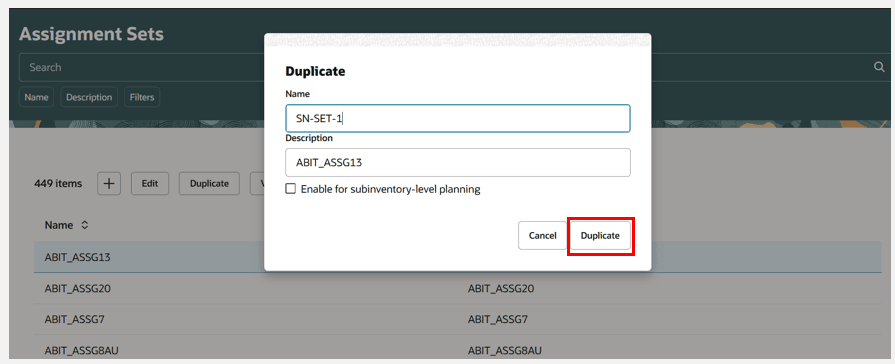
Duplicate Assignment Set
- The duplicate assignment set is opened.
- Provide additional details and click the Save button when done.
View Sourcing Hierarchy
View Sourcing Hierarchy helps you find the various assignment levels assigned to an item and organization based on the date selected. The view lists all the relevant assignments across the sourcing hierarchy applicable for the item, organization, and start date provided.
This helps you identify how the planning processes will apply the sourcing rules for the item and organization on a given date and identify a valid sourcing supply chain, from the most granular sourcing rule to the least granular sourcing rule.
To view the sourcing hierarchies of an assignment set:
- Select the assignment set and click the View Sourcing Hierarchy button.
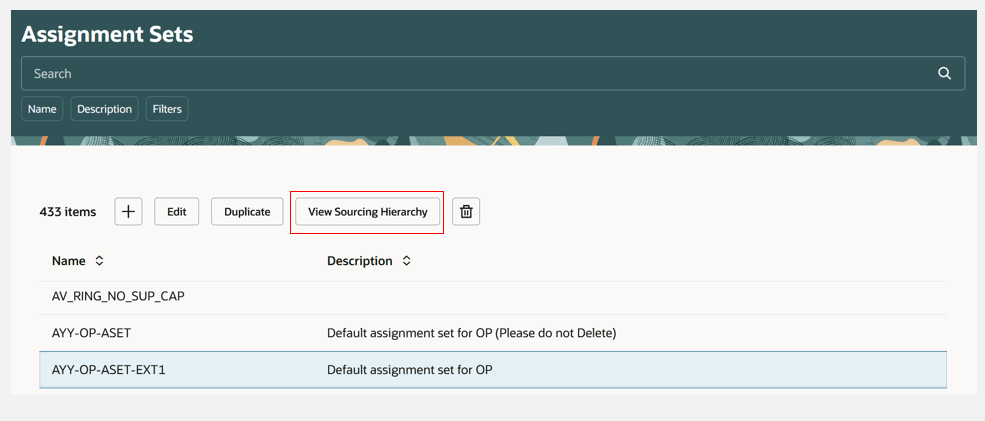
Click on View Sourcing Hierarchy Button
- The Sourcing Hierarchy drawer opens, with the assignment set name selected in the filter.
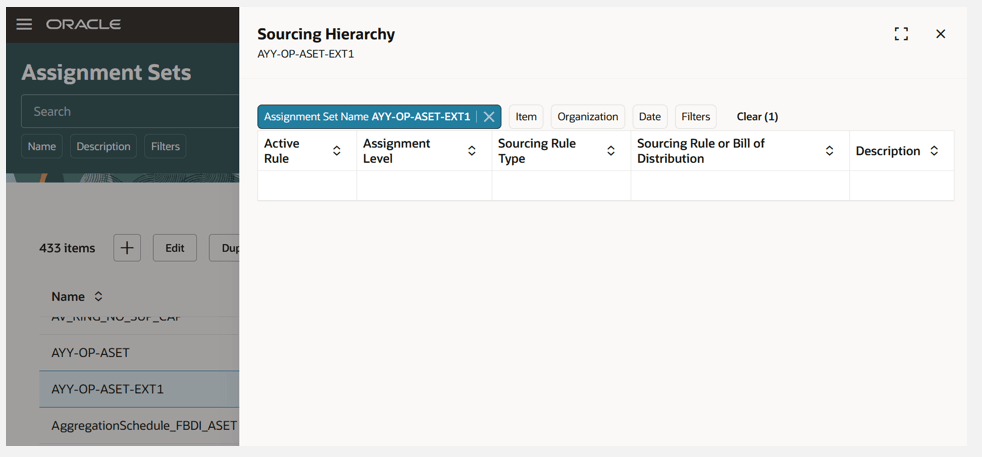
Sourcing Hierarchy Drawer Opens with Assignment Set
- Select the item, organization, and start date. All these attributes are mandatory to view sourcing hierarchy in an assignment set.
- The sourcing hierarchy details are displayed.
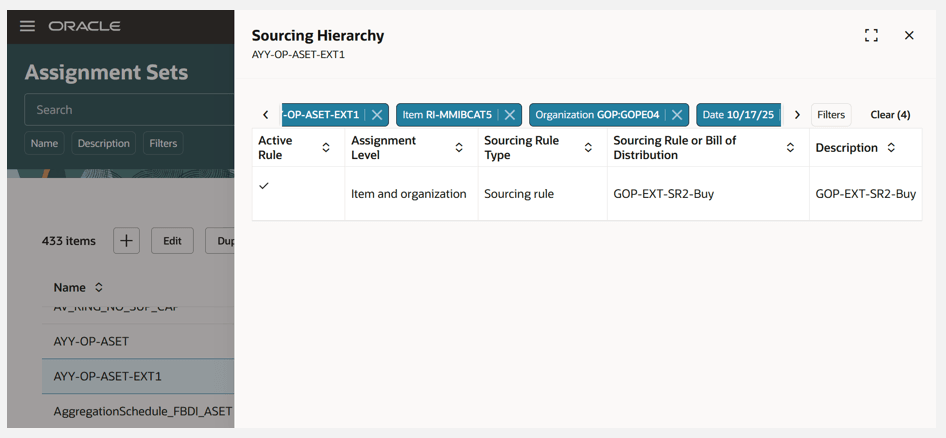
Sourcing Hierarchy Details Displayed for Item and Organization
Assignment Sets – Sourcing Assignments Section
Let’s now understand the Sourcing Assignments section on the page.
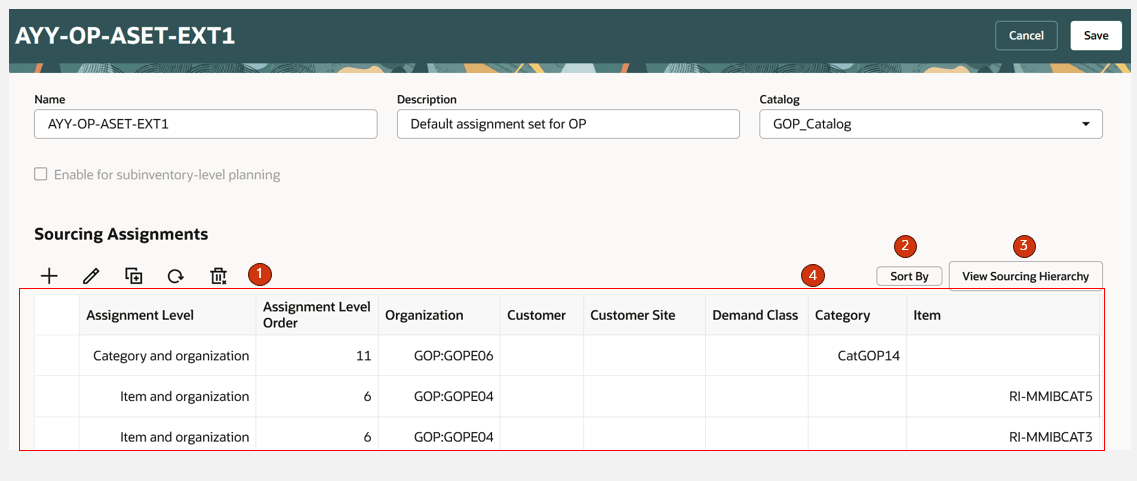
Sourcing Assignments on an Assignment Set Page
- Sourcing assignments toolbar – Enables you to create, copy, and delete a sourcing assignment. You can mass edit after selecting multiple sourcing assignments. You can also refresh sourcing assignments after edits.
- Sort By – Lets you perform advanced sorting of sourcing assignments.
- View Sourcing Hierarchy – Lets you view the sourcing hierarchy of an item and organization in the assignment set.
- Sourcing details – Displays the details of the sourcing assignments within the assignment set.
To add a sourcing assignment:
- Click the + icon. A new sourcing assignment row is added at the beginning of the sourcing assignments details region, with Item and Organization as the default assignment level.
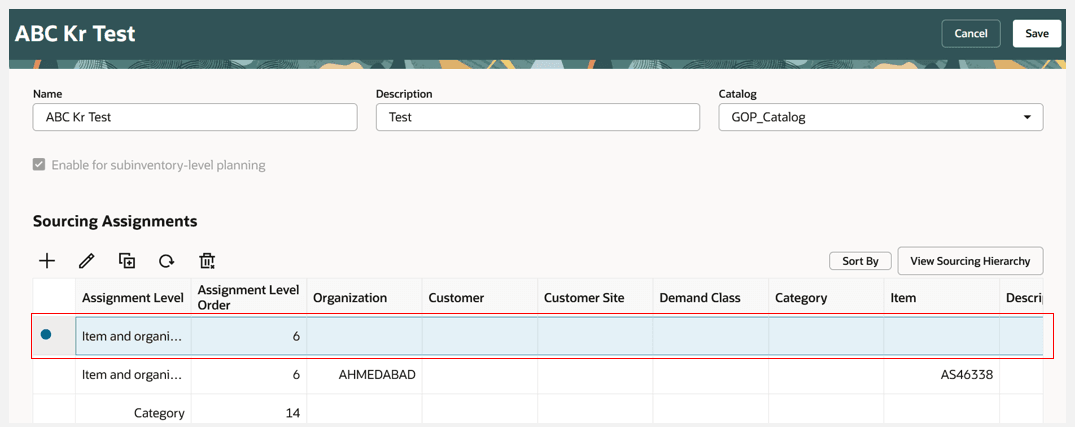
Add a New Sourcing Assignment
- Update the Assignment Level as needed.
- Enter other sourcing assignment details.
- Click Save.
To edit a sourcing assignment:
- Select a sourcing assignment row and perform inline edits of the detail.
- If needed, select another row and perform inline edits for that row. Repeat as needed.
- Click Save when done.
To copy a sourcing assignment:
- Select a sourcing assignment row.
- Click the Copy icon.
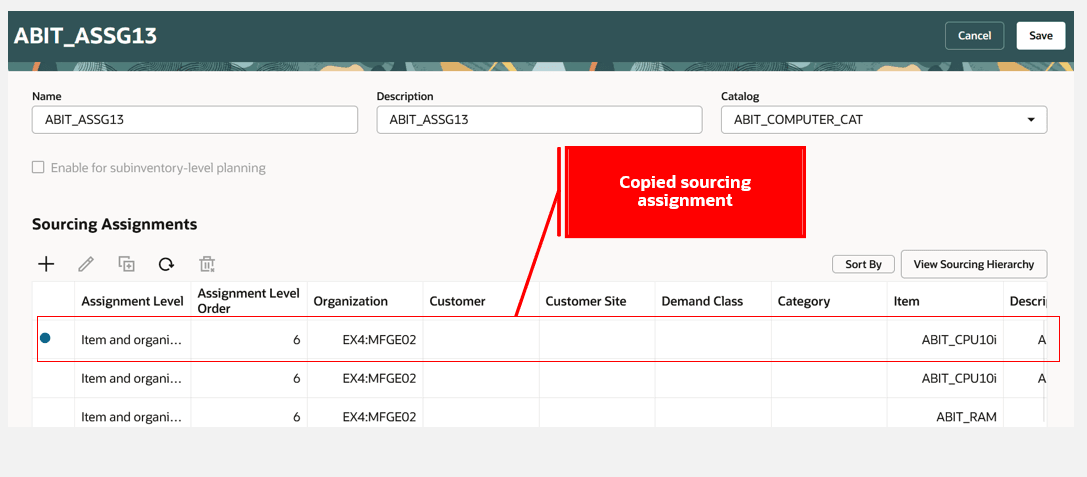
Copied Sourcing Assignment
- Update the details as needed.
- Click Save.
To delete a sourcing assignment
- Select one or more sourcing assignment rows.
- Click the Delete icon.
Mass Edit
- Mass edits are supported if the records selected are of the same assignment level.
- The mass edit flow ensures that there are no duplicate sourcing assignments.
- Sourcing Type, Sourcing Rule, or Bill of Distribution can be selected for sourcing assignments in mass edit.
- Zone or Region can also be updated for multiple sourcing assignments in mass edit for region-based assignment levels.
Perform the following steps to mass edit multiple sourcing assignments:
- Select multiple sourcing assignments that belong to the same assignment level.
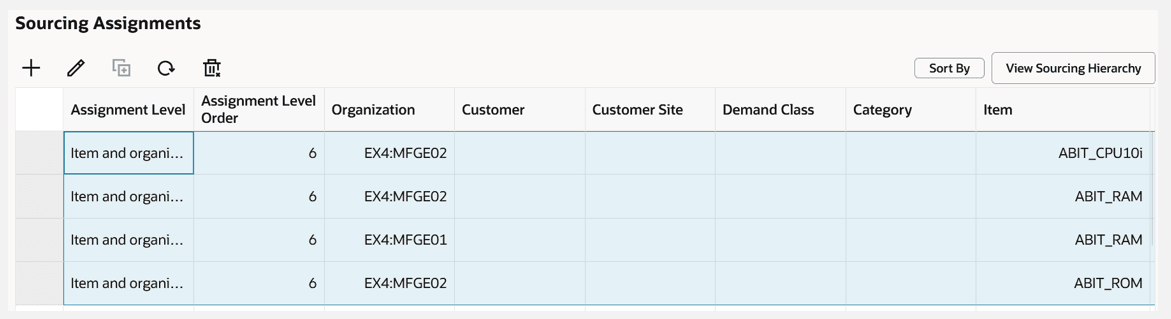
Select Multiple Sourcing Assignments
- Click the Edit icon.
- The Sourcing assignment attributes drawer opens.
- Select Sourcing Type, Sourcing Rule or Bill of Distribution, Zone, and Region based on the assignment level.
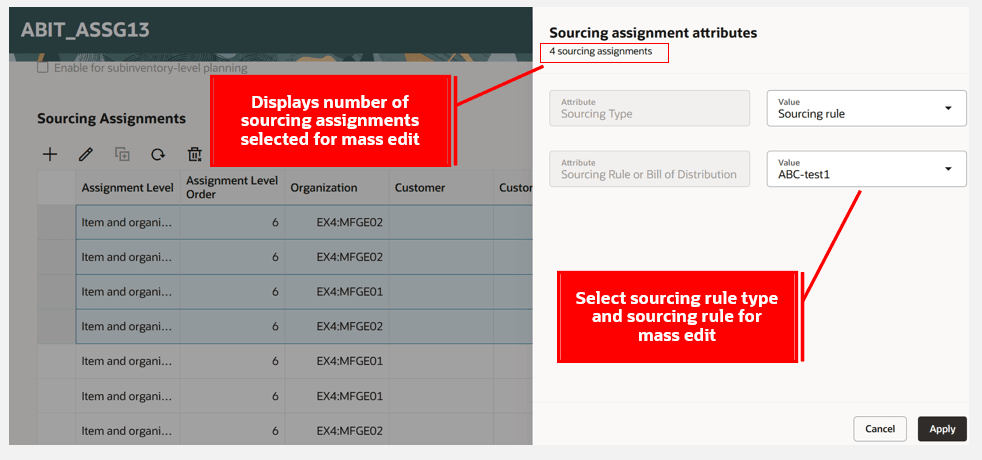
Mass Edit Details
- Click the Apply button. The drawer closes and the changes are reflected in the selected sourcing assignments.
- Click Save.
The following columns are displayed in sourcing assignments:
- Assignment Level
- Assignment Level Order
- Organization
- Customer
- Customer Site
- Demand Class
- Category
- Item
- Description
- Sourcing Type
- Sourcing Rule or Bill of Distribution
- Zone
- Region
The Assignment Level Order column is a new column that represents the priority order of the assignment levels. This helps you understand how the planning process decides among a given set of sourcing assignments.
The priority order of assignment levels is shown in the following table:
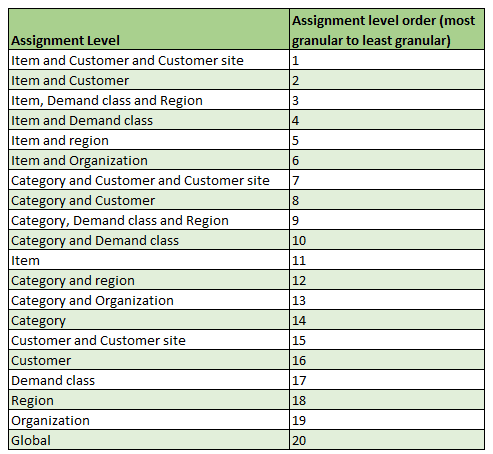
Assignment Level Order for Assignment Levels
Column filters are ad-hoc filters that are appended to the keyword search and filter chips allowing you to further refine your results. To access column filters, hover over the column header and click on the Filter icon.
Here’s an example of applying a column filter for Assignment Level in sourcing assignments.
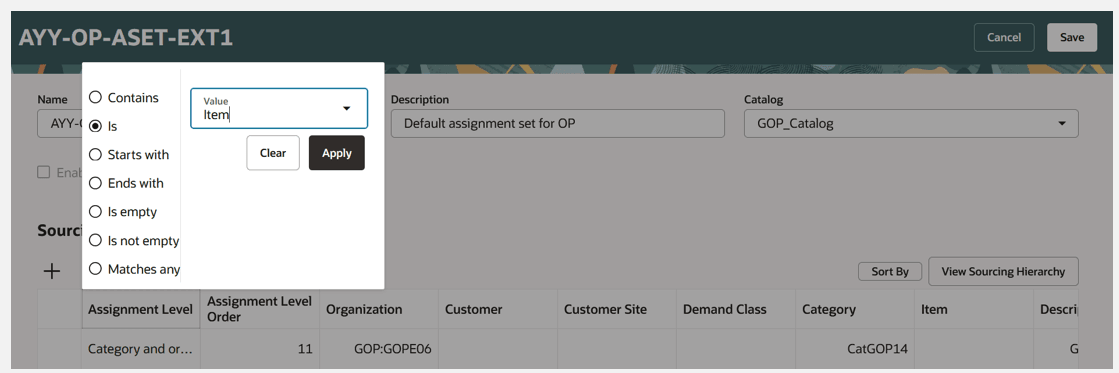
Column Filter for Assignment Level Column in Sourcing Assignments
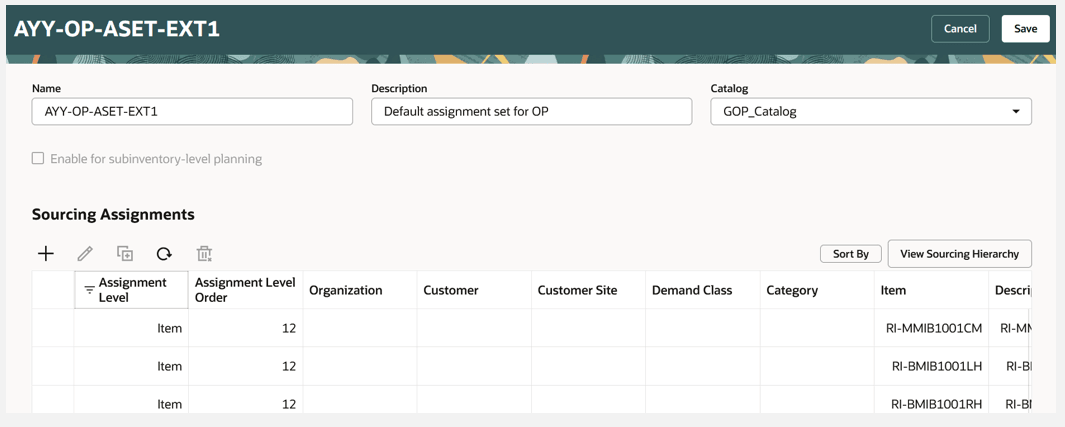
Result After Applying Column Filter for Assignment Level Column in Sourcing Assignments
Sort By
You can perform sorting of sourcing assignments with multiple columns using Sort By.
- Click the Sort By button on the Sourcing Assignments toolbar.
- The Sorting drawer opens.
- Select one or more columns and the sorting order for each.
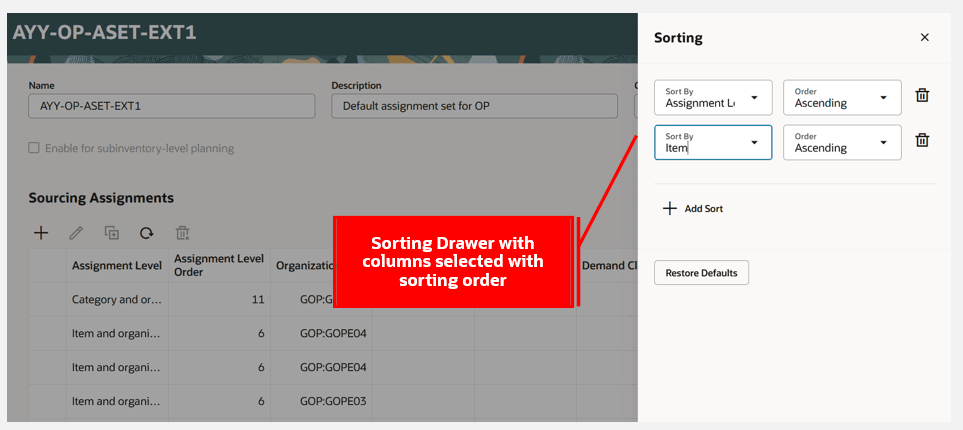
Sorting of Values Across Multiple Columns in Sourcing Assignments
You can click on Restore Defaults in the Sorting drawer to remove multicolumn sorting.
Quick Actions
You can now navigate to Redwood Assignment Sets from Quick Actions. To enable Quick Actions to navigate to Sourcing Assignment Sets:
- Go to Navigator > My Enterprise > Setup and Maintenance.
- Search for and select the Manage Administrator Profile Values task.
- Search for the profile display name: Redwood Pages for Sourcing Rules, Bills of Distribution, and Assignment Sets Enabled.
- Set the Profile Value to Yes and save. (You can set this profile at the User or Site level).
Quick Actions for assignment sets in Supply Chain Planning and for Global Order Promising in Order Management will now navigate to the Redwood Assignment Sets page.
Steps to enable and configure
Use the Opt In UI to enable this feature. For instructions, refer to the Optional Uptake of New Features section of this document.
Offering: Supply Chain Planning
Tips and considerations
- If you want to use the Redwood: Manage Souring Assignments Using a New User Experience feature, then you must opt in to its parent feature: Order Backlog Management. If you’ve already opted in to this parent feature, then you don’t have to opt in again.
- You can enable a guided journey for the Assignment Sets page.
- POST and PATCH operations aren’t available for assignment sets REST services.
- You can also enable subinventory level planning on the Assignment Sets page in Replenishment Planning .
- Click the Cancel button in an assignment set to discard unsaved changes or to go back to the Assignment Sets main page.
- View Sourcing is not available on the Assignment Sets page.
Access requirements
Users who are assigned a configured job role that contains these privileges can access this feature:
- Monitor Supply Planning Work Area (MSC_MONITOR_SUPPLY_PLANNING_WORK_AREA_PRIV)
- Monitor Demand and Supply Planning Work Area (MSC_MONITOR_DEMAND_AND_SUPPLY_PLANNING_WORK_AREA_PRIV)\
- Manage Replenishment Planning (MSC_MONITOR_REPLENISHMENT_PLANNING_WORK_AREA_PRIV)
- Manage Sales and Operations Planning (MSC_MONITOR_SALES_AND_OPERATIONS_PLANNING_WORK_AREA_PRIV)
- Monitor Backlog Management Work Area (MSC_MONITOR_BACKLOG_MANAGEMENT_WORK_AREA_PRIV)
- Monitor Order Promising Work Area (MSC_MONITOR_ORDER_PROMISING_WORK_AREA_PRIV)
- Manage Planning Sourcing Assignment (MSP_MANAGE_PLANNING_SOURCING_ASSIGNMENT_PRIV)
- View Planning Sourcing Assignment (MSP_VIEW_PLANNING_SOURCING_ASSIGNMENT_PRIV)
These privileges were available prior to this update.