Plan Considering Output of the Same Item Generated in Multiple Times in a Manufacturing Process
In process manufacturing environments, the same output may be generated multiple times during the manufacturing process. For example, butter may be collected during the churning operation and again during a subsequent scraping operation. This update in Oracle Supply Planning honors these definitions in the process work definition, ensuring that the timing and quantity of the output supply are calculated accurately and used to meet demand.
Supply Planning Impact
You can now add the same output item across multiple operations within a process work method, improving accuracy and consistency in operational planning.
This enhancement ensures that:
- By-product and co-product supplies are calculated accurately for each operation where they are produced, based on the estimated open operation end quantity of the primary item.
- Work order demand for components at each operation is calculated using the estimated open operation start quantity of the primary item.
- Resource requirements for each operation are calculated based on the estimated open operation start quantity of the primary item.
Types of products for which multiple outputs is supported in a process work method
|
Work Definition |
Work Order |
Ad hoc completion |
|
|
Primary |
Not supported |
Not supported |
Not supported |
|
Co-product |
Supported |
Supported |
Supported |
|
By-product |
Supported |
Supported |
Supported |
For example, consider a work definition AG_Engine with multiple outputs defined across operations:
- KB-PAPER-BOARD is defined as a co-product and is produced in Operation 20 and Operation 30.
- KB-PAPER-SLUDGE-F is also defined as a co-product and may be produced in Operation 10 or Operation 30, depending on shop floor conditions.
- The primary item, KB-PAPER-ROLL2, is produced in Operation 20.
This example illustrates how the same co-product can be defined as an output in multiple operations within a single process work method, providing flexibility to reflect actual production scenarios on the shop floor.
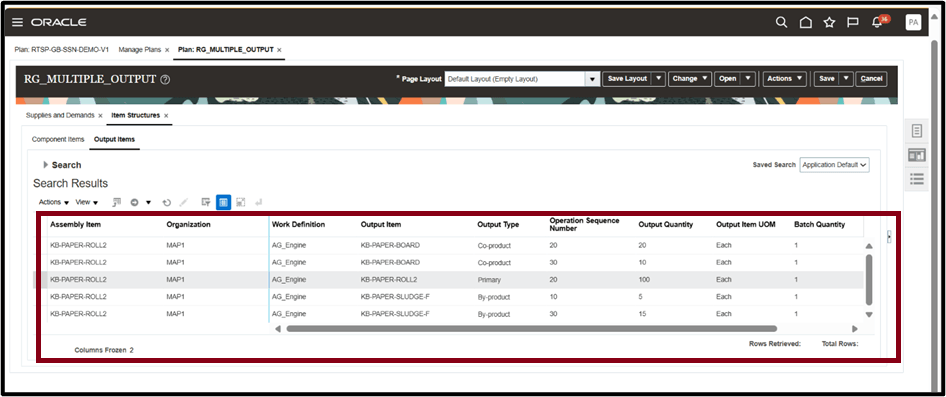
Item Structure With Multiple Output
Plan Output
Based on a demand of 100 units for the primary item KB-PAPER-ROLL2 with a due date of 02/01/2030, a corresponding supply of 100 units for the primary item is generated at Operation 20.
Using this primary item quantity, output items are generated at their respective due dates according to the defined output quantities. For example:
- KB-PAPER-BOARD supply is generated with quantities of 20 units at Operation 20 and 30 units at Operation 30.
- KB-PAPER-SLUDGE-F supply is generated with quantities of 5 units at Operation 10 and 15 units at Operation 30, based on the output quantity defined per unit of the primary item.
This approach ensures that co-product supplies are planned accurately at the operation level based on the primary item demand.
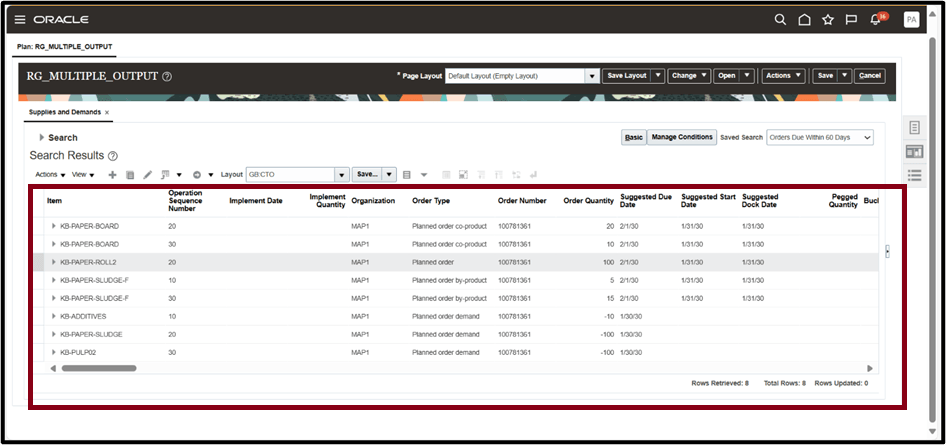
Multiple Output Supply Generated Across Different Operations
Steps to enable and configure
You don't need to do anything to enable this feature.
Access requirements
No separate privilege is required to access this feature.