Preserve inventory cost and lot traceability during item conversion
The Item Translate transaction helps you to convert all or part of the available quantity in a lot to a different item, while retaining lot-level traceability. You can translate an item while retaining the lot number, or translate both the item and the lot. This supports controlled item reclassification and material conversion without manual inventory reconciliation.
Each Item Translate transaction creates a linked pair of inventory transactions: a source-item issue and a resultant-item receipt. When these transactions are transferred to Cost Management, the Create Cost Accounting Distributions process records the inventory movement, offset, and any applicable variance so inventory value and accounting remain accurate.
When Item Translate transactions are interfaced to Cost Accounting, transactions for the source items are costed based on the cost method:
- Average Cost: The average cost at the item-valuation unit level as on the cost date.
- Actual Cost: The cost of the layer being depleted.
- Standard Cost: The standard cost of the item at the inventory organization level.
The transactions for the resultant item are costed as per the user entered cost. If the user doesn't enter a cost., the current cost of the resultant item is used.
The paired issue and receipt create inventory valuation and offset distributions:
- The inventory valuation distribution of the source item issue will always deplete inventory based on the cost method of the source item.
- The offset distribution of the source item issue will be based on the user entered cost. If there is a difference between the offset distribution and the inventory valuation distribution, it will be booked as a variance.
- The inventory valuation distribution of the resultant item receipt will be based on the user entered cost.
- The offset distribution of the resultant item receipt will be based on the user entered cost.
Here's how the user can enter a cost for the resultant item while performing an Item Translate:
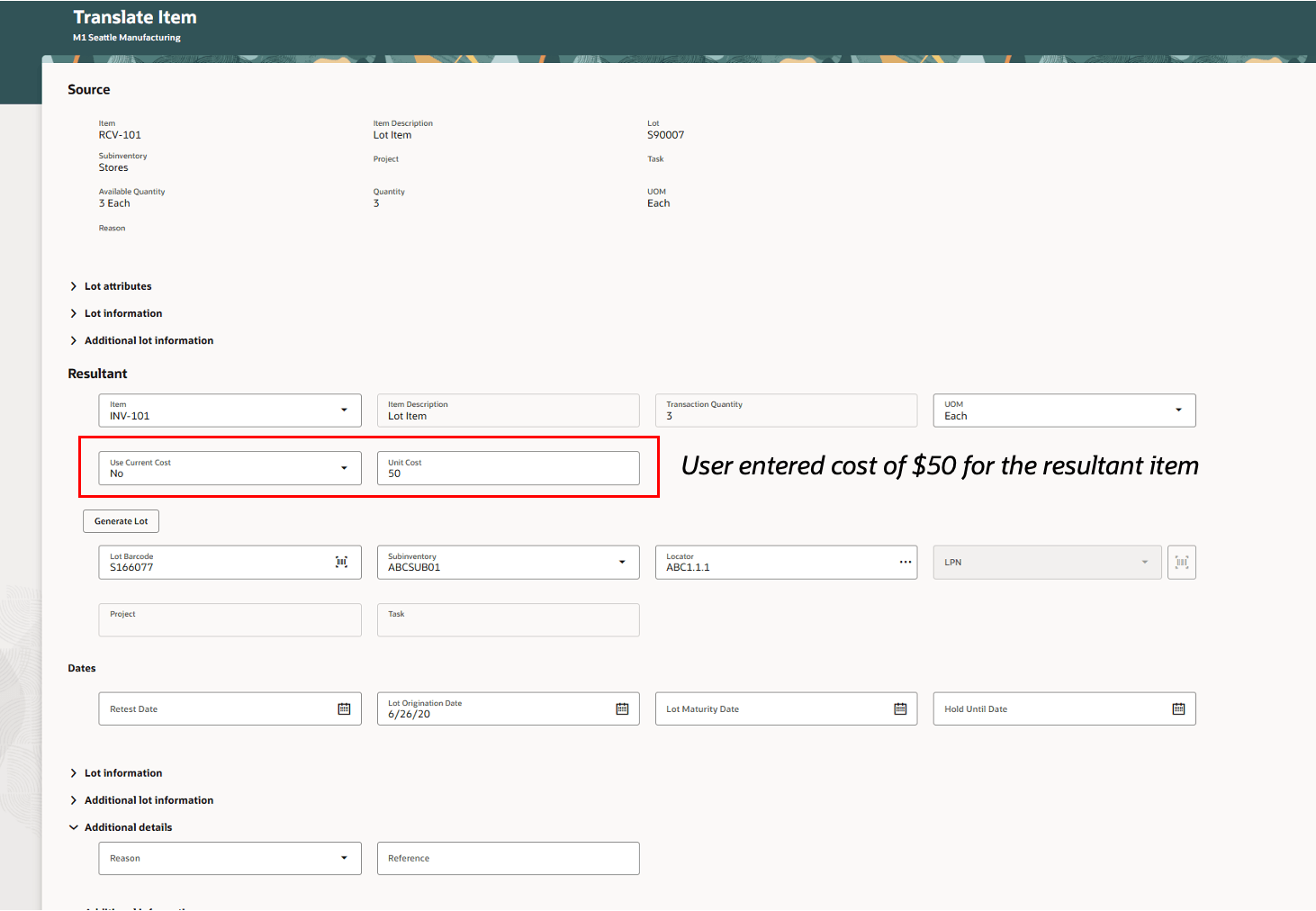
User entered cost during item translate
The following table lists the distributions created for the transactions corresponding to the source item, similar to how a miscellaneous issue transaction would be costed.
| Accounting Line Type | Transaction Type |
|---|---|
| Inventory Valuation | Credit |
| Offset | Debit |
| Variance | Credit |
| Expense | Debit |
| Material Overhead Absorption | Credit |
Note: Expense and Material Overhead Absorption distributions are created only when the accounting overhead rules are defined for the issue leg of the transactions or the rules are defined for the receipt leg of the transaction with Absorption Type set to Expense.
Example of source item issue for an Item Translate event:
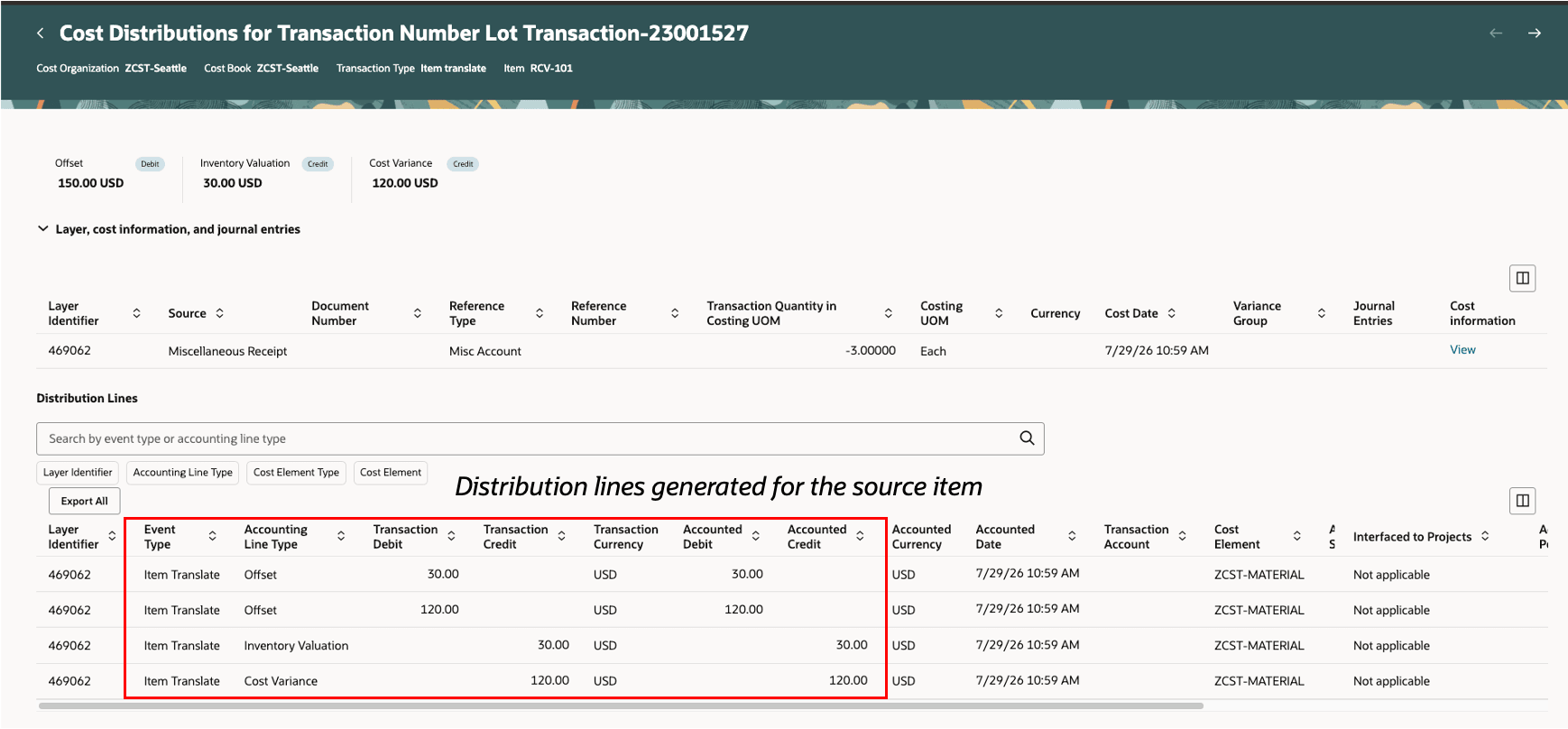
Source item distributions
The following table lists the distributions created for the transactions corresponding to the resultant item, similar to how a miscellaneous receipt transaction would be costed.
| Accounting Line Type | Transaction Type |
|---|---|
| Inventory Valuation | Debit |
| Offset | Credit |
| Inventory Valuation (Overhead) | Debit |
| Material Overhead Absorption | Credit |
Note: Inventory Valuation (for overhead) and Material Overhead Absorption distributions are created only when the accounting overhead rules are defined for the receipt leg of the transactions.
Example of resultant item receipt for an Item Translate event:
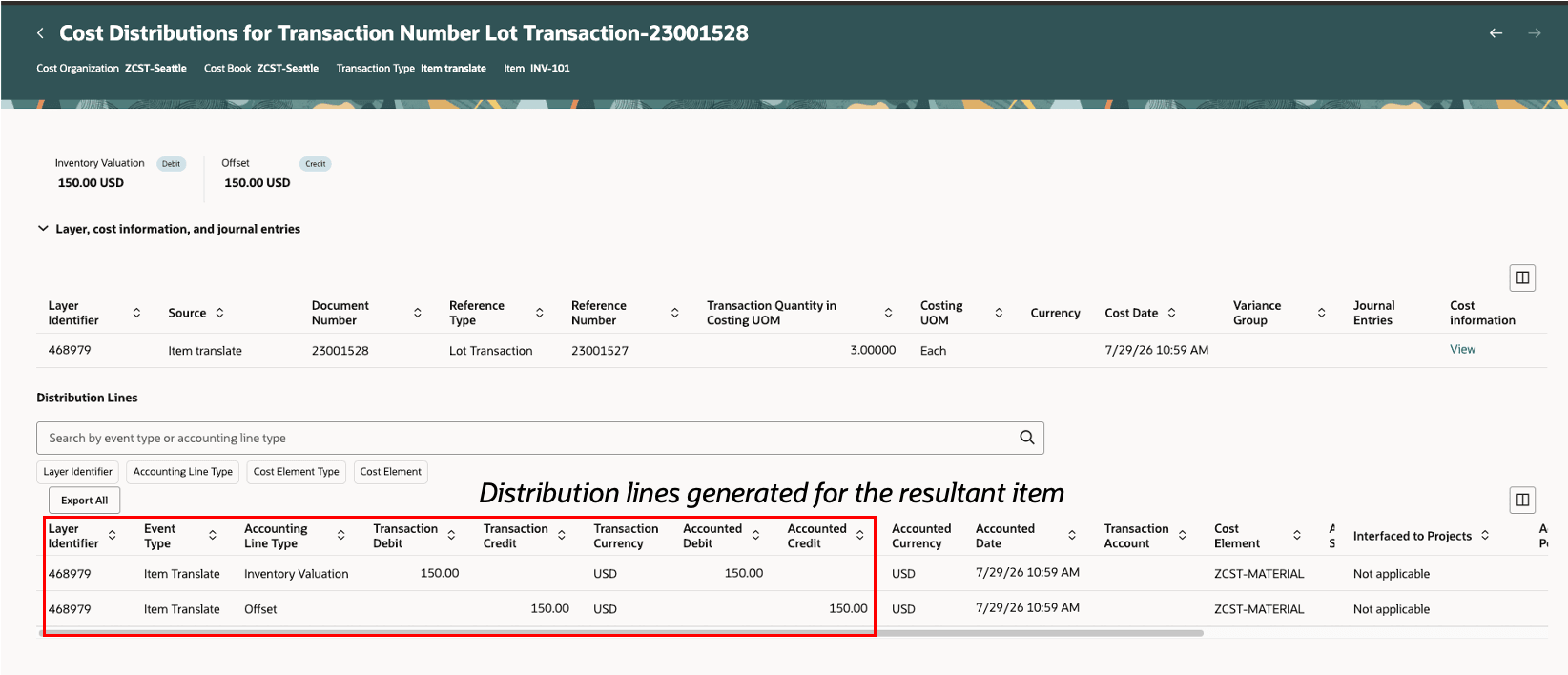
Resultant item distributions
Here's an example of how the paired transactions would look. Let's assume the source item, Milk, is being translated to the resultant item, Curd. Milk's current cost is $5, based on its cost method. The user enters the item unit cost of Curd as $6. This is how the distributions would look:
| Transaction Type | Item | Accounting Line Type | Quantity | Cost | Debit | Credit |
|---|---|---|---|---|---|---|
| Source item Issue | Milk | Inventory Valuation | 100 | $5 | $500 | |
| Source item Issue | Milk | Offset | 100 | $6 | $600 | |
| Source item Issue | Milk | Variance | 100 | $1 | $100 | |
| Resultant item receipt | Curd | Inventory Valuation | 100 | $6 | $600 | |
| Resultant item receipt | Curd | Offset | 100 | $6 | $600 |
This way, the offset accounts for both the source item and the resultant item will be balanced.
If Milk and Curd have different units of measure, such as liter and kg, then the unit cost is derived based on the unit of measure conversion rules specified in Inventory.
To support accounting of this type of lot transaction, a new event type has been introduced: Item Translate. Based on your accounting requirements, review and modify the subledger journal entry rule sets to account for these transactions. You can either copy an existing journal entry rule set or use the seeded rule sets to set up account rules for the new accounting event.
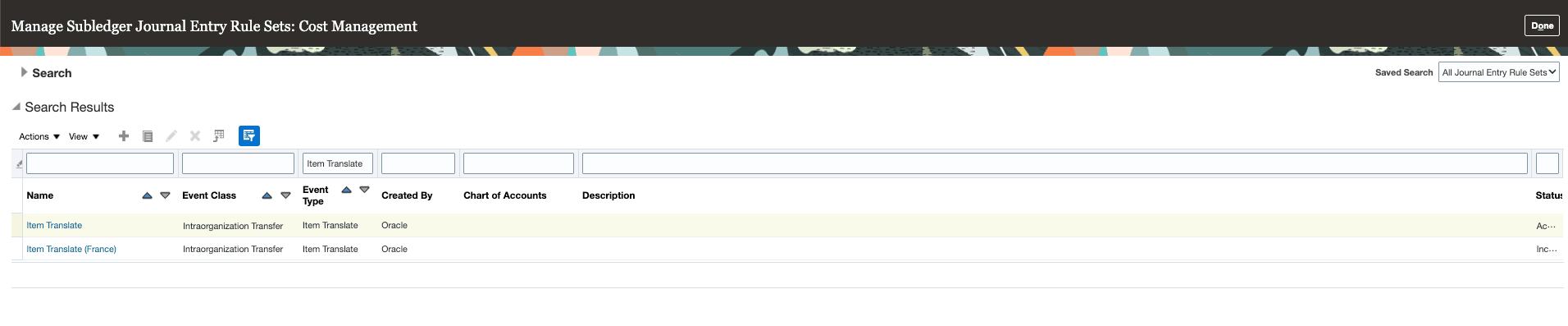
Subledger journal entry rule sets
Some benefits of this feature include:
- Maintain lot lineage for traceability, quality investigations, and regulatory reporting.
- Correct item assignment errors and support controlled material conversion without manual inventory reconciliation.
- Preserve clear inventory valuation and accounting visibility when inventory is converted between items.
- Provide an auditable record of the source issue, resultant receipt, entered cost, and any resulting variance.
Steps to enable and configure
There are no steps to enable this feature.
Tips and considerations
- Transaction unit costs can be entered when you perform a item translate transaction in Inventory. However, entering a cost that is significantly different from the current cost can cause large swings in the unit cost of remaining on-hand inventory.
- If you use the Use Current Item Cost option while processing the item translate transaction, make sure that the resultant item isn't a new item without a cost. This will ensure that both the issue and receipt legs of the transaction get costed correctly.
-
You can create receipt cost adjustments for the receipt leg of the lot transactions from the Manage Cost Adjustments page.
-
On the Manage Accounting Overhead Rules page, you can define accounting overhead rules for lot transactions. Overheads for the issue leg of the transaction can only be expensed. However, overheads defined for the receipt leg of the transaction can be included in inventory or expensed.
- While creating Standard Cost Overhead Absorption Rules, you can find the new transaction type, Item Translate under the transaction group Intra organization transfers, similar to the other lot transactions:
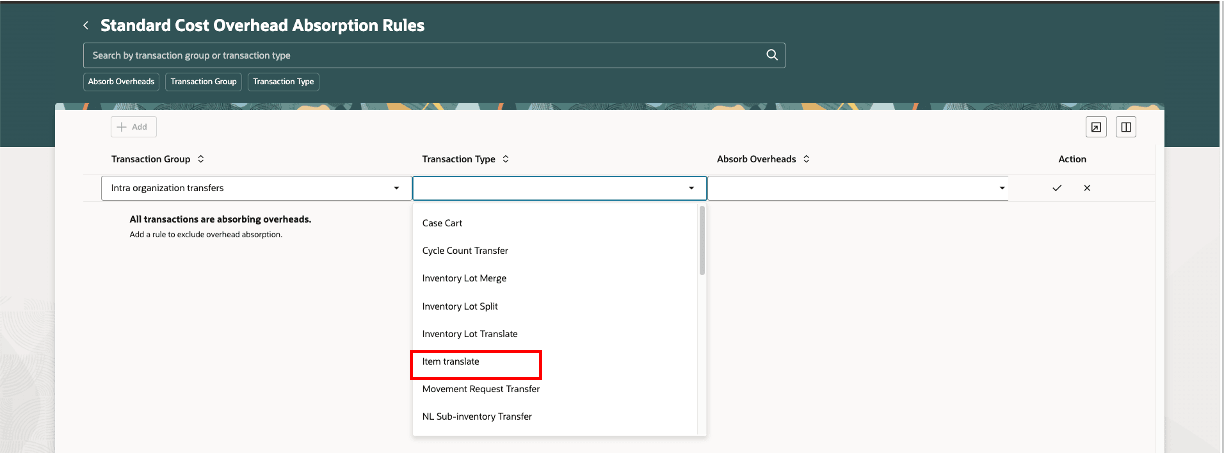
Standard cost overhead absorption rules
Key resources
- Oracle Fusion Cloud SCM: Implementing Manufacturing and Supply Chain Materials Management guide, available on the Oracle Help Center.
- Oracle Fusion Cloud SCM: Using Supply Chain Cost Management guide, available on the Oracle Help Center.
Access requirements
If you are using custom job roles, then you need to validate that you have the previously delivered privileges listed.
| Privilege Status | Privilege Name and Code |
|---|---|
| Existing |
Create Cost Distributions (CST_CREATE_COST_DISTRIBUTIONS_PRIV) |
| Existing | Review Cost Distribution (CST_REVIEW_COST_DISTRIBUTIONS_PRIV) |