Knowledge Agents
What is a Knowledge Agent?
Agent that augments AI Vector Search and LLM capabilities with information from organization-approved content, including enterprise repositories, OCI Object Storage, S3-compatible object storage, internal sites, uploaded files, and, where permitted, public web sources.
-
Contextual retrieval from unstructured sources and files
-
Grounded responses traceable to enterprise-approved sources
-
Supports unauthenticated web sources for broader knowledge retrieval
-
Supports file system sources for knowledge retrieval
-
Supports data sources from repositories such as SharePoint, Google Drive, OCI Object Storage, S3-compatible object storage, internal sites, and uploaded files.
-
Creates context based suggestions to ask the Agent
-
Web crawling support for dynamic web pages
-
Metadata detection for PDF documents
Create a Knowledge Agent
-
Add Data Sources:
Before creating a Knowledge Agent, make sure at least one data source is configured. Knowledge Agents rely on data sources such as SharePoint, Google Drive, OCI Object Storage, S3-compatible object storage, internal sites, and uploaded files to retrieve and ground their answers. Create the knowledge sources for your agent to learn from by adding one or more unstructured data sources, such as file uploads, Microsoft SharePoint document repositories, Google Drive, OCI Object Storage, S3-compatible object storage, or web content, including unauthenticated web pages. See Web Source, File Source, SharePoint Source, Google Drive, OCI Object Storage, and S3-Compatible Object Storage for instructions on adding data sources that serve as the agent’s knowledge base.
Important: Markdown
.mdfiles are not supported for Knowledge Agent data source file ingestion. You cannot upload, parse, index, or retrieve content from Markdown files in Knowledge Agent data sources. -
Automated Data Processing:
Each data source you configure is automatically processed and progresses through the following stages.
-
Crawling: Retrieve data from configured sources.
-
Parsing: Analyze unstructured data and transform into structured format.
-
Storing: Write the structured data from parsing stage to the database.
-
Chunking: Divide the text data into chunks for direct embedding in the next stage.
-
Embedding: Convert collected data into vector representations.
-
Ingestion: Store processed data in the vector database.
See Data Sources Troubleshooting for information about data source-related statuses and errors.
Note: Data processing happens as soon as a data source is configured, and is not part of the Knowledge Agent creation.
-
-
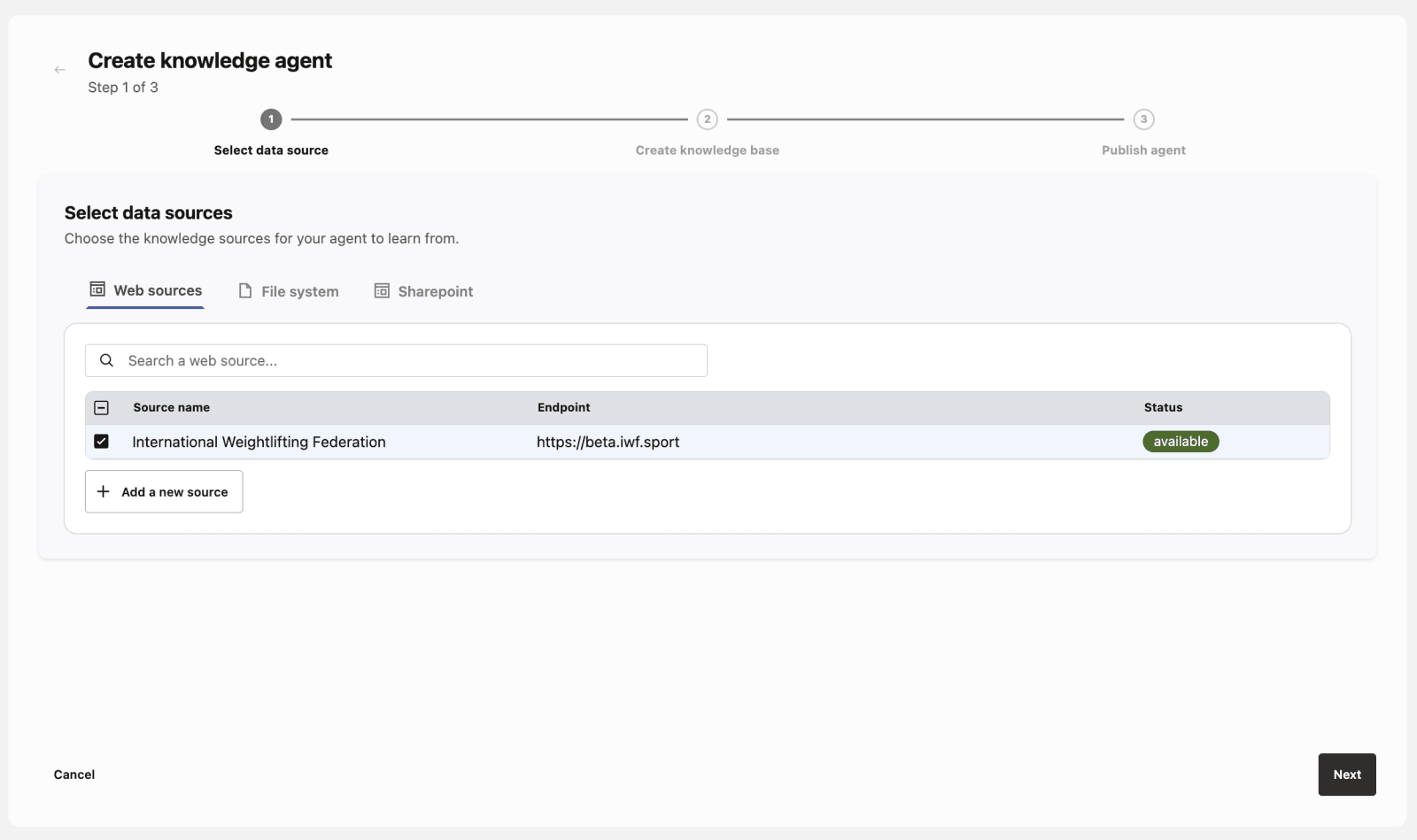
Select Data Sources:
Once the configured data is fully processed and ingested, it becomes available for selection as a data source for the Knowledge Agent. You can select any number of data sources, including a mix of web, SharePoint, Google Drive, OCI Object Storage, S3-compatible object storage, and file system sources.
Note: All data sources selected for a Knowledge Agent must use the same embedding model.
-
Create Knowledge Base:
Assign a name and description to the knowledge agent. Make the description as detailed as possible because it will be used for many downstream purposes.
-
Select a Generative Model:
Select a configured generative model to associate with the Knowledge Agent. The agent uses the selected model to generate responses from the retrieved content.
Note: OpenRouter generative model configurations are not available for Knowledge Agents. Select another supported generative model.
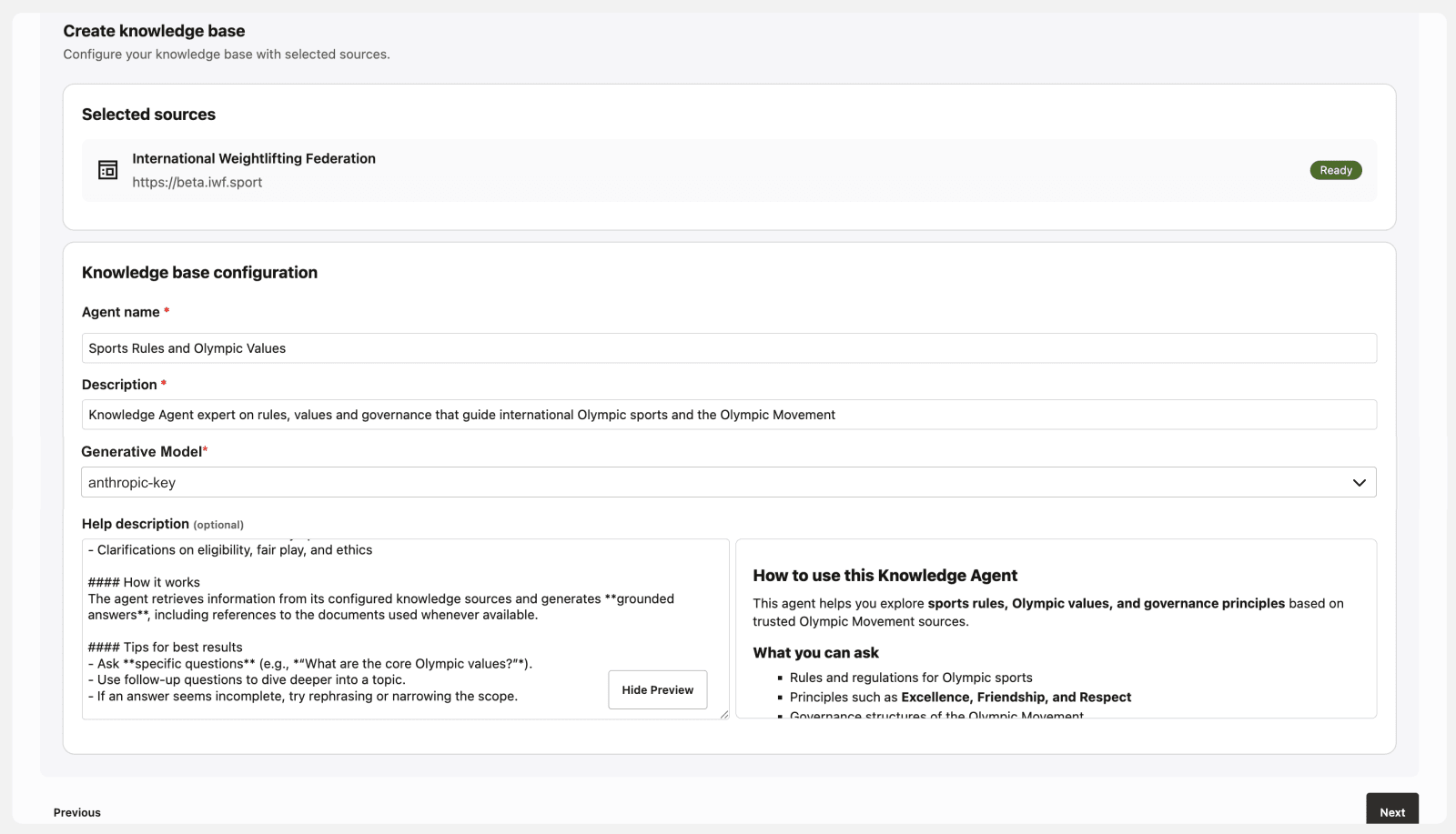
You can change the generative model associated with a Knowledge Agent after creating it. See Change the LLM for an Existing Knowledge Agent.
-
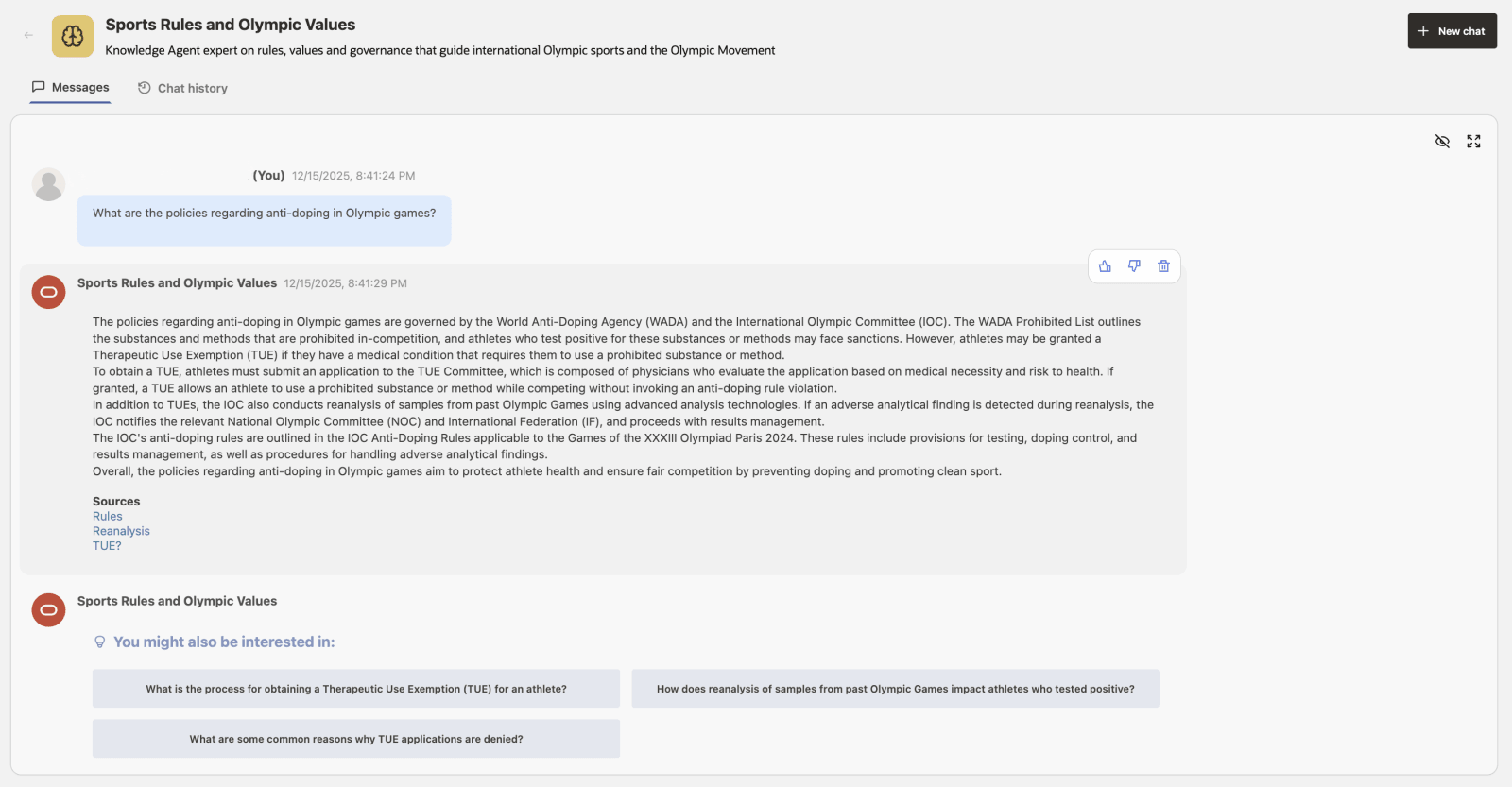
Publish the Agent and Start Conversing:
Publish the agent to make it available. Chat with the knowledge agent and receive answers based on the ingested data.
-
Click on the referenced resources to open the documents used by the LLM.
See Collect Diagnostics for information about downloading application logs for troubleshooting or support.
Share a Knowledge Agent
You can share a Knowledge Agent that you own or for which you have the Can manage access level.
Note: Users who receive access to a shared Knowledge Agent can interact with it even if they do not have access to the agent’s configured LLM. The Knowledge Agent uses its default LLM for their interactions.
Currently, Knowledge Agents can be created only with data sources that use the same embedding model. The user interface validates this requirement before it allows you to create the Knowledge Agent and associates the common embedding model with the agent.
When you share a Knowledge Agent, it retains its associated embedding model even if the recipient uses a different embedding model. The recipient’s or system default embedding model is not used directly by the Knowledge Agent.
- Open the Knowledge Agent page.
- Select Share from the Actions menu for the agent.
- In the Share dialog, review the users and groups that have access and their current access levels.
- Search for and select users or groups to add, change an existing access level, or remove access. Click Save changes to apply the changes.
The Share dialog identifies the resource owner as Owner. You cannot change or remove the owner’s access. See Manage Identity and Access for access-level definitions.
Change the LLM for an Existing Knowledge Agent
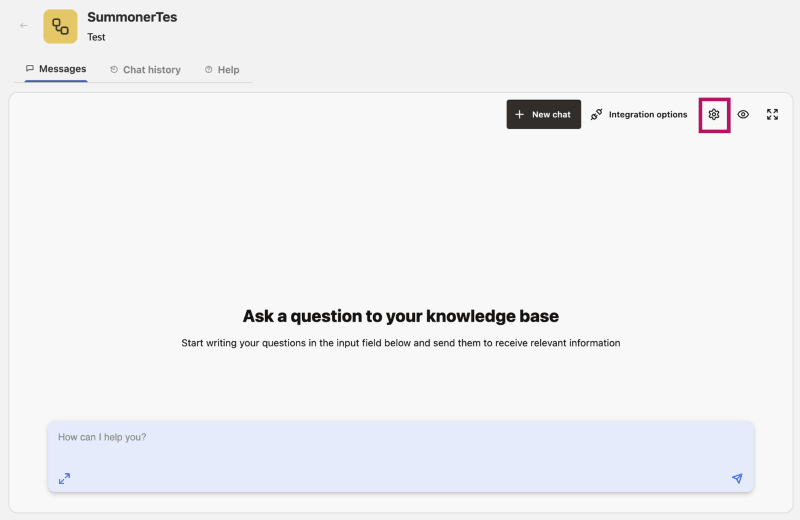
You can change the generative model associated with a Knowledge Agent at any time from its chat window.
-
In the Knowledge Agent chat window, click the Settings gear icon between Integration Options and the eye icon.
-
In the tray that opens on the right, select another configured generative model from the Generative Model list.
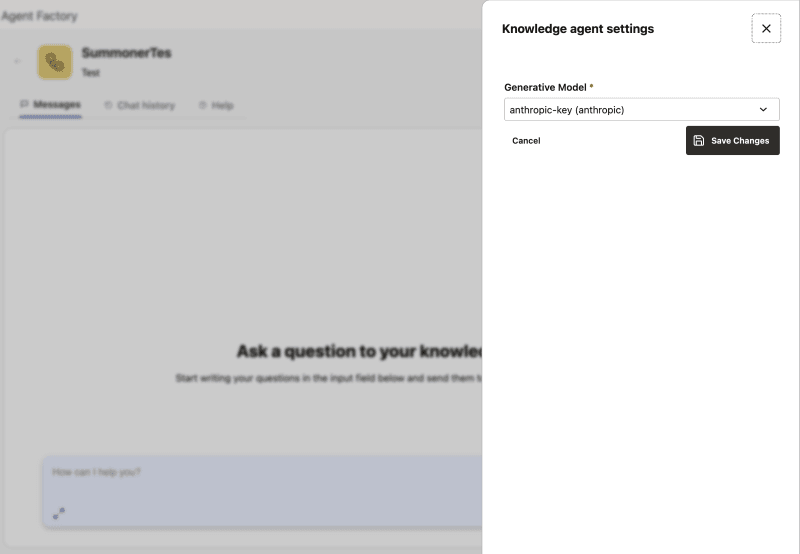
The Knowledge Agent uses the newly selected model for subsequent responses, including when it is used from an Agent Builder workflow.
Note: If you change a Knowledge Agent’s default LLM, the agent uses the new model for all end users.
Troubleshoot Knowledge Agents
| Symptom | Check |
|---|---|
| A source is not available when creating a Knowledge Agent | Confirm the source is an unstructured source supported by Knowledge Agent and ingestion has completed. |
| Source status remains not ingested or error | Review data source status details, connector credentials, network access, and application logs. |
| Answers do not cite expected documents | Confirm the document was ingested, contains extractable text, and is included in the agent’s selected sources. |
| PDF content is missing | Confirm the PDF contains text. Scanned image PDFs may require OCR before upload. |
| Pre-built Knowledge Assistant was not installed | Confirm the deployment is not air-gapped, required embedding model is configured, and wallet certificates were available if using a database wallet. |
For unresolved ingestion or chat failures, collect diagnostics after reproducing the issue. See Collect Diagnostics.
Oracle AI Database Private Agent Factory Knowledge Assistant
When running outside of an air-gapped environment, Agent Factory installation sets up an out-of-the-box knowledge assistant that can answer your questions about this documentation.
Note:
If the application is running in an air-gapped environment, the Oracle AI Database Private Agent Factory Knowledge Assistant will not be installed. Not installing this agent does not compromise the functionality of the Agent Factory application or the Knowledge Agent component.
If running outside an air-gapped environment but using a database wallet, you need to set up wallet certificates in order to install this agent. See Add Wallet Certificates.
If the agent was not installed out of the box for any of the above reasons, you can install the Oracle AI Database Private Agent Factory Knowledge Assistant from the Datasets tab by selecting Import Dataset.
The Agent Factory Knowledge Assistant uses the bundled multilingual-e5-base embedding model. During installation, Agent Factory imports embeddings for the Agent Factory User Guide that use this model. The assistant does not use the default embedding model configured in Model Management.
Note: The Oracle AI Database Private Agent Factory Knowledge Assistant supports only multilingual-e5-base. OCI Generative AI Cohere embedding models-cohere.embed-v4.0, cohere.embed-multilingual-light-v3.0, cohere.embed-english-v3.0, and cohere.embed-multilingual-v3.0 remain available for custom external data sources and custom Knowledge Agents.
Once installation is complete, you can find the Oracle AI Database Private Agent Factory Knowledge Assistant under Knowledge Agents in the left menu, ready for use. As part of this setup, Oracle data source - Oracle AI Database Private Agent Factory Documentation is also added.
You cannot delete the Oracle AI Database Private Agent Factory Knowledge Assistant as its shipped by default.
You also cannot delete the “Oracle data source - Oracle AI Database Private Agent Factory Documentation” data source, nor can you use it to create a custom knowledge agent.
What Can the Oracle AI Database Private Agent Factory Knowledge Assistant Help With?
You can ask questions about Agent Factory features, configuration, and administration, including:
- Installation, Deployment, and Upgrades: Prerequisites, Linux and macOS setup, container-image and OCI Marketplace deployment, and upgrades.
- Building Agents and Workflows: Agent Builder, nodes, templates, sample workflows, testing, publishing, and Agent Spec import and export.
- Pre-Built Agents: Knowledge Agents, Deep Data Research Agents, and Data Analysis Agents.
- Models and Data Sources: Generative and embedding model configuration, and supported data-source connectors.
- Integrations and Interoperability: MCP servers, API-key access for published agents and workflows, and Agent2Agent (A2A) integrations with external agents.
- Security, Access, and Administration: Users, roles, resource sharing, SSO, proxy, SMTP, observability, certificates, Agent Memory, and CLI administration.
- Utilities and Troubleshooting: Datasets, Prompt Lab, AI Enrichment, diagnostics, FAQs, and troubleshooting guidance.
How to Use the Oracle AI Database Private Agent Factory Knowledge Assistant?
-
Type Your Question
Enter your question in the chat, for example: How do I add a custom Knowledge Agent? For best results, be as specific as possible with your queries. For troubleshooting related questions, mention the scenario or error message you are experiencing. Select Editor Mode icon in the chat box to view and type your query in an expanded text input area.
-
Get Expert Guidance
The Assistant will respond with relevant, accurate information drawn from Oracle AI Database Private Agent Factory documentation.
Note: The Oracle AI Database Private Agent Factory Knowledge Assistant provides information based on the latest official documentation. For sensitive implementations or Oracle-internal topics, always verify against Oracle’s official guidelines, security, and compliance policies.
-
Ask Follow-Up Questions
Need more details or clarification? Simply submit a follow-up question.
-
Provide Feedback
Help us improve! Use the thumbs up or thumbs down icons to rate the helpfulness of the response.
-
Review Chat History
You can click on “Chat History” to view your previous interactions with the Assistant at any time.
Caution: The Oracle AI Database Private Agent Factory Knowledge Assistant relies on artificial intelligence models or systems. While useful when properly used, materials generated may be incomplete and/or contain errors and inaccuracies. Your access and use of this feature is at your own risk. Oracle has no responsibility or liability for any damages resulting from such access or use.
See Collect Diagnostics for information about downloading application logs for troubleshooting or support.
Oracle Database Knowledge Assistant
You can install the Oracle Database Knowledge Assistant from the Datasets tab by selecting Import Dataset. You can ask queries related to Oracle Database and its related products. Database Assistant uses the below public Oracle Database sources to answer questions:
- Oracle product documentation
- Oracle technical briefs
- Oracle blogs
- Oracle error messages
- Oracle product new features guides
Once the import is completed, you can find the Oracle Database Knowledge Assistant under Knowledge Agents in the left menu. During import, the following data sources are automatically created: Oracle Product Documentation, Oracle White Papers, Oracle Error Messages, Oracle Blogs, and Oracle Product New Features.
The Oracle Database Knowledge Assistant, including its shipped data sources, uses the bundled multilingual-e5-base embedding model. It does not use the default embedding model configured in Model Management.
Note: The Oracle Database Knowledge Assistant supports only multilingual-e5-base. OCI Generative AI Cohere embedding models-cohere.embed-v4.0, cohere.embed-multilingual-light-v3.0, cohere.embed-english-v3.0, and cohere.embed-multilingual-v3.0 remain available for custom external data sources and custom Knowledge Agents.
You cannot delete the Oracle Database Knowledge Assistant.
You cannot delete the data sources that are automatically created during import, nor can you use them to create custom knowledge agents.
How to Use the Oracle Database Knowledge Assistant?
-
Type Your Question
Enter your question in the chat, for example: Can I install Oracle Database Free into VirtualBox? For best results, be as specific as possible with your queries. For troubleshooting related questions, mention the scenario or error message you are experiencing. Select Editor Mode icon in the chat box to view and type your query in an expanded text input area.
-
Get Expert Guidance
The Assistant will respond with relevant, accurate information drawn from the Oracle Database sources.
Note: The Oracle Database Knowledge Assistant provides information based on the official Oracle Database documentation, technical briefs, Oracle blogs, and other sources. For sensitive implementations or Oracle-internal topics, always verify against Oracle’s official guidelines, security, and compliance policies.
-
Ask Follow-Up Questions
Need more details or clarification? Simply submit a follow-up question.
-
Provide Feedback
Help us improve! Use the thumbs up or thumbs down icons to rate the helpfulness of the response.
-
Review Chat History
You can click on “Chat History” to view your previous interactions with the Assistant at any time.
Caution: The Oracle Database Knowledge Assistant relies on artificial intelligence models or systems. While useful when properly used, materials generated may be incomplete and/or contain errors and inaccuracies. Your access and use of this feature is at your own risk. Oracle has no responsibility or liability for any damages resulting from such access or use.
See Collect Diagnostics for information about downloading application logs for troubleshooting or support.