25.1.9.1.11.3.1 Determining Assignees Generically
Use a package function to determine potential owners for a task at runtime.
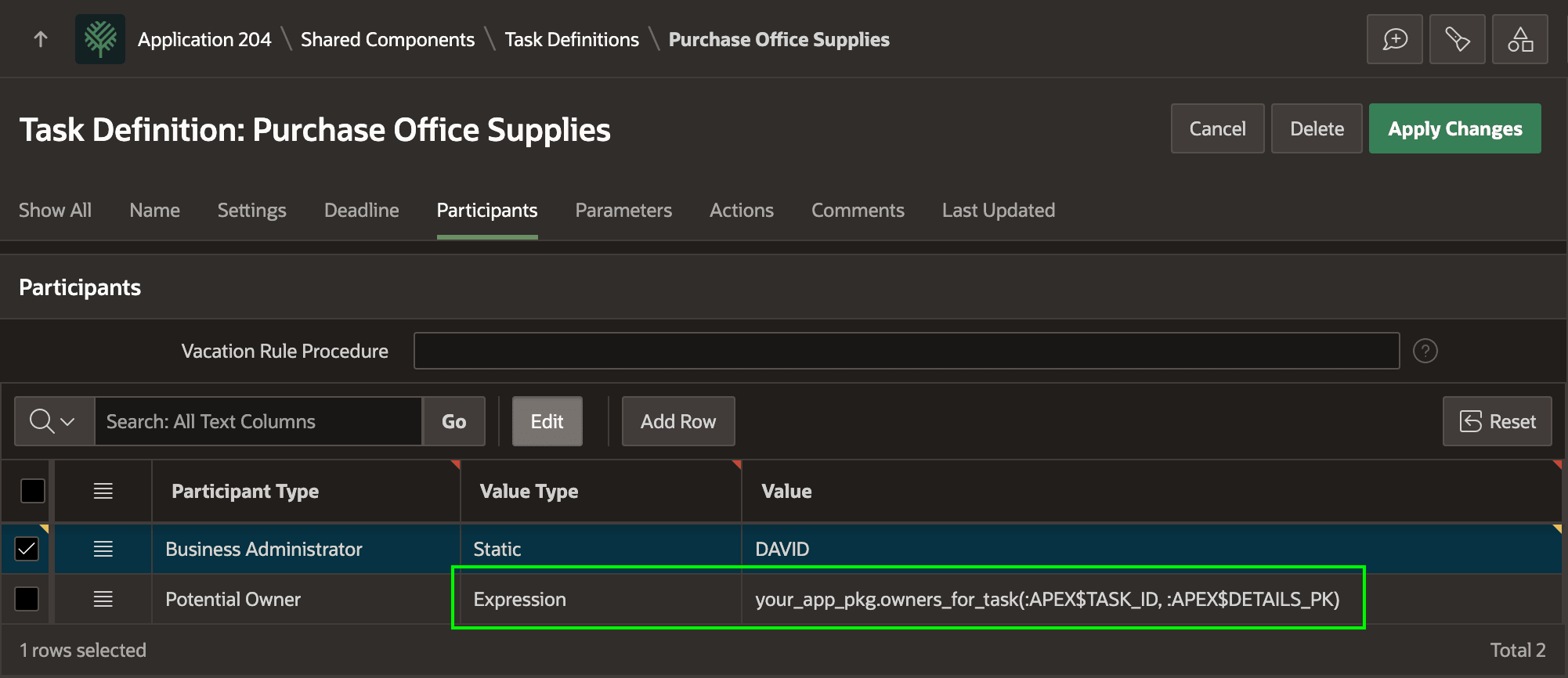
The Purchase Office Supplies task definition in this example configures a
static username DAVID as the business administrator, and uses an
Expression to call an OWNERS_FOR_TASK function in the
package YOUR_APP_PKG. This dynamically determines the list of potential
owners. It returns a comma-separated list of case-sensitive usernames. The function
accepts the task ID and primary key of the business entity related to the task instance
as parameters. The Purchase Office Supplies task definition does not use
an associated business entity row, nor does it accept a Details Primary Key at
creation time. However, this function signature illustrates a best practice for
providing key information that generic task owner assignment logic typically needs.
your_app_pkg.owners_for_task(:APEX$TASK_ID,:APEX$DETAILS_PK)Figure 25-54 Participants for Purchase Office Supplies Task Definition
your_app_pkg specification looks like this:package your_app_pkg as
-------------------------------------------------
-- Returns comma-separated list of case-sensitive
-- usernames who are potential owners for task id
-- passed in
-------------------------------------------------
function owners_for_task(
p_task_id in number,
p_detail_pk in varchar2)
return varchar2;
-------------------------------------------------
-- Returns comma-separated list of email
-- addresses of potential owners for task id
-- passed in
-------------------------------------------------
function owner_emails_for_task(
p_task_id in number,
p_detail_pk in varchar2)
return varchar2;
end your_app_pkg;Parent topic: Notifying Assignees on Create