ALTER LOCKDOWN PROFILE
Purpose
Use the ALTER LOCKDOWN PROFILE statement to alter a PDB lockdown profile. You can use PDB lockdown profiles in a multitenant environment to restrict user operations in pluggable databases (PDBs).
Immediately after you create a lockdown profile with the CREATE LOCKDOWN PROFILE statement, all user operations are enabled for the profile. You can then use the ALTER LOCKDOWN PROFILE statement to disable certain user operations for the profile. When a lockdown profile is applied to a CDB, application container, or PDB, users cannot perform the operations that are the disabled for the profile. If you later would like to reenable some of the disabled user operations, you can use the ALTER LOCKDOWN PROFILE statement to do so.
The ALTER LOCKDOWN PROFILE statement allows you to disable or enable:
-
User operations associated with certain database features (using the lockdown_features clause)
-
User operations associated with certain database options (using the lockdown_options clause)
-
The issuance of certain SQL statements (using the lockdown_statements clause)
See Also:
-
Oracle Database Security Guide for more information on PDB lockdown profiles
Prerequisites
-
You must issue the
ALTERLOCKDOWNPROFILEstatement from the CDB Root or Application Root. -
You must have the
ALTERLOCKDOWNPROFILEsystem privilege in the container in which you issue the statement.
Syntax
alter_lockdown_profile::= 
Description of the illustration alter_lockdown_profile.eps
lockdown_features::= 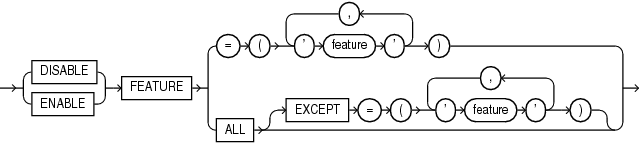
Description of the illustration lockdown_features.eps
lockdown_options::= 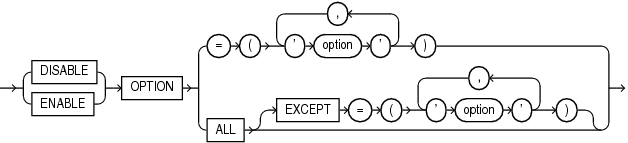
Description of the illustration lockdown_options.eps
lockdown_statements::= 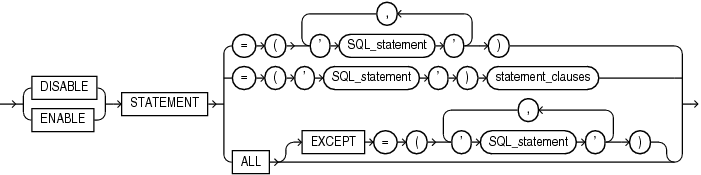
Description of the illustration lockdown_statements.eps
statement_clauses::= 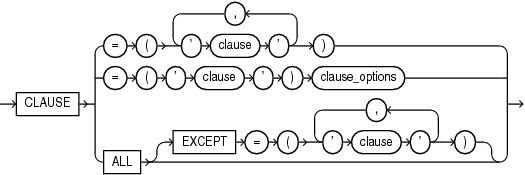
Description of the illustration statement_clauses.eps
clause_options::= 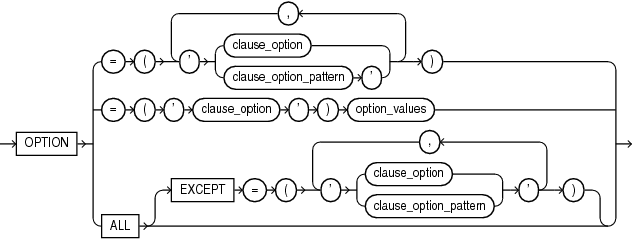
Description of the illustration clause_options.eps
option_values::= 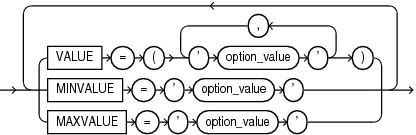
Description of the illustration option_values.eps
Semantics
profile_name
Specify the name of the PDB lockdown profile to be altered.
You can find the names of existing PDB lockdown profiles by querying the DBA_LOCKDOWN_PROFILES data dictionary view.
lockdown_features
This clause lets you disable or enable user operations associated with certain database features.
-
Specify
DISABLEto add a restriction for the specified features. Users will be restricted from performing these operations in any PDB to which the profile applies. -
Specify
ENABLEto remove a restriction for the specified features. Users will be allowed to perform these operations in any PDB to which the profile applies. -
Use feature to specify the features whose operations you want to disable or enable.Table 11-1 lists the features you can specify and describes the operations associated with each feature. The table also indicates a feature bundle for each feature. For feature, you can specify a feature bundle name to disable or enable user operations for all features in that bundle, or you can specify an individual feature name. You can specify feature bundle names and feature names in any combination of uppercase and lowercase letters.
-
Use
ALLto specify all features listed in the table. -
Use
ALLEXCEPTto specify all features listed in the table except the specified features.
If you omit this clause, then the default is ENABLE ALL.
  <div class="infoboxnote" markdown="1">
  **Note:**
  - The Oracle Text type `FILE_DATASTORE` is deprecated. Oracle recommends that you replace `FILE_DATASTORE` indexes with the `DIRECTORY_DATASTORE` index type for greater security as it enables file access to be based on directory objects.

  - The Oracle Text type `URL_DATASTORE` is deprecated. Oracle recommeds that you replace `URL_DATASTORE` with `NETWORK_DATASTORE`, which uses ACLs to control access to specific servers.
  </div>
Table 1 PDB Lockdown Profile Features
| Feature Bundle | Feature | Operations |
|---|---|---|
AWR_ACCESS |
AWR_ACCESS |
The PDB taking manual and automatic Automatic Workload Repository (AWR) snapshots |
COMMON_SCHEMA_ACCESS |
COMMON_USER_LOCAL_SCHEMA_ACCESS |
A common user invoking an invoker’s rights code unit or accessing a BEQUEATH CURRENT_USER view owned by any local user in the PDB |
COMMON_SCHEMA_ACCESS |
LOCAL_USER_COMMON_SCHEMA_ACCESS |
|
COMMON_SCHEMA_ACCESS |
SECURITY_POLICIES |
Creation of certain security policies by a local user on a common object, including:
|
CONNECTIONS |
COMMON_USER_CONNECT |
A common user connecting to the PDB directly. If this feature is disabled, then in order to connect to the PDB, a common user must first connect to the CDB root and then switch to the desired PDB using the ALTER SESSION SET CONTAINER statement. |
CONNECTIONS |
LOCAL_SYSOPER_RESTRICTED_MODE_CONNECT |
A local user with the SYSOPER privilege connecting to a PDB that is open in RESTRICTED mode |
CTX_LOGGING |
CTX_LOGGING |
Use logging in Oracle Text PL/SQL procedures such as CTX_OUTPUT.START_LOG and CTX_OUTPUT.START_QUERY_LOG |
JAVA |
JAVA |
Java as a whole. If this feature is disabled, then all options and features of the database that depend on Java will be disabled. |
JAVA_RUNTIME |
JAVA_RUNTIME |
Operations through Java that require java.lang.RuntimePermission |
NETWORK_ACCESS |
AQ_PROTOCOLS |
Using HTTP, SMTP, and OCI notification features. |
NETWORK_ACCESS |
CTX_PROTOCOLS |
|
NETWORK_ACCESS |
DBMS_DEBUG_JDWP |
Using the DBMS_DEBUG_JDWP PL/SQL package |
NETWORK_ACCESS |
UTL_HTTP |
Using the UTL_HTTP PL/SQL package |
NETWORK_ACCESS |
UTL_INADDR |
Using the UTL_INADDR PL/SQL package |
NETWORK_ACCESS |
UTL_SMTP |
Using the UTL_SMTP PL/SQL package |
NETWORK_ACCESS |
UTL_TCP |
Using the UTL_TCP PL/SQL package |
NETWORK_ACCESS |
XDB_PROTOCOLS |
Using HTTP, FTP, and other network protocols through XDB |
OS_ACCESS |
DROP_TABLESPACE_KEEP_DATAFILES |
Dropping a tablespace in the PDB without specifying the INCLUDING CONTENTS AND DATAFILES clause in DROP TABLESPACE statement |
OS_ACCESS |
EXTERNAL_FILE_ACCESS |
Using external files or directory objects in the PDB when PATH_PREFIX is not set for the PDB |
OS_ACCESS |
EXTERNAL_PROCEDURES |
Using external procedure agent extproc in the PDB |
OS_ACCESS |
FILE_TRANSFER |
Using the DBMS_FILE_TRANSFER package |
OS_ACCESS |
JAVA_OS_ACCESS |
Using java.io.FilePermission from Java |
OS_ACCESS |
LOB_FILE_ACCESS |
Using BFILE and CFILE data types |
OS_ACCESS |
TRACE_VIEW_ACCESS |
Using the following trace views:
|
OS_ACCESS |
UTL_FILE |
Using UTL_FILE. If this feature is disabled, then the database blocks use of the UTL_FILE.FOPEN function. |
lockdown_options
This clause lets you disable or enable user operations associate with certain database options.
-
Specify
DISABLEto disable user operations for the specified options. Users will be restricted from performing these operations in any PDB to which the profile applies. -
Specify
ENABLEto enable user operations for the specified options. Users will be allowed to perform these operations in any PDB to which the profile applies. -
For option, you can specify the following database options in any combination of uppercase and lowercase letters:
-
DATABASEQUEUING– Represents user operations associated with the Oracle Database Advanced Queuing option -
PARTITIONING– Represents user operations associated with the Oracle Partitioning option
-
-
Use
ALLto specify all options in the preceding list. -
Use
ALLEXCEPTto specify all options in the preceding list except the specified options.
If you omit this clause, then the default is ENABLE OPTION ALL.
lockdown_statements
This clause lets you disable or enable the issuance of certain SQL statements.
-
Specify
DISABLEto disable the issuance of the specified SQL statements. Users will be restricted from issuing these statements in any PDB to which the profile applies. -
Specify
ENABLEto enable the issuance of the specified SQL statements. Users will be allowed to issue these statements in any PDB to which the profile applies. -
For SQL_statement, you can specify the following statements in any combination of uppercase and lowercase letters:
-
ADMINISTERKEY MANAGEMENT -
ALTERDATABASE -
ALTERPLUGGABLEDATABASE -
ALTERSESSION -
ALTERSYSTEM -
ALTERTABLE -
ALTERINDEX -
ALTERTABLESPACE -
ALTERPROFILE -
CREATETABLE -
CREATEINDEX -
CREATETABLESPACE -
CREATEPROFILE -
CREATEDATABASE LINK -
DROPTABLE -
DROPINDEX -
DROPTABLESPACE -
DROPPROFILE
-
-
Use
ALLto specify all statements in the preceding list. -
Use
ALLEXCEPTto specify all statements in the preceding list except the specified statements.
If you omit this clause, then the default is ENABLE STATEMENT ALL.
statement_clauses
This clause lets you disable or enable specific clauses of the specified SQL statement.
-
Use clause to specify the SQL keywords that form the clause you want to disable or enable. You can specify a clause in any combination of uppercase and lowercase letters.
-
Use
ALLto specify all clauses for the SQL statement. -
Use
ALLEXCEPTto specify all clauses for the SQL statement except the specified clauses.
For clause, you must specify at least enough keywords to unambiguously identify a single clause for the SQL statement. The following are some examples of how to specify clause for the ALTER SYSTEM statement:
-
To specify the archive_log_clause::=, specify
ARCHIVE. This is sufficient because no otherALTERSYSTEMclause begins with the keywordARCHIVE. Alternatively, you can specifyARCHIVELOGfor semantic clarity, but theLOGkeyword is unnecessary. -
To specify either of the rolling_migration_clauses::=, you must specify
STARTROLLINGMIGRATIONorSTOPROLLINGMIGRATIONin order to distinguish these clauses from the similarly named rolling_patch_clauses::=STARTROLLINGPATCHandSTOPROLLINGPATCH. -
You cannot specify the single keyword
FLUSH, because severalALTERSYSTEMclauses begin with this keyword. You must instead specify each clause separately, such asFLUSHSHARED_POOLorFLUSHGLOBALCONTEXT.
There is no need to specify optional keywords within a clause, because they have no effect. For example:
- The archive_log_clause::= has an optional
INSTANCEkeyword. However, you cannot enable or disable onlyARCHIVELOGclauses that contain theINSTANCEkeyword. SpecifyingARCHIVELOGINSTANCEis equivalent to specifyingARCHIVEorARCHIVELOG.
There is no need to specify parameter values within a clause, because they have no effect. For example:
- The shutdown_dispatcher_clause::= requires you to specify a dispatcher_name. However, you cannot enable or disable
SHUTDOWNclauses that contain a specific dispatcher name. SpecifyingSHUTDOWNdispatcher1is equivalent to specifyingSHUTDOWN. See Also: ALTER DATABASE, ALTER PLUGGABLE DATABASE, ALTER SESSION, and ALTER SYSTEM for complete information on the clauses for these statements
clause_options
This clause is valid only when you specify one of the following for lockdown_statements and statement_clauses:
{ DISABLE | ENABLE } STATEMENT = ('ALTER SESSION') CLAUSE = ('SET')
{ DISABLE | ENABLE } STATEMENT = ('ALTER SYSTEM') CLAUSE = ('SET')
This clause lets you disable or enable the setting or modification of specific options with the ALTER SESSION SET or ALTER SYSTEM SET statements.
-
Use clause_option to specify the option you want to disable or enable.
-
Use clause_option_pattern to specify a pattern that matches multiple options. Within the pattern, specify a percent sign (%) to match zero or more characters in an option name. For example, specifying
'QUERY_REWRITE_%'is equivalent to specifying both theQUERY_REWRITE_ENABLEDandQUERY_REWRITE_INTEGRITYoptions. -
You can specify clause_option and clause_option_pattern in any combination of uppercase and lowercase letters.
-
Use
ALLto specify all options. -
Use
ALLEXCEPTto specify all options except the specified options. See Also: The alter_session_set_clause clause ofALTERSESSIONand the alter_system_set_clause clause ofALTERSYSTEMfor complete information on the options you can specify for these statements
option_values
This clause is valid only when you specify one of the following for lockdown_statements, statement_clauses, and clause_options:
DISABLE STATEMENT = ('ALTER SESSION') CLAUSE = ('SET') OPTION = clause_option
DISABLE STATEMENT = ('ALTER SYSTEM') CLAUSE = ('SET') OPTION = clause_option
This clause lets you specify a default value for an option when disabling the setting of that option. For options that take numeric values, this clause also lets you restrict users from setting an option to certain values.
-
The
VALUEclause lets you specify a default option_value for clause_option, which will go into effect for any PDB to which the profile applies after you close and reopen the PDB. If clause_option accepts multiple default values, then you can specify more than one option_value in a comma-separated list. The purpose of using this clause is to simultaneously set a default value for an option and restrict users from setting or modifying the value. -
The
MINVALUEclause lets you restricts users from setting the value of clause_option to a value less than option_value. You can specify this clause only for options that take a numeric value. -
The
MAXVALUEclause lets you restricts users from setting the value of clause_option to a value greater than option_value. You can specify this clause only for options that take a numeric value. -
You can specify both the
MINVALUEandMAXVALUEclauses together to restrict users from setting the value of clause_options to any value less thanMINVALUEor greater thanMAXVALUE. -
MINVALUEandMAXVALUEsettings take effect immediately when the lockdown profile is assigned to a PDB; you need not close and reopen the PDB. See Also: Oracle Database Reference for complete information on the values allowed for the various options
Examples
The following statement creates PDB lockdown profile hr_prof:
CREATE LOCKDOWN PROFILE hr_prof;The remaining examples in this section alter hr_prof.
Disabling Features for PDB Lockdown Profiles: Examples
The following statement disables all features in the feature bundle NETWORK_ACCESS:
ALTER LOCKDOWN PROFILE hr_prof
  DISABLE FEATURE = ('NETWORK_ACCESS');
The following statement disables the LOB_FILE_ACCESS and TRACE_VIEW ACCESS features:
ALTER LOCKDOWN PROFILE hr_prof
  DISABLE FEATURE = ('LOB_FILE_ACCESS', 'TRACE_VIEW_ACCESS');
The following statement disables all features except the COMMON_USER_LOCAL_SCHEMA_ACCESS and LOCAL_USER_COMMON_SCHEMA_ACCESS features:
ALTER LOCKDOWN PROFILE hr_prof
  DISABLE FEATURE ALL EXCEPT = ('COMMON_USER_LOCAL_SCHEMA_ACCESS', 'LOCAL_USER_COMMON_SCHEMA_ACCESS');
The following statement disables all features:
ALTER LOCKDOWN PROFILE hr_prof
  DISABLE FEATURE ALL;
Enabling Features for PDB Lockdown Profiles: Examples
The following statement enables the UTL_HTTP and UTL_SMTP features, as well as all features in the feature bundle OS_ACCESS:
ALTER LOCKDOWN PROFILE hr_prof
  ENABLE FEATURE = ('UTL_HTTP', 'UTL_SMTP', 'OS_ACCESS');
The following statement enables all features except the AQ_PROTOCOLS and CTX_PROTOCOLS features:
ALTER LOCKDOWN PROFILE hr_prof
  ENABLE FEATURE ALL EXCEPT = ('AQ_PROTOCOLS', 'CTX_PROTOCOLS');
The following statement enables all features:
ALTER LOCKDOWN PROFILE hr_prof
  ENABLE FEATURE ALL;
Disabling Options for PDB Lockdown Profiles: Examples
The following statement disables user operations associated with the Oracle Database Advanced Queuing option:
ALTER LOCKDOWN PROFILE hr_prof
  DISABLE OPTION = ('DATABASE QUEUING');
The following statement disables user operations associated with the Oracle Partitioning option:
ALTER LOCKDOWN PROFILE hr_prof
  DISABLE OPTION = ('PARTITIONING');
Enabling Options for PDB Lockdown Profiles: Examples
The following statement enables user operations associated with the Oracle Database Advanced Queuing option:
ALTER LOCKDOWN PROFILE hr_prof
  ENABLE OPTION = ('DATABASE QUEUING');
The following statement enables user operations associated both with the Oracle Database Advanced Queuing option and the Oracle Partitioning option:
ALTER LOCKDOWN PROFILE hr_prof
  ENABLE OPTION ALL;
Disabling SQL Statements for PBB Lockdown Profiles: Examples
The following statement disables the ALTER DATABASE statement:
ALTER LOCKDOWN PROFILE hr_prof
  DISABLE STATEMENT = ('ALTER DATABASE');
The following statement disables the ALTER SYSTEM SUSPEND and ALTER SYSTEM RESUME statements:
ALTER LOCKDOWN PROFILE hr_prof
  DISABLE STATEMENT = ('ALTER SYSTEM')
          CLAUSE = ('SUSPEND', 'RESUME');
The following statement disables all clauses of the ALTER PLUGGABLE DATABASE statement, except DEFAULT TABLESPACE and DEFAULT TEMPORARY TABLESPACE:
ALTER LOCKDOWN PROFILE hr_prof
  DISABLE STATEMENT = ('ALTER PLUGGABLE DATABASE')
          CLAUSE ALL EXCEPT = ('DEFAULT TABLESPACE', 'DEFAULT TEMPORARY TABLESPACE');
The following statement disables using the ALTER SESSION statement to set or modify COMMIT_WAIT or CURSOR_SHARING:
ALTER LOCKDOWN PROFILE hr_prof
  DISABLE STATEMENT = ('ALTER SESSION')
          CLAUSE = ('SET')
          OPTION = ('COMMIT_WAIT', 'CURSOR_SHARING');
The following statement disables using the ALTER SYSTEM statement to set or modify the value of PDB_FILE_NAME_CONVERT. It also sets the default value for PDB_FILE_NAME_CONVERT to 'cdb1_pdb0', 'cdb1_pdb1'. This default value will take effect the next time the PDB is closed and reopened.
ALTER LOCKDOWN PROFILE hr_prof
  DISABLE STATEMENT = ('ALTER SYSTEM')
          CLAUSE = ('SET')
          OPTION = ('PDB_FILE_NAME_CONVERT')
          VALUE = ('cdb1_pdb0', 'cdb1_pdb1');
The following statement disables using the ALTER SYSTEM statement to set or modify the value of CPU_COUNT to a value less than 8:
ALTER LOCKDOWN PROFILE hr_prof
  DISABLE STATEMENT = ('ALTER SYSTEM')
          CLAUSE = ('SET')
          OPTION = ('CPU_COUNT')
          MINVALUE = '8';
The following statement disables using the ALTER SYSTEM statement to set or modify the value of CPU_COUNT to a value greater than 2:
ALTER LOCKDOWN PROFILE hr_prof
  DISABLE STATEMENT = ('ALTER SYSTEM')
          CLAUSE = ('SET')
          OPTION = ('CPU_COUNT')
          MAXVALUE = '2';
The following statement disables using the ALTER SYSTEM statement to set or modify the value of CPU_COUNT to a value less than 2 or greater than 6:
ALTER LOCKDOWN PROFILE hr_prof
  DISABLE STATEMENT = ('ALTER SYSTEM')
          CLAUSE = ('SET')
          OPTION = ('CPU_COUNT')
          MINVALUE = '2'
          MAXVALUE = '6';
Enabling SQL Statements for PBB Lockdown Profiles: Examples
The following statement enables all statements except ALTER DATABASE:
ALTER LOCKDOWN PROFILE hr_prof
  ENABLE STATEMENT ALL EXCEPT = ('ALTER DATABASE');
The following statement enables the ALTER DATABASE MOUNT and ALTER DATABASE OPEN statements:
ALTER LOCKDOWN PROFILE hr_prof
  ENABLE STATEMENT = ('ALTER DATABASE')
          CLAUSE = ('MOUNT', 'OPEN');
The following statement enables all clauses of the ALTER PLUGGABLE DATABASE statement, except DEFAULT TABLESPACE and DEFAULT TEMPORARY TABLESPACE:
ALTER LOCKDOWN PROFILE hr_prof
  ENABLE STATEMENT = ('ALTER PLUGGABLE DATABASE')
         CLAUSE ALL EXCEPT = ('DEFAULT TABLESPACE', 'DEFAULT TEMPORARY TABLESPACE');
The following statement enables using the ALTER SESSION statement to set or modify COMMIT_WAIT or CURSOR_SHARING:
ALTER LOCKDOWN PROFILE hr_prof
  ENABLE STATEMENT = ('ALTER SESSION')
         CLAUSE = ('SET')
         OPTION = ('COMMIT_WAIT', 'CURSOR_SHARING');