Using Graph Assistant in Modeler
The Graph Assistant feature in Modeler enables you to use natural language to create, review, and modify property graphs. You can describe the graph or the changes you want, and the Graph Assistant generates or updates the graph accordingly.
Before you use Graph Assistant, ensure that the following prerequisites are met:
- You are connected either to an Oracle Autonomous AI Database instance running Oracle AI Database 26ai, or to an Oracle AI Database 26ai instance with DBMS_CLOUD installed.
-
An AI profile is configured for the database environment. Graph Assistant uses the AI profile to interpret natural language prompts and generate or modify property graphs. See Generate SQL from Natural Language Prompts Using Select AI for more information.
-
The Graph Assistant option is enabled in the Modeler Settings panel.
-
Select the AI profile that you want Graph Assistant to use from the Profile list in the Graph Assistant section of the Modeler Settings panel.
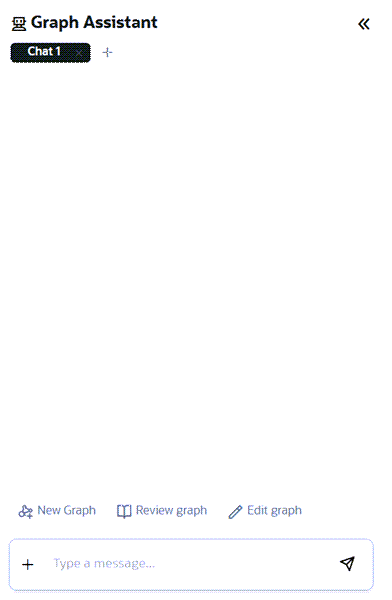
To open Graph Assistant, expand the Graph Assistant panel by clicking the arrow on the left side of the Modeler page.
Figure: Graph Assistant
Description of the illustration modeler_get_started_graph_assistant.png
The Graph Assistant panel contains the following components:
-
Message box: Enter a natural language prompt or follow-up instruction.
-
Send: Submits the prompt to Graph Assistant.
-
Conversation area: Displays the prompts and responses exchanged with Graph Assistant.
-
Add (+): Starts a new conversation.
See also Store Chats and Clear Chats configurations in Configuring Modeler Settings.
You can use Graph Assistant to perform the following tasks:
-
Create a new property graph from a natural language description.
-
Review an existing property graph and receive a summary of its structure.
-
Modify an existing property graph by adding, removing, or updating vertices, edges, labels, or properties.
-
Fix warnings while creating or editing a property graph.
-
Creating a Property Graph Using Graph Assistant
You can create a property graph using Graph Assistant. -
Reviewing a Property Graph Using Graph Assistant
You can use Graph Assistant to review a property graph after it has been loaded into the Modeler. -
Editing a Property Graph Using Graph Assistant
You can use Graph Assistant to edit a property graph only after the graph has been loaded into the Modeler.
Creating a Property Graph Using Graph Assistant
You can create a property graph using Graph Assistant.
-
Expand the Graph Assistant panel by clicking the arrow on the left side of the Modeler page.
-
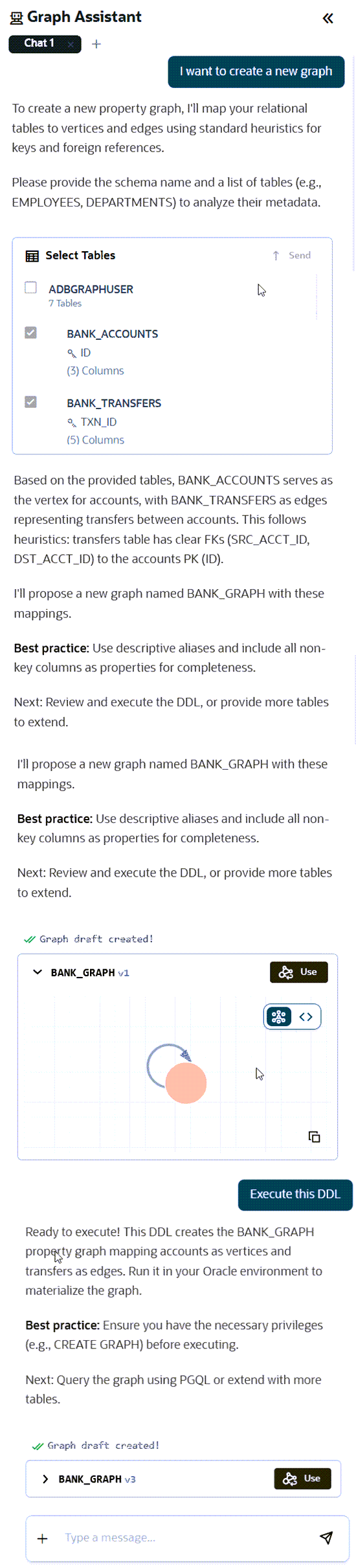
Click New Graph above the message box.
-
Select the source data tables that are required as input for the graph.
-
Click Send in the Select Tables panel.
Graph Assistant displays the property graph generated using the selected tables.
-
Review the generated graph or refine the graph using additional instructions.
Note: To create a PGQL property graph, add
OPTIONS (PG_PGQL)at the end of the DDL generated by Graph Assistant. See PGQL Property Graphs for more information on DDL syntax. -
Prompt Graph Assistant to execute the DDL if the proposed graph design is as expected.
Figure: Creating a SQL Property Graph Using Graph Assistant
Description of the illustration modeler_graph_assitant_new_graph.png
Tip: Click Use to load the graph into Modeler. This makes the graph DDL available, enabling Graph Assistant to review or modify a property graph in subsequent prompts.
-
Click Create Graph in the top right of the page.
The graph gets created and you can interact with the graph using Graph Explorer.
Reviewing a Property Graph Using Graph Assistant
You can use Graph Assistant to review a property graph after it is loaded in Modeler.
-
Expand the Graph Assistant panel by clicking the arrow on the left side of the Modeler page.
-
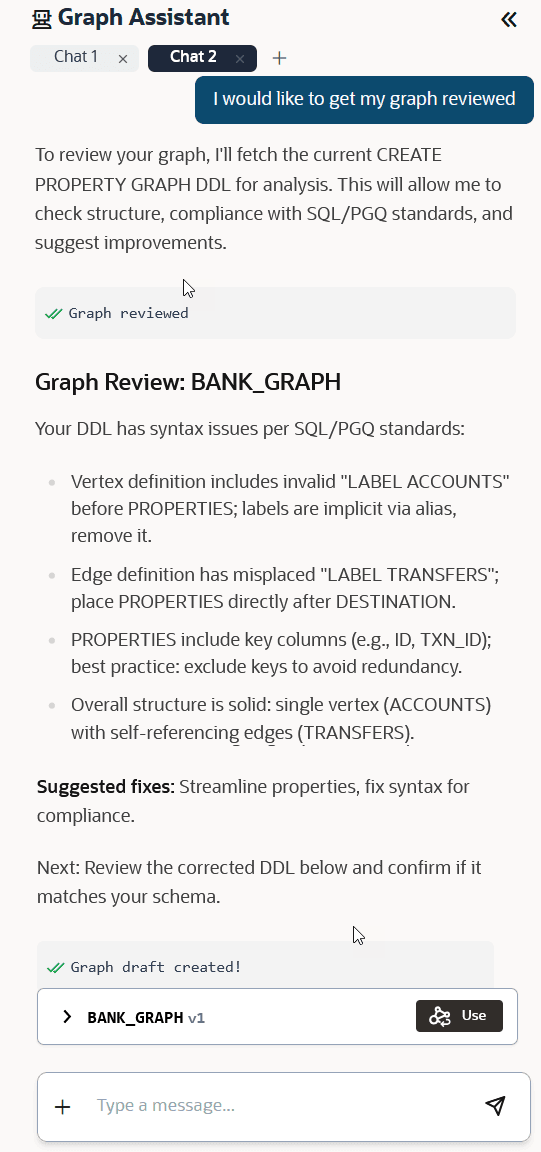
Click Review graph above the message box.
Note: Graph Assistant can review or modify only the graph that is currently loaded in Modeler. If you create a graph draft using Graph Assistant, click Use to load the generated graph into the Modeler. Until you click Use, the graph DDL is not available and Graph Assistant cannot review or modify the graph.
The summary of the property graph that is loaded in the modeler is retrieved and displayed.
Figure: Reviewing a SQL Property Graph Using Graph Assistant
Description of the illustration modeler_graph_assitant_review_graph.png
Editing a Property Graph Using Graph Assistant
You can use Graph Assistant to edit a property graph only after the graph is loaded into Modeler.
-
Expand the Graph Assistant panel by clicking the arrow on the left side of the Modeler page.
-
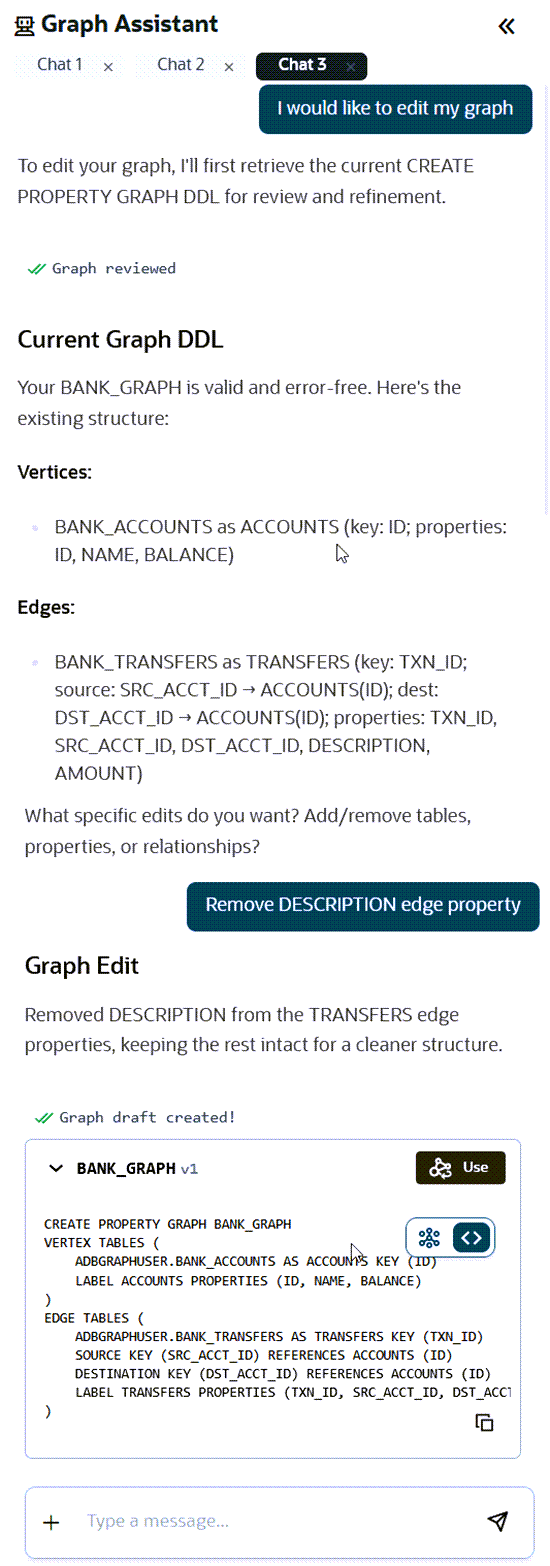
Click Edit graph above the message box.
Note: Graph Assistant can review or modify only the graph that is currently loaded in Modeler. If you create a graph draft using Graph Assistant, click Use to load the generated graph into Modeler. Until you click Use, the graph DDL is not available and Graph Assistant cannot review or modify the graph.
The summary of the property graph that is loaded in Modeler is retrieved and displayed.
-
Prompt Graph Assistant to edit the graph as required.
Figure: Editing a SQL Property Graph Using Graph Assistant
Description of the illustration modeler_graph_assitant_edit_graph.png
-
Review the generated graph or refine the graph using additional instructions.
-
Click Update Graph on the top right of the page.
The graph gets updated and can be queried in Graph Explorer.