3 AI Reference Implementation: Offer Recommendation
Learn about the features you can implement using machine learning (ML) workflows and models created with the artificial intelligence (AI) microservices available in Oracle Communications Cloud Scale Monetization.
Topics in this document:
About the AI Reference Implementation
Cloud Scale Monetization provides extensible microservices that let you build ML workflows to implement AI-powered features and functionalities. You use inference services to generate valuable insights, make accurate predictions, and deliver personalized suggestions to your customers.
You can use these microservices to create models tailored to your business needs. The models integrate with Oracle Monetization Suite products and you can train them using your own data and adapt them to your specific requirements using the training services.
You can configure, add, or remove the model’s features. This may include features like the country, state, currency, and usage pattern of the customers.
Note:
This release offers only one AI-based feature because the AI-based microservices and associated features are still in an experimental phase.
Next Best Offer Recommendation
Cloud Scale Monetization uses AI to recommend the best customized offers, allowing you to present top recommendations for products, bundles, or services relevant to each customer.
The recommendation engine analyzes a combination of customer profile attributes, engagement history, product catalog information, and past purchase behavior to suggest the most appropriate offers for each customer. You can use these recommendations to target customers with highly relevant offers and support personalized marketing and upselling strategies.
For example, the system can propose offers or products based on a customer’s usage trends when a contract is about to expire or if the customer indicates interest in changing plans. You can also use the feature to identify top-performing offers or products within specific customer segments.
Figure 3-1 shows a sample end-to-end workflow of the AI- and ML-based model within Convergent Charging Controller.
Figure 3-1 Sample Workflow for AI-ML Model Within Convergent Charging Controller
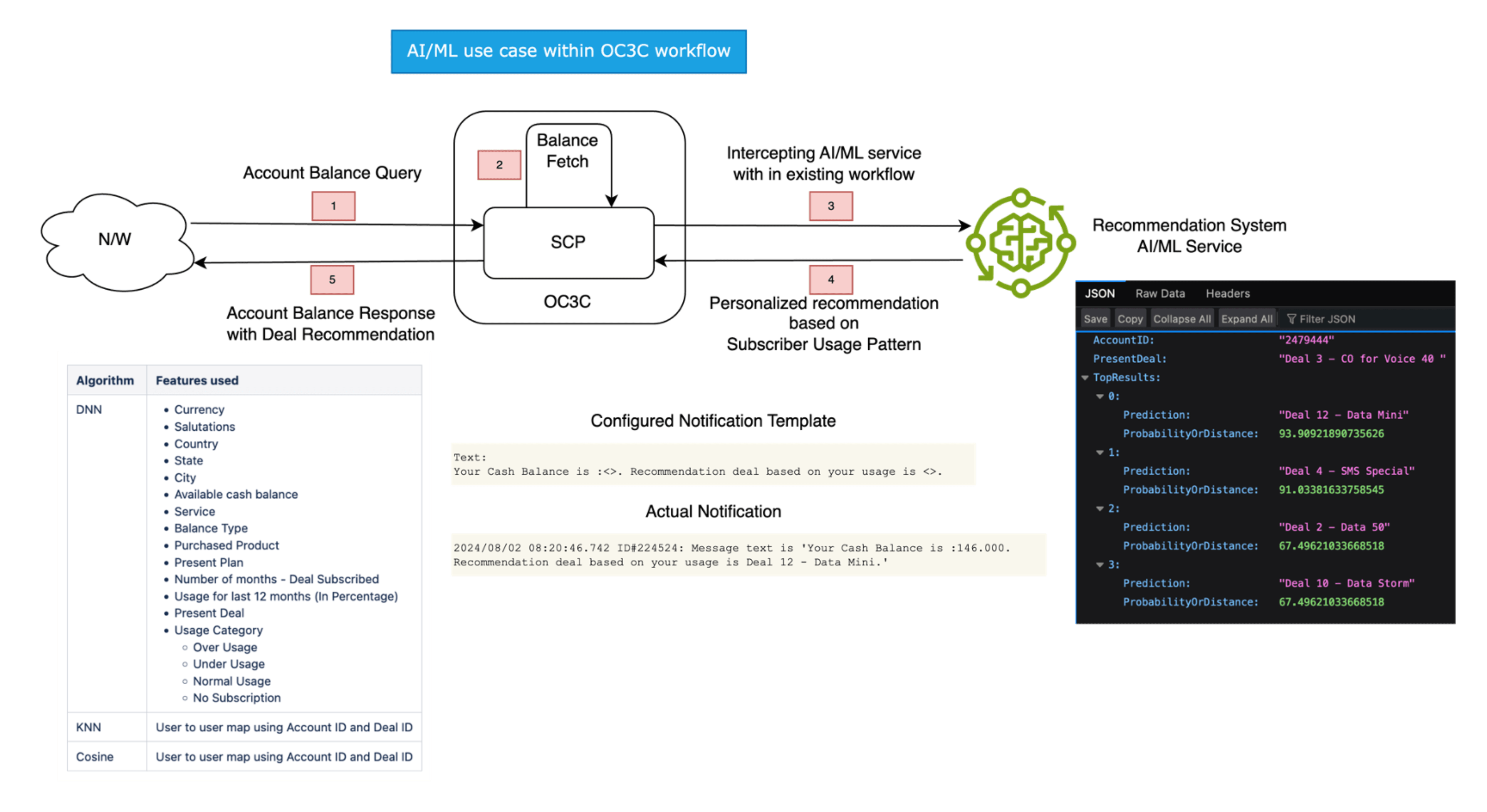
In Figure 3-1, the workflow starts when the system receives a network event or request, such as a customer action or usage update. The Service Control Point (SCP) collects and formats the required customer information and forwards it to the prediction engine.
The prediction engine uses trained models, such as a deep neural network (DNN), k-nearest neighbors (KNN), or cosine similarity, along with configured features like country, usage, and product, to generate personalized offer recommendations. The prediction service returns the top recommended offers, ranked with a probability or score.
Note:
Figure 3-1 is only an example using Convergent Charging Controller as the product. You can configure AI to integrate with other Oracle Monetization products in the Cloud Scale Monetization as needed.