1 About Convergent Charging Controller
This chapter provides an overview of Oracle Communications Convergent Charging Controller.
About Convergent Charging Controller
Convergent Charging Controller is an Intelligent Network (IN) based session control and charging application. You use Convergent Charging Controller to:
-
Manage mobile and fixed telephony services, messaging services, and offerings such as Friends and Family and call forwarding.
-
Control sessions, such as route calls based on least-cost routing.
-
Rate sessions and manage subscriber balances. Convergent Charging Controller maintains a record for every subscriber, including their current balance. This enables you to manage calls based on credit; for example, force session termination when credit is exhausted.
Figure 1-1 shows how Convergent Charging Controller works with the network to control voice calls and perform session charging. Convergent Charging Controller also handles SMS, data, and other telecom services. Convergent Charging Controller can integrate with Oracle Billing and Revenue Management (BRM), and with other third-party billing systems to create bills and request payments from customers.
Figure 1-1 Convergent Charging Controller on the Network
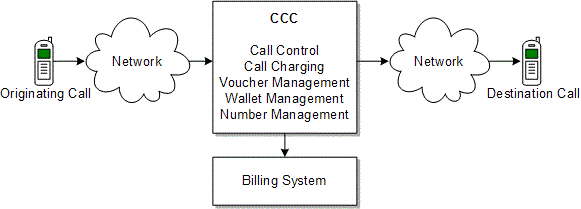
Calls are routed through the Convergent Charging Controller application as follows:
-
A subscriber makes a call, which is routed to Convergent Charging Controller.
-
A Convergent Charging Controller network connectivity agent accepts the call and translates the incoming protocol to an internal signaling protocol.
-
Based on the calling subscriber's telephone number, Convergent Charging Controller identifies the subscriber.
-
Based on the subscriber data, Convergent Charging Controller starts a control plan to manage the call. The control plan is a series of steps and decisions implemented as feature nodes. Each feature node performs a specific function; for example, routing the call based on the prefix, or applying an alternate tariff.
-
Based on the control plan and the data stored with the subscriber's account, Convergent Charging Controller routes the call as necessary, and terminates the call.
-
Convergent Charging Controller uses the Voucher and Wallet Server to update the subscriber's balance.
Figure 1-2 shows a high-level view of the Convergent Charging Controller system architecture.
Figure 1-2 Convergent Charging Controller System Architecture
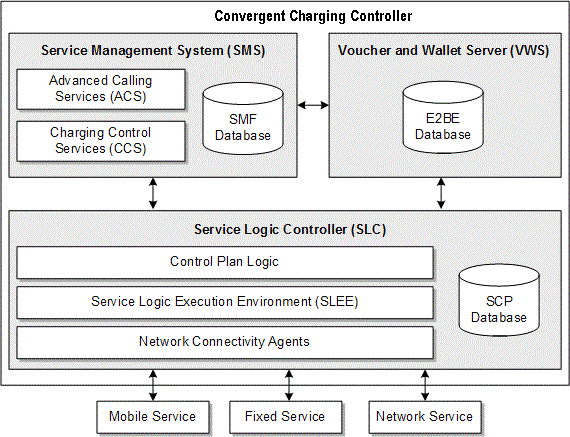
In Figure 1-2:
-
The Service Logic Controller (SLC) performs most of the Convergent Charging Controller functionality:
-
Calls, sessions, and messages connect to Convergent Charging Controller network connectivity agents.
-
The Service Logic Execution Environment (SLEE) provides a common execution environment for Convergent Charging Controller applications; for example, Advanced Control Services (ACS) and Charging Control Services (CCS).
-
The control plan logic manages the calls and sessions. For example, a control plan for a Friends and Family service determines if a call is eligible for a discount, and applies the discount.
-
The SCP database contains a subset of the data stored in the main Convergent Charging Controller database (the SMF database). The data in the SCP database is subscriber data and control plan data.
-
-
You use the Service Management System (SMS) GUI to configure and manage Convergent Charging Controller. It includes:
-
Advanced Control Services (ACS). You use ACS to create control plans that manage calls; for example, control how calls are routed and terminated.
-
Charging Control Services (CCS). You use CCS to manage how calls are rated, interactions with the Voucher and Wallet Server, and interactions with subscriber data.
-
The SMF database. This database is the main Convergent Charging Controller repository for system data, including subscriber data, rating configuration data, and voucher and wallet data.
-
-
The Voucher and Wallet Server manages charging, vouchers, balances, and subscribers.
The E2BE database contains voucher, wallet, and reservation details. It also contains a subset of data from the SMF database, such as subscriber data.
About Implementing Convergent Charging Controller
To implement Convergent Charging Controller, you perform the following tasks:
-
Create service providers (customers). You use Convergent Charging Controller to manage session control and rating for service providers. For example, if you are a mobile network operator (MNO), you can run Convergent Charging Controller to manage call routing and rating for multiple mobile virtual network operators (MVNO). Each service provider has an entry in the SMF database.
-
Configure service provider data. For example, you can configure:
-
Announcement sets. Announcement sets specify the announcements that a customer can use. You can also configure global announcements that all customers can use.
-
Geography sets. Geography sets specify geographic locations based on telephone prefixes. For example, a geography set can organize prefixes by countries or regions. Geography sets can be used for rating calls by charging different rates based on call origin and call destination. Geography sets are also used for implementing least-cost routing.
-
Holiday sets. Holiday sets specify the holidays for each customer. Holiday sets are used when rating calls; for example, to provide a discount on New Year's Day.
-
-
Create tariffs and product types to rate sessions. Tariffs specify how much to charge for a session; for example, 10 cents per minute. Product types include the tariffs to use for rating calls, and the control plans used for controlling calls. You can rate services based on various properties; for example duration of the call and geographic location of the calling number and destination number.
-
Create control plans. Control plans specify how calls are routed, including service calls that subscribers make to check their balances. Control plans are run based on the product type associated with the caller and service. You can define a set of feature nodes that each customer can use for creating control plans.
For example, you can use control plans for the following:
-
Configure features such as call forwarding, Friends and Family, and least-cost routing.
-
Configure call controls, such as call screening and call termination.
-
Configure announcements that are played to subscribers during a call.
-
-
Create subscribers. Subscribers are the people who purchase and use the services that you offer. You can create subscribers in various ways; for example, by using the SMS GUI or the provisioning interface (PI).
-
Configure subscriber self-care. For example, you can allow subscribers to add numbers to their Friends and Family service.
To configure Convergent Charging Controller session control and charging, you typically perform three types of tasks:
-
Edit configuration files.
-
Use the SMS GUI to configure data used by control plans.
-
Use the Control Plan Editor (CPE) to create control plans.
For example, when configuring call termination, you do the following:
-
Edit the acs.conf file to specify how the pending termination number is captured in CDRs.
-
Use ACS to specify the default termination number range, and the termination number rage for each service provider.
-
Use CPE to configure how calls are terminated in control plans.
As another example, to configure a Friends and Family service, you do the following:
-
Use CCS to configure the numbers that qualify for friends and family.
-
Use CPE to configure a Friends and Family service in control plans.
About Convergent Charging Controller Components
You do most of your call configuration by using Advanced Control Services (ACS) and Charging Control Services (CCS).
-
You use ACS to configure call routing, and to configure and manage many Convergent Charging Controller system-related features. For example, you use ACS to assign resources to service providers, manage passwords, and set up geography sets and holiday sets used by service providers.
-
You use CCS for setting up and managing rating, subscriber management, and voucher management.
You open the ACS GUI and the CCS GUI from the Service Management System (SMS) GUI.
Figure 1-3 shows the main SMS window opened to the CCS (Prepaid Charging) application menu.
Figure 1-3 SMS GUI with CCS (Prepaid Charging) Menu
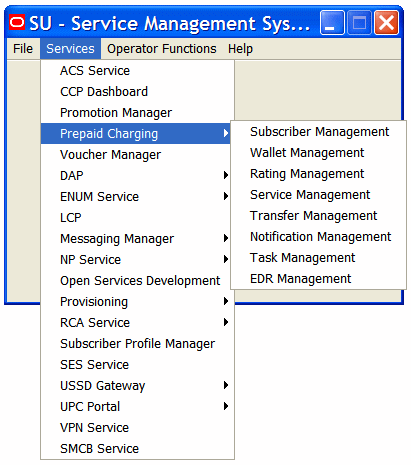
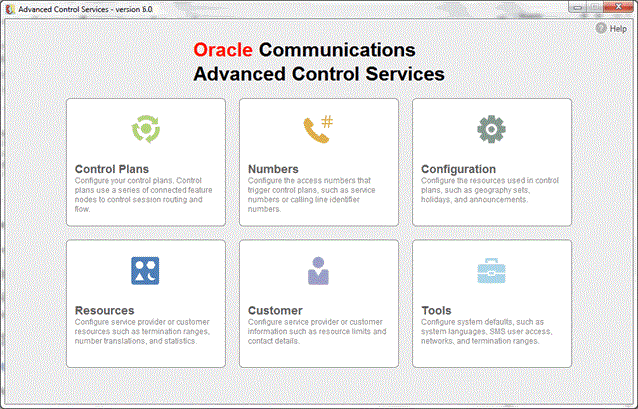
Figure 1-4 shows the ACS window.
In addition to ACS and CCS, Convergent Charging Controller includes the following applications:
-
Messaging Manager provides a messaging system for mobile networks. Messaging Manager components operating at the network layer can route traffic and perform protocol translation between different services.
-
Number Portability Service Pack provides call routing based on number portability. You can configure number portability in control plans.
-
Promotion Manager is a Convergent Charging Controller service used for setting up promotions; for example, setting up counters to track subscriber usage.
-
Subscriber Event Service (SES) is a Convergent Charging Controller service that enables service providers to send text messages to subscribers who roam in and out of the home network. For example, a service provider greets inbound messages with a welcome message.
Network and Messaging Protocol Support
Convergent Charging Controller includes several components that support various messaging and network protocols:
-
CAP3 SMS Gateway translates CAP v3 SMS INAP operations to the CAP v2 equivalent. This application supports charging for SMS messages.
-
CDMA (U-CA-IS41) enables the IS-41 protocol to provide phone services to subscribers on CDMA networks.
-
Data Access Pack (DAP) is an extension module that you can configure in control plans to communicate with external systems by using SOAP, XML, HPSA, and PIXML.
-
Diameter Control Agent (DCA) translates Diameter messages. DCA is the Convergent Charging Controller Diameter south-bound charging interface to network elements, such as SMSC/MMSC and GGSN. Diameter messages are used for authentication, authorization, and accounting (AAA). You use Diameter to control calls based on the caller's balance; for example, to see if there is enough cash balance to make a call.
-
Diameter Charging Driver (DCD) supports prepaid charging by managing authentication, authorization, and accounting (AAA). DCD is the Convergent Charging Controller Diameter north-bound charging interface to third-party billing systems. DCD supports the RFC 3588 and RFC 4006 Diameter protocols.
-
LDAP Control Agent maps billing requests between LDAP and Convergent Charging Controller.
-
Radius Control Agent (RCA) enables integration between a RADIUS server and Convergent Charging Controller.
-
Session Control Agent (SCA) is a SIP-transparent back-to-back user agent (B2BUA), redirect server, proxy server, and registrar. It provides support for SIP/SIMPLE messaging and integrated triggering capabilities. The SCA enables real-time charging, instant messaging, and personal mobility in SIP-based next generation networks and in the IP Multimedia Subsystem (such as 3GPP IMS and 3GPP2 MMD).
-
SIGTRAN Transaction Capabilities Application Part (TCAP) Interface integrates Convergent Charging Controller with a TCAP stack.
-
Short Message Services (SMS) Center enables applications to send messages to an SMS center by using Universal Computer Protocol (UCP).
-
Short Message Service Email Interface (SEI) enables sending and receiving email on a mobile phone by using Short Message Service (SMS).
-
Universal Call Agent for ISUP provides Intelligent Network functionality by using fixed connections between incoming and outgoing calls. This prevents the need to upgrade or replace non-SS7 capable switches.
-
Unstructured Supplementary Service Data (USSD) Gateway enables USSD messages and International Mobile Subscriber Identity (IMSI) management.
-
Virtual Private Network (VPN) service enables VPN networks on an IN system.
Convergent Charging Controller Interface Components
Convergent Charging Controller includes the following components to support network interfaces:
-
EDR Control Agent (ECA) translates event data records (EDRs) into online session trigger messages, which are sent to a Convergent Charging Controller application. Convergent Charging Controller can use the content of the IDR messages in control plans, and respond to the originator. For example, you can find data about calls, such as the SIM that was used, and process the call differently based on the data.
-
ENUM Control Agent uses E.164 Number Mapping (ENUM) to translate numbers from the E.164 standard to a Universal Resource Identifier (URI) or IP address.
-
Location Capabilities Pack (LCP) finds the location of the caller. LCP enables a caller to establish a roaming call on a foreign network.
-
Open Services Development (OSD) enables control plans to read from WSDL files.
-
Short Message Charging Bundle (SMCB) enables billing of SMS messages.