3 About Lead-to-Order
Learn about the Lead-to-Order business process in Oracle Communications Digital Business Experience.
The Lead-to-Order business process orchestrates the entire customer acquisition journey from initial engagement through order confirmation. It is designed to streamline the transition from identifying a sales lead, progressing through qualification, solution configuration, offer negotiation, and ultimately capturing the order in compliance with business policies and customer requirements.
The process begins with lead management, where prospects are captured via diverse channels, such as digital marketing campaigns, inbound inquiries, and partner referrals. Leads are evaluated and prioritized based on qualification criteria, such as serviceability, intent, and potential value. Effective lead qualification ensures that sales resources are invested in high-potential opportunities.
Once qualified, leads transition to opportunity and configuration management. Enterprise Sales Representatives (ESRs) leverage Digital Business Experience’s integrated catalog capabilities to propose tailored solutions, encompassing products, services, and bundles. Dynamic pricing, discounting mechanisms, and policy-driven configurations ensure proposals are competitive and commercially viable while remaining compliant.
After agreement on the proposed offering, the process advances to order capture and submission. Digital Business Experience supports order creation by transforming the agreed proposal into an executable order, capturing all details necessary for downstream fulfillment, provisioning, and billing. Approval workflows, order validation, and integration with Oracle Communications Order and Service Management (OSM) provide strong governance and operational accuracy.
This end-to-end process eliminates manual hand-offs and reduces errors by enabling data continuity across lead, quote, and order stages, providing customers with a seamless sales experience. The Lead-to-Order process in Digital Business Experience is aligned with Telemanagement Forum (TMF) Open Digital Architecture (ODA) business architecture and is realized with the integration of OSM, Oracle Communications Billing and Revenue Management (BRM), Siebel CRM, and associated systems.
The solution supports the following processes facilitated by integrated capabilities:
- Lead Management
- Opportunity Management
- Quote Management
- Order Capture and Submission
- Order Validation and Approval
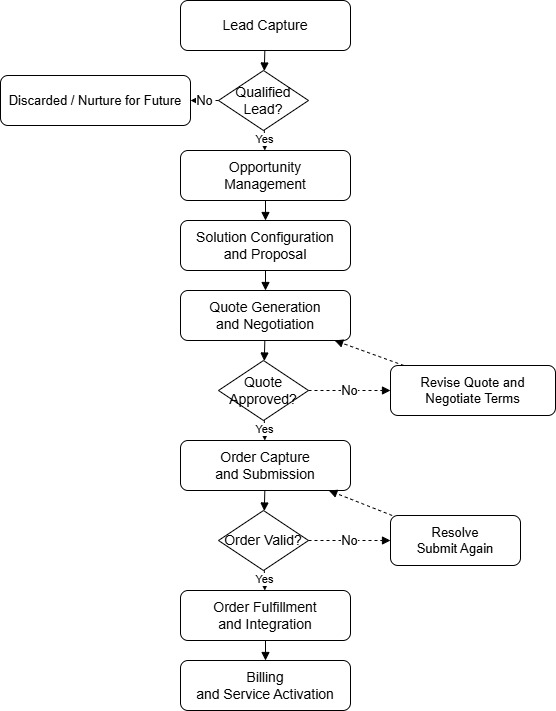
The following diagram depicts the flow of the Lead-to-Order journey.
Figure 3-1 Lead-to-Order Business Process Flow
Implementing Lead-to-Order
The solution supports the Lead-to-Order business process using deployment accelerators based on industry best practices and a comprehensive integration methodology.
Implementing the Lead-to-Order business process with Digital Business Experience adopts a modular methodology using industry-standard best practices and defined integration patterns.
The process starts with configuring lead capture and qualification workflows, integrating marketing inputs, web forms, and Siebel CRM lead sources. Qualification rules and scoring models are implemented to ensure a consistent and structured intake of sales opportunities.
Next, solution configuration capabilities are set up, including product and service catalogs, commercial bundles, pricing, and discounting frameworks. Guided selling tools are enabled to help sales representatives tailor solutions to customer needs while adhering to business constraints.
Approval processes and workflows are configured for proposal reviews, pricing approvals, and exception handling, ensuring compliance and minimizing risk. Once a proposal is accepted, the system is configured to automatically convert proposals into formal orders with complete fidelity.
Order capture forms and validation rules are defined to ensure accurate and complete order data. Integration with downstream systems, including Oracle Communications Order and Service Management and Oracle Communications Billing and Revenue Management, is tested thoroughly to support automated fulfillment, service activation, and invoicing. Reporting and analytics dashboards are configured to monitor the key metrics: order conversion rates, process efficiency, order accuracy, and sales cycle times.
This comprehensive configuration ensures the Lead-to-Order process is streamlined, robust, and ready to scale across large, complex telecommunications sales environments, enhancing both sales efficiency and customer satisfaction.
See Oracle Communications Digital Business Experience Lead to Order Implementation Guide for detailed information about implementing this business process.
Participating Applications in Lead-to-Order
- Siebel CRM
- Oracle Communications Billing and Revenue Management
- Oracle Communications Order and Service Management
- Oracle Analytics Publisher