7.1.1.7 Rollover
Rollover refers to the rescheduling of a certain percentage of cash flows to a future time bucket. This occurs when an asset/liability is renewed for an additional term. The amount of cash flow rolled over is thus reduced/increased from the original time bucket and assigned to the new time bucket in the future.
The assumption specification and computation method for this subcategory remain unchanged. This subcategory allows rollovers to be specified even on repos, reverse repos and swaps. In the case of rollover of swaps, the user is required to select the transaction legs option as two.
If a rollover is specified on an asset or liability that has underlying collateral, then the availability of the underlying should be determined. Only if the underlying collateral is available during the extended period, the assumption should be allowed to be saved
Rollover of assets impacts the inflow amount and rollover of liabilities impacts the cash outflow amount. The signage and computation depends on the product type selected. In a rollover assumption, cash flow movement happens from previous bucket/s to the forward buckets.
See Defining a New Business Assumption for information on the steps involved in specifying this assumption.
The following steps are involved in applying the delay in cash flow timing assumption to cash flows:
- If time-specific or critical obligation, record the delay and indicate a breach.
Rollover of Assets refers to the rescheduling of a certain percentage of cash flows to a future time bucket. This occurs when an asset is renewed for an additional term. The amount of cash flow rolled over is thus reduced from the original time bucket and assigned to the new time bucket. The effect of this assumption would be an altered final cash flow in the affected time buckets. The rollover of assets impacts the inflow amount.
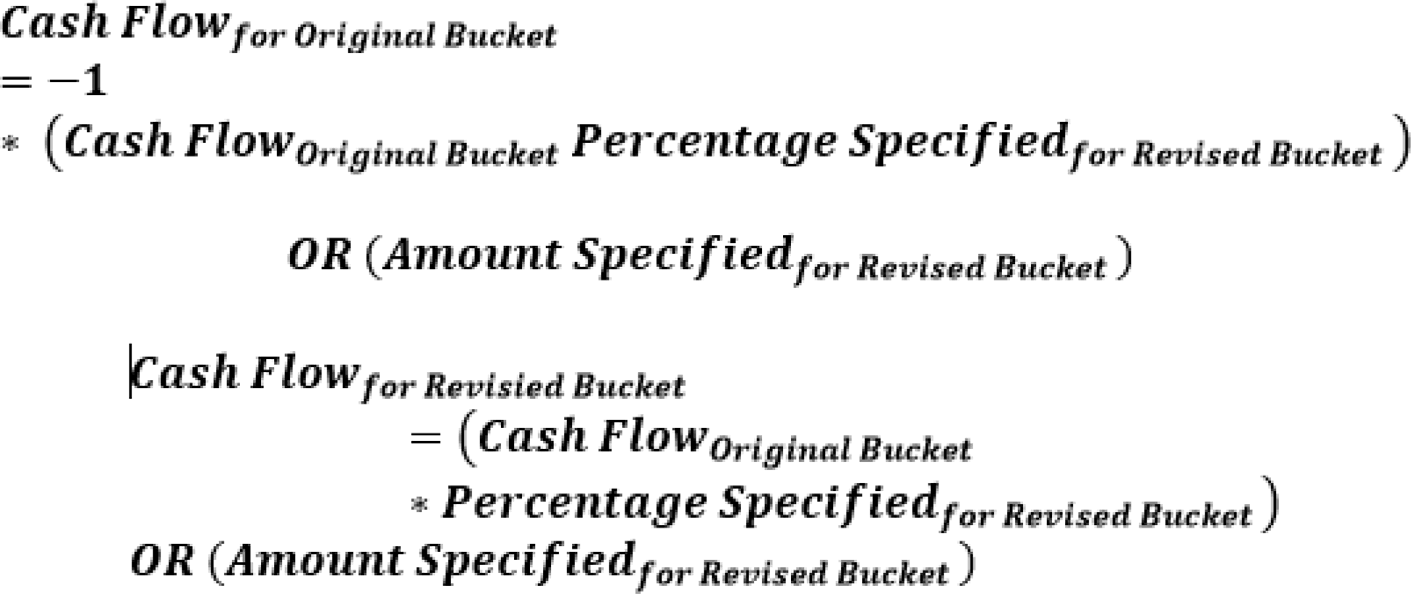
Cash flow assignment is done in the following manner:
Figure 7-5 Formula for cash flow assignment

For instance, Rollover of Assets is explained in the following example of the assumption applied to product type (Loan), legal entity (LE 1), and currency (USD).
Table 7-8 Cash Flow Movement - Rollover
Business Assumption Definition Cash flow Assignment Product Type Legal Entity Currency Original Maturity Bucket Revised Time Bucket Rollover % Contra ctual Cash flow Time Bucket Revised Cash flow amount Loan LE 1 USD 15-30 Days 60-90 Days 10% 10000 15-30 Days 3000 [= 10000 – (10%* 10000) – (60% * 10000)] 5000 60-90 Days 6000 [(= 5000 + (10* 10000)] 180-360 Days 60% 7000 180-360
Days
13000 [= 7000 + (60%* 10000)] Rollover of liabilities refers to the rescheduling of a certain percentage of cash flows to a future time bucket. It occurs when the liabilities are renewed for an additional term. The amount of cash flow rolled over is thus increased in the original maturity time bucket and assigned to the new maturity time bucket. The effect of the business assumption would be an altered final cash flow in the various time buckets. Rollover of liabilities impacts the cash outflow amount.
Cash flow assignment is done in the following manner:
Figure 7-6 Formula for cash flow assignment