7.1.1.8 Run-Off
In a Run-off assumption, the bank assumes that a certain percentage of deposits/liabilities will be withdrawn by their customers before the scheduled maturity of the deposit. This business assumption would result in an additional outflow in an earlier time bucket and a reduction in the contractual cash outflow in the original time bucket. The assumption can also be applied to assets as well, where the impact on cash flows will be opposite to that specified for deposits above.
The cash flow movement happens from forward bucket/s to the previous bucket/s since cash flows which were expected to be withdrawn at a future date are getting withdrawn as on date.
See Defining a New Business Assumption for information on the steps involved in specifying this assumption.
The following steps are involved in applying the delay in cash flow timing assumption to cash flows:
- If time-specific or critical obligation, record the delay and indicate a breach. Cash flow assignment is done in the following manner:
Figure 7-7 Formula for cash flow assignment
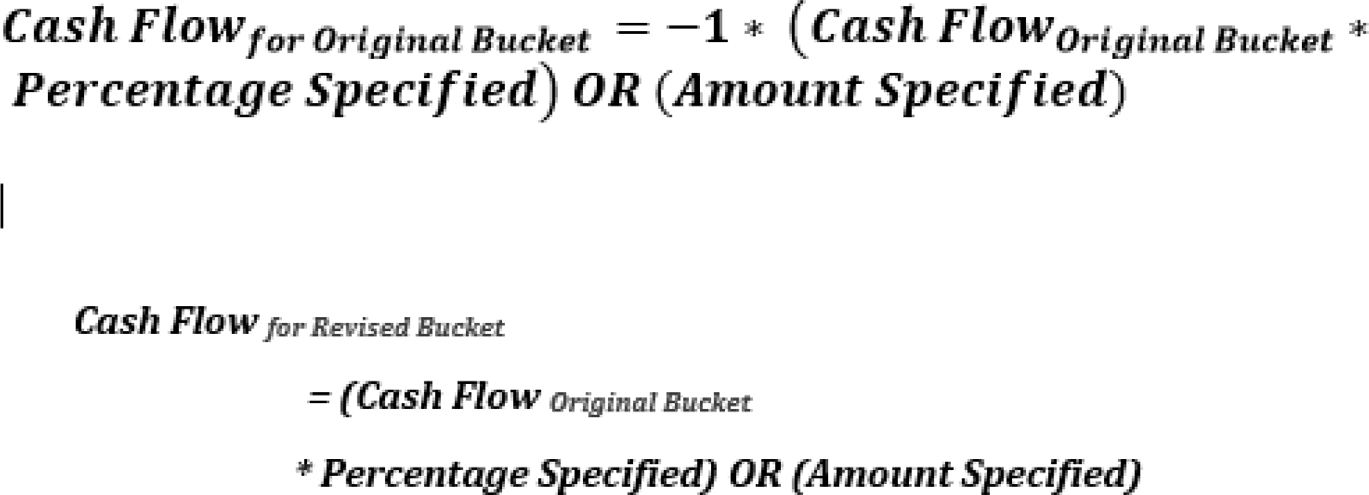
An illustration is as follows:
Table 7-9 Cash Flow Movement - Run-off
Business Assumption Definition Legal Entity Customer From Bucket To Bucket Assumption Unit Run- off Assignment Method Assumption Category Based On Legal Entity 1 Customer 2 6-
6Days
3-
3Days
Percentage 10% Equal Cash Flow Movement: Run - off Cash Flows Table 7-10 Cash Flow Movement - Run-off
Cash flow Assignment To Bucket Contractual Cash Flow(From Bucket) Contractual Cash Flow(To Bucket) Run-off Revised Cash flow(From Bucket) Revised Cash flow (To Bucket) Overnight 20000 10000 500 10500 [=(20000*10%)/4] [=(10000+500)] 1-1 Day 11000 500 11500 [=(20000*10%)/4] 1800018000 [(20000-20000*10%)] [=(11000+500)] [(20000- 2-2 Days 22000 500 20000*10%)] 22500 [=(20000*10%)/4] [=(22000+500)] 3-3 Days 12000 500 12500 [=(20000*10%)/4] [=(12000+500)]