2 Roles
Roles are used to classify users based on job responsibilities and actions to be performed in the solution. Using roles, a user's access can be restricted to specific areas or functions within the system. Users must be associated with at least one job role in order to access the solution and may be associated with several roles if desired.
For example, within Merchandising, a Supply Chain Analyst may only have the ability to maintain item sourcing related information but not the ability to modify any other details on an item's definition. This role would be given view only access to the item workflow, with the exception of item supplier screens where the role will be granted management access, but note that a user in the Data Steward role might have ability to manage the general item definition, including item sourcing information.
Figure 2-1 Roles to Classify
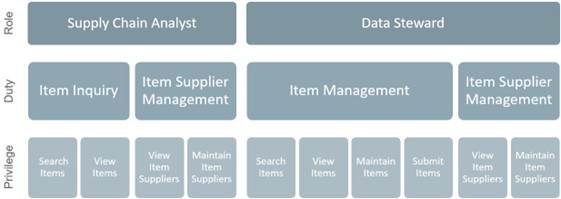
Roles Provided at Initial Setup
A default security configuration is provided with each solution during installation and is intended to be used as a starting point as you define the roles that align for your business and users. The provided roles can be modified by adding or removing duties and/or individual privileges to adjust the access granted to the role, or the roles can be deleted completely.
Additional roles can be created and mapped to the desired duties or privileges. Administrator users can change the mappings of roles, duties and privileges in the Oracle Retail Application Administration Console's User Interface.
Details about how to manage these application security policies are available in Managing User Security in the Oracle Retail Merchandising Administration Guide.
These roles are provided in the default security configuration for Merchandising’s Locations Destination:
-
Foundation Application Administrator (FND_APPLICATION_ADMINISTRATOR_JOB)
-
Foundation Data Steward (FND_DATA_STEWARD_JOB)
-
Supply Chain Analyst
Foundation Application Administrator
The Application Administrator is a part of a retailer's IT department responsible for maintaining and configuring the Pricing application. Primary responsibilities include:
-
Maintaining daily operations, such as daily batch processes of the application.
-
Supporting end-users and providing the first level of support for the application.
-
Applying patches and upgrades to the application on a regular basis.
-
Troubleshooting and resolving product issues.
-
Setting up users and security privileges for the application.
Foundation Data Steward
The Data Steward is responsible for the management of foundational data elements for Merchandising, which includes ensuring the completeness and accuracy of the data, as well as development and enforcement of standard processes.
Buyer
Develops business strategies and seasonal assortment plans to maximize the development of the brand, as well as sales and profits for a department or assigned area. Their primary responsibilities are:
- Performing market and competitive analysis and analyze sales trends to keep abreast of current trends.
- Developing business strategies outlining strengths, weaknesses, new opportunities and threats.
- Analyzing and approving new product or concepts for their department.
- Maintaining relationships, resolving issues and conducting negotiations with significant suppliers and agents.
- Managing sales and margin dollar performance against plan.
- Recommending adjustments to the plan to maximize sales, profits, and to protect the brand.
Inventory Analyst
The Inventory Analyst works with the buyer to ensure product distribution aligns to strategy. The Inventory Analyst is responsible for managing and allocating inventory at the store level. This includes:
- Working with the buyer to develop and manage buy plans.
- Ensuring stores maintain appropriate in stock service levels and weeks on hand.
- Modifying store replenishment settings to achieve sales and inventory plans.
- Communicating regularly with stores concerning inventory levels and assortments.
- Communicating with production team to ensure on time delivery of product developing action plans for delayed product.
- Partnering with distribution center to ensure accurate and on-time delivery to stores of allocated merchandise.
- Supporting promotions with appropriate inventory.
- Developing exit strategies for managing disposition of discontinuing products.
Inventory Manager
Responsible for working with the buying teams to execute the inventory strategy for a retailer. Primary responsibilities include:
- Coordinating with their team of inventory analysts to execute to the inventory strategies for their division.
- Partnering with the buying team in assessing and determining assortment and financial goals.
- Communicating regularly with stores concerning inventory levels and assortments.
- Communicating with production team to ensure on time delivery of product developing action plans for delayed product.
Corporate Inventory Control Analyst
Inventory control analysts at corporate collaborate with their warehouse and store counterparts to ensure accurate levels of inventory through the retailer's supply chain. This includes.
- Scheduling, coordinating, and reviewing cycle counts performed in stores and warehouses.
- Monitoring and resolving inventory discrepancies, problem orders, and transfer issues.
- Making recommendations to minimize supplier invoice discrepancies.
- Analyzing inventory-related procedures to suggest process improvements.
Inventory Control Manager
Inventory control managers develop and implement inventory control procedures for a retailer and direct the work of inventory control analysts at corporate, in stores, and in warehouse to ensure accurate levels of inventory through the retailer's supply chain. This includes:
- Developing procedures for cycle counting in stores and warehouses.
- Assisting in the resolution of inventory discrepancies.
- Analyzing inventory-related procedures and implementing process improvements.
- Auditing operational processes and compliance procedures.
Sourcing Analyst
Manages the sourcing for a retailer, including importing processes, to ensure efficient and ethical procurement of merchandise. This includes:
- Ensuring product is sourced from the best supplier or factory so that a quality product is produced ethically, on-time, and at the right price- Processing product claims with vendors, supporting quality.
- Researching problems, develop resolutions, lead negotiations.
- Reviewing and maintaining import details related to items and purchase orders, such as expenses, assessments, duties, discharge lading ports, and partner information.
- Monitoring for and resolving any issues related to importing of merchandise, including troubleshooting disruptions to the calendar and communication with all partners connected with the calendar.
- Communicating with merchandising, import operations and overseas offices agents to resolve issues with deliveries.
Supply Chain Analyst
The Supply Chain Analyst is responsible for planning, coordinating and controlling all aspects of supply chain management, including demand and capacity planning, product sourcing, and distribution, using the most efficient and cost effective means available. Usually focused on a group of suppliers and or locations within a category, key responsibilities include:
-
Analyzing supplier compliance performance to use in supplier negotiations and to optimize lead times settings to provide more accurate view of inbound inventory.
-
Analyzing cost and performance of shipping inside the retailer's supply chain to optimize the shipping schedules and sourcing locations for the retailer's stores.
-
Conducting root cause analysis on problem areas.
-
Recommending and implementing supply chain improvement programs.
Financial Analyst
Responsible for analyzing financial information of an area within the enterprise to assist in decision making and assist with planning for the brand. This includes:
- Supporting the finance team with scheduled reports and budgets.
- Monitoring performance indicator trends and analyze causes of unexpected variances.
- Assisting with financial report generation, budget and trend preparation, business plans.
- Assisting with cost control and conduct budget meetings with department managers.
- Developing, analyzing, and preparing data for use in negotiations with suppliers.
- Managing and approving the corporate view of vendor trade funds.
Financial Manager
Responsible for the financial accounting of a retailer's business, which includes making sure that all financial operations are running smoothly, bills are paid on time, figures are reported timely and accurately, period end books are closed properly. This includes:
- Ensuring period end reporting is completed in a timely manner.
- Ensuring the timely resolution of auditing issues.
- Ensuring in the timely resolution of vendor payment issues, including the resolving cost and other invoicing discrepancies.
- Identifying risks and opportunity areas to the operations.
- Providing performance reporting highlighting trends and opportunities to assist in improving profits, margins and reducing costs.