Define Allocation Step - Type Page
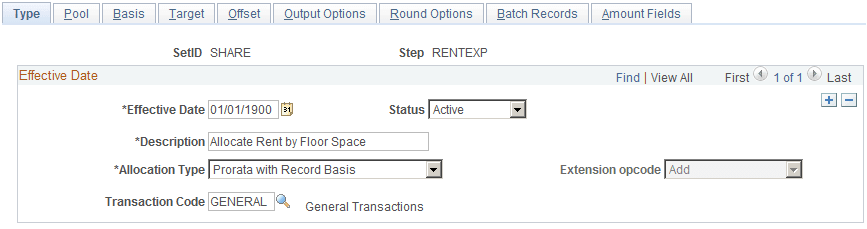
Use the Allocation Step - Type page (ALLOC_CALC_OPTN) to define one of five allocation types, as well as any special arithmetic operations that you want to perform by using the pool and basis.
Select a transaction code for use in interunit and intraunit allocations.
Navigation:
This example illustrates the fields and controls on the Define Allocation Step - Type page. You can find definitions for the fields and controls later on this page.
Note:
The data that is entered using these pages can also be loaded as an Application Data Set using the Data Migration Workbench. For more information about ADS and the Data Migration Workbench for FSCM applications, see Using the Data Migration Workbench for PeopleSoft Allocations
| Field or Control | Description |
|---|---|
|
Allocation Type |
Select a calculation option to determine the pool amounts that are going to the targets from one of the following allocation types:
|
|
Extension opcode (extension operation code) |
When you select Arithmetic Operation, the extension operation code field becomes active and you can select Add, Subtract, Multiply, or Divide. |
|
Transaction Code |
Select the appropriate code when you use interunit and intraunit allocation. |
These tables illustrate the results of a simple rent allocation using the same pool of 400 GBP but different allocation types.
The following example illustrates the allocation type of spread evenly:
| Basis and Target For a Pool of 400 GBP | Account | Department | Amount |
|---|---|---|---|
|
Basis |
|
11001 |
One of 4 departments |
|
|
|
12000 |
One of 4 departments |
|
|
|
13000 |
One of 4 departments |
|
|
|
22001 |
One of 4 departments |
|
Target |
RENT |
11001 |
100 GBP |
|
|
RENT |
12000 |
100 GBP |
|
|
RENT |
13000 |
100 GBP |
|
|
RENT |
22001 |
100 GBP |
The following example illustrates the allocation type of fixed basis:
| Basis and Target For a Pool of 400 GBP | Account | Department | Amount |
|---|---|---|---|
|
Basis |
|
11001 |
10 percent |
|
|
|
12000 |
20 percent |
|
|
|
13000 |
20 percent |
|
|
|
22001 |
50 percent |
|
Target |
RENT |
11001 |
40 GBP |
|
|
RENT |
12000 |
80 GBP |
|
|
RENT |
13000 |
80 GBP |
|
|
RENT |
22001 |
200 GBP |
The following example illustrates the allocation type of prorata:
| Basis and Target For a Pool of 400 GBP | Account | Department | Amount |
|---|---|---|---|
|
Basis |
FLOORSPACE |
11001 |
10 SQF |
|
|
FLOORSPACE |
12000 |
20 SQF |
|
|
FLOORSPACE |
13000 |
20 SQF |
|
|
FLOORSPACE |
22001 |
50 SQF |
|
Target |
RENT |
11001 |
40 GBP |
|
|
RENT |
12000 |
80 GBP |
|
|
RENT |
13000 |
80 GBP |
|
|
RENT |
22001 |
200 GBP |
The following example illustrates the allocation type of arithmetic operations of multiplication:
| Basis and Target For a Pool of 400 GBP | Account | Department | Amount |
|---|---|---|---|
|
Basis |
FLOORSPACE |
11001 |
10 SQF |
|
|
FLOORSPACE |
12000 |
20 SQF |
|
|
FLOORSPACE |
13000 |
20 SQF |
|
|
FLOORSPACE |
22001 |
50 SQF |
|
Target |
RENT |
11001 |
4000 GBP |
|
|
RENT |
12000 |
8000 GBP |
|
|
RENT |
13000 |
8000 GBP |
|
|
RENT |
22001 |
20000 GBP |