Employment Record Numbers
Employment record numbers (ERNs), in combination with a person's ID, uniquely identify a person's job data records. The system distinguishes between a person's organizational instances by using a new ERN when you create a new instance.
The system also creates a new ERN when you create a job data record in the following circumstances:
| Action | Comments |
|---|---|
|
Create concurrent jobs, including:
|
Note: Additional organizational instances are identified as hires on human resources reports and additional assignments are not. Use this distinction to guide how you enter additional jobs in the system. If you do not need to distinguish between concurrent jobs, choose one method of entering concurrent jobs and use it consistently. See (Classic) Adding Organizational Instances. |
|
Create a global assignment (employees only). |
Use the Home/Host Information component (HOME_HOST_DATA) to create a global assignment job record. The system gives the global assignment (host) job record a new employment record number to distinguish it from the employee's original (home) job record. See PeopleSoft Human Resources Track Global Assignments: Understanding Global Assignment Tracking. |
|
Create a temporary assignment, including Japanese intercompany transfer (shukkou). |
When you assign a worker to a temporary assignment on the Job Data component, the system suspends the substantive job and identifies the temporary job record with a new employment record number. |
Example: A Person with Multiple ERNs
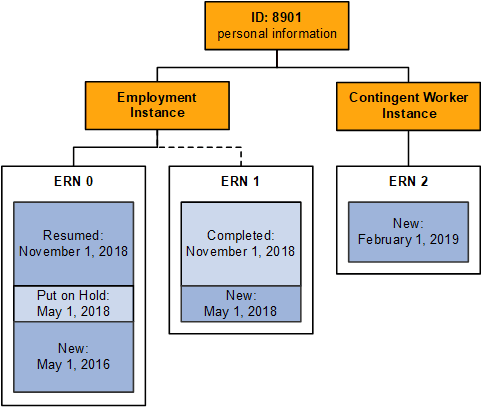
Jan Smith is hired to work in the sales division of Sutter Enterprises. After two years of outstanding performance, she starts a six-month temporary assignment in a subsidiary company to assist with the launch of a new application. At the end of the assignment she returns to her original job, but three months later she takes on a consulting role at the subsidiary in addition to her sales job. This table lists the changes to Jan's job records over the three-year period:
| Action Date | Employment Instance | Contingent Worker Instance |
|---|---|---|
|
May 1, 2016 |
Employment instance created. Job record identified by:
|
|
|
May 1, 2018 |
Substantive job suspended. |
|
|
May 1, 2018 |
New job record for temporary assignment created. Job record identified by:
|
|
|
November 1, 2018 |
Temporary assignment completed. |
|
|
November 1, 2018 |
Substantive job resumed. |
|
|
February 1, 2019 |
No change to employment job record. |
Contingent worker instance created. Job record identified by:
|
This diagram illustrates Jan Smith's job records under the organizational relationships. Under the person record, there are separate employee and contingent worker organizational instances. There are two ERNs under the employment instance and one ERN under the contingent worker instance. Each ERN has its own event history: