Choose Between Predictable and Adaptive Automation

Most organizations benefit from having a combination of automation solutions. However, if predictable automation can effectively automate your business processes, you generally don't need to incorporate adaptive automation.

To learn about each option, see:
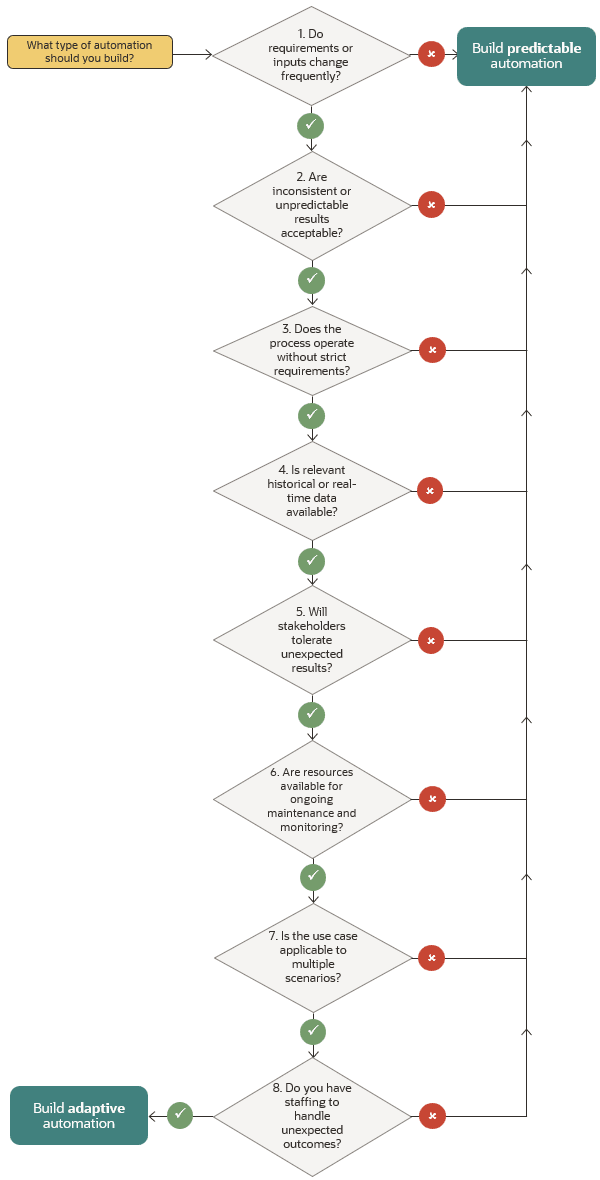
If you answer Yes to any question, go to the next question. If you answer No to any question, build predictable automation. 1. Do requirements or inputs change frequently? 2. Are inconsistent or unpredictable results acceptable? 3. Does the process operate without strict requirements? 4. Is relevant historical or real-time data available? 5. Will stakeholders tolerate unexpected results? 6. Are resources available for ongoing maintenance and monitoring? 7. Is the use case applicable to multiple scenarios? Last question: 8. Do you have staffing to handle unexpected outcomes? If you've answered Yes to all questions, build adaptive automation.


Question How to interpret your answer

1. Do requirements or inputs change frequently?

  • If Yes, adaptive automation can adjust to changing and unpredictable circumstances.

  • If No, predictable automation can probably automate your business process effectively.

2. Are inconsistent and unpredictable results acceptable?

  • If Yes, adaptive automation introduces flexibility, which could improve outcomes.

  • If No, predictable automation delivers the same outcome, every time.

3. Does the process operate without strict requirements?

For example, regulatory, compliance, or audit requirements.

  • If Yes, adaptive automation allows for more flexibility and an approach that evolves over time.

  • If No, predictable automation includes clear and auditable logic.

4. Is relevant historical or real-time data available?

  • If Yes, adaptive automation requires relevant and up-to-date data to learn how to work.

  • If No, predictable automation typically doesn't rely on historical and current data for its success.

5. Will stakeholders tolerate unexpected results?

Consider customers and employees.

  • If Yes, adaptive automation often improves over time but can behave in unexpected ways.

  • If No, predictable automation offers consistency and fewer surprises.

6. Are resources available for ongoing maintenance and monitoring?

  • If Yes, adaptive automation requires occasional retraining and monitoring, much like an employee.

  • If No, predictable automation requires less monitoring.

7. Is the use case applicable to multiple scenarios?

  • If Yes, even with some variations, adaptive automation handles change better and can adapt to varying requirements.

  • If No, predictable automation ensures stability and exact outcomes.

8. Do you have staffing to handle unexpected outcomes?

Consider the volume of work, the frequency with which humans are kept in the loop, and the impact of analyzing unexpected outcomes.

  • If Yes, adaptive automation offers many benefits that can outweigh the downsides of unexpected outcomes and human involvement.

  • If No, predictable automation usually doesn't require a human in the loop and tends to deliver more consistency.


Pros and Cons

Evaluate the tradeoffs of predictable and adaptive automation.

Type of automation Pros Cons

Predictable

  • Autonomous: Operates independently, without needing to keep a human in the loop

  • Reliable: Is a dependable worker that completes the same tasks in the same order every time

  • Brittle: Fails when it encounters something that it doesn't know how to handle

  • Prescriptive: Does only the work that it is told to do, so teams must create comprehensive requirements for integration developers

  • Restrictive: Offers fewer opportunities for innovation and efficiency

  • Time intensive during development: Requires a time investment to validate that its functionality is correct during development

Adaptive

  • Agile: Can get up and running faster than predictable automation

  • Insightful: Can consider factors that people might not think about

  • Intelligent: Possesses human-like reasoning; can analyze requirements and choose the right path forward based on knowledge and logic

  • Resilient: Is able to continue working after encountering the unexpected, such as errors

  • Transformative: Offers opportunities for innovation and improved efficiency

  • Unfailing: Always completes a task

  • Versatile: Is a more flexible and adaptive solution than predictable automation

  • Disruptive: Introduces a paradigm shift that isn't always welcome, particularly among teams who value the trust they have developed with the current processes

  • Rigid: Tends to work in a linear fashion, and sometimes behaves inconsistently when it works on complex workflows and tries to plan for unexpected problems

  • Unaware: Often cannot identify its own mistakes

  • Unpredictable: Behaves in ways that neither humans nor AI can anticipate, thereby introducing risk; can provide inaccurate information or complete a task incorrectly

  • Time intensive during runtime: Requires a time investment to validate that its behavior is correct during runtime