Defining an Allocation Source
Begin by defining the members from which the rule will retrieve the data to allocate.
For each dimension in the Source column, select the member or members that hold the data to allocate. You must select a member for every dimension. If a dimension does not apply to the data in your rule, select the No<dimname> member. See Dimension and Member Requirements When Creating Rules.
To select members for the source:
-
On the Waterfall Setup tab, select an allocation rule, and then click Edit.
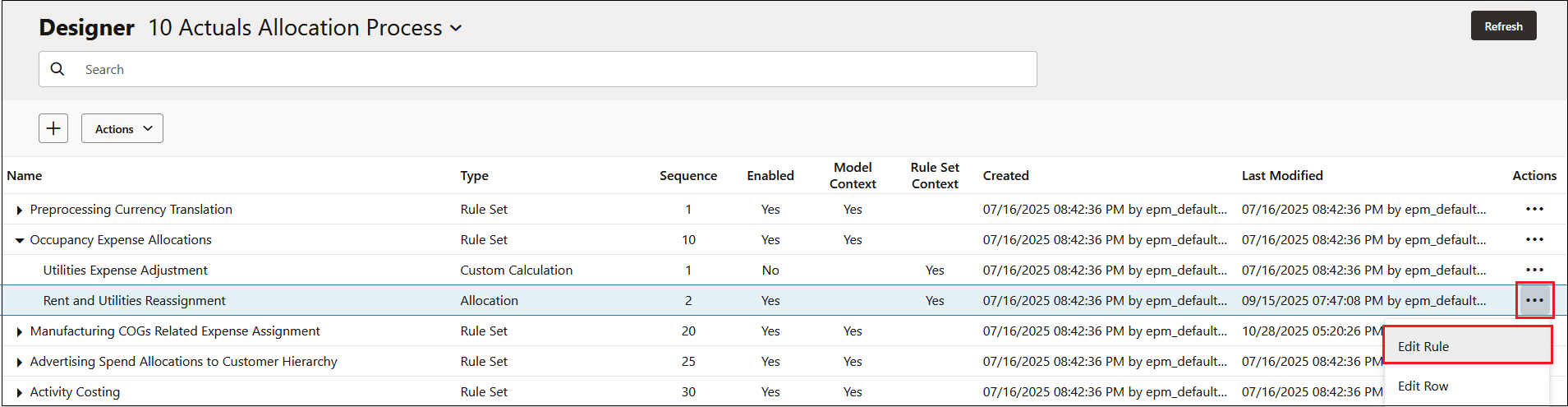
The rule is opened with Source/Destination information displayed.
-
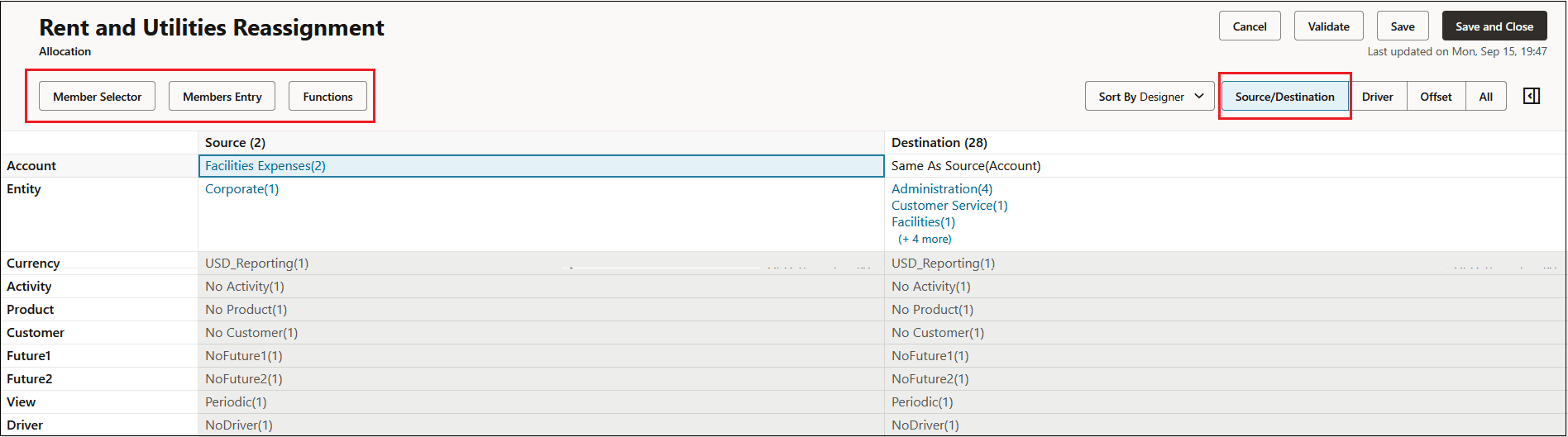
Click in the Source column next to a dimension to enable the Edit button, and then click Edit.
-
In the Edit Source Component panel in the Members tab, define the source members for the dimension by doing one of the following:
-
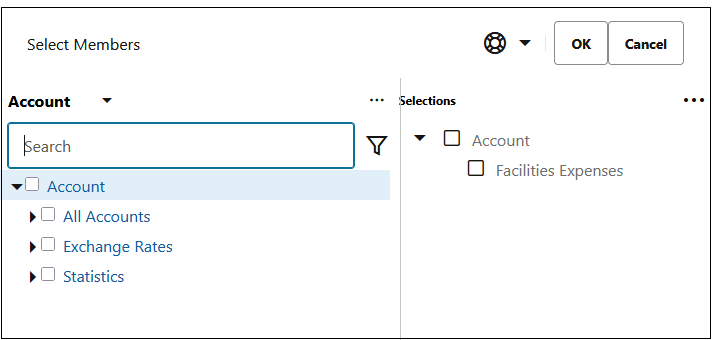
Click Member Selector to open the Select Members dialog box, where you can browse the dimension hierarchy and select the members to add to the source dimension. See Using the Member Selector.
In this example, the Facilities Expenses member has been added to the Account dimension.
Tip:
Selecting an upper-level member selects all the descendants of that member. For example, if you choose "All Accounts", then your selection is really all the Level 0 descendants of "All Accounts". The rule will execute an allocation for each level-0 member. Selecting an upper-level member eliminates the need to pick each specific member individually.
-
Enter member names, one per line, in the Dimension Members area.
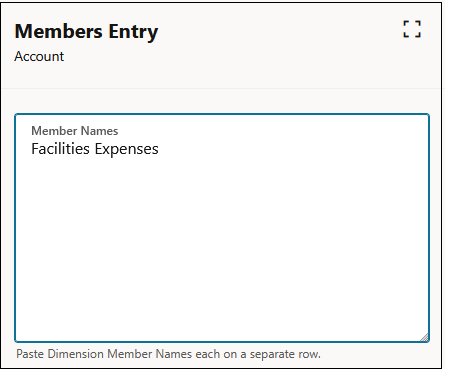
Tip:
If you have a list of members in an Excel spreadsheet, you can copy these members from Excel, and then paste them into the Dimension Members area. The members will be added to the dimensions in the source to which they were assigned when the dimensions were created. See Adding Members to a Dimension.
-
-
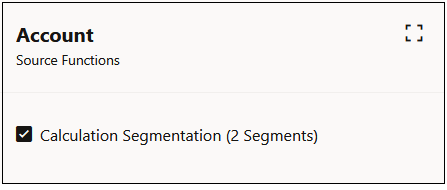
Optional: To segment rules into smaller rules to execute separately, select Calculation Segmentation next to the dimension.
Calculation segmentation enables the calculation to process rules with a very large data range, which would otherwise be too large for Oracle Essbase to process. Calculation segmentation is enabled for up to two dimensions in each rule.
Tip:
Use Calculation Segmentation only when your source range is extremely large and sparsely populated. As a best practice, you should call support before proceeding with this option.
-
Optional: Click the Manage Filters tab to apply filters to limit the members included in the source. See Managing Filters for Source and Destination Members.
-
Click Submit to save the information you have added for the source.
Tip:
-
To view details about the rule configuration, click
 to open the Rule Configuration panel.
-
The numbers in parenthesis to the right of each member indicates the number if level 0 descendants. This helps you identify the size of the range you are defining.
-
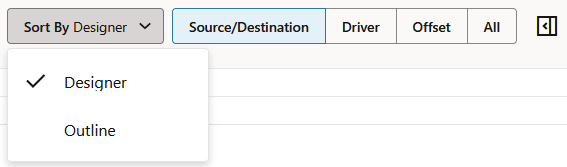
The default sort order for the dimensions is set to Designer. If you need to compare the data on this page to Smart View or another data output, change the sort order from Designer to Outline so that the sort order is the same as the sort order in Smart View or your other data output.