FSM Case and Task Recurrence
Field Service Management (FSM) recurrence creates and maintains a series of cases or CRM tasks that repeat according to a defined calendar pattern. It supports creating future occurrences and keeping an individual occurrence different from the series. You can also apply changes from an occurrence forward and remove occurrences.
This capability operates on case and CRM task records in NetSuite. Record creation and series maintenance occur in the background.
Use the sections in this topic to review the full capability:
How It Works
A series consists of a primary case or task and its later occurrences. A hidden Field Service Recurrence record stores the pattern and processing information. Each case or task links to that definition and has an Instance Index identifying its position. The primary is index 1.
The following diagram shows how a recurrence pattern creates and extends a series:
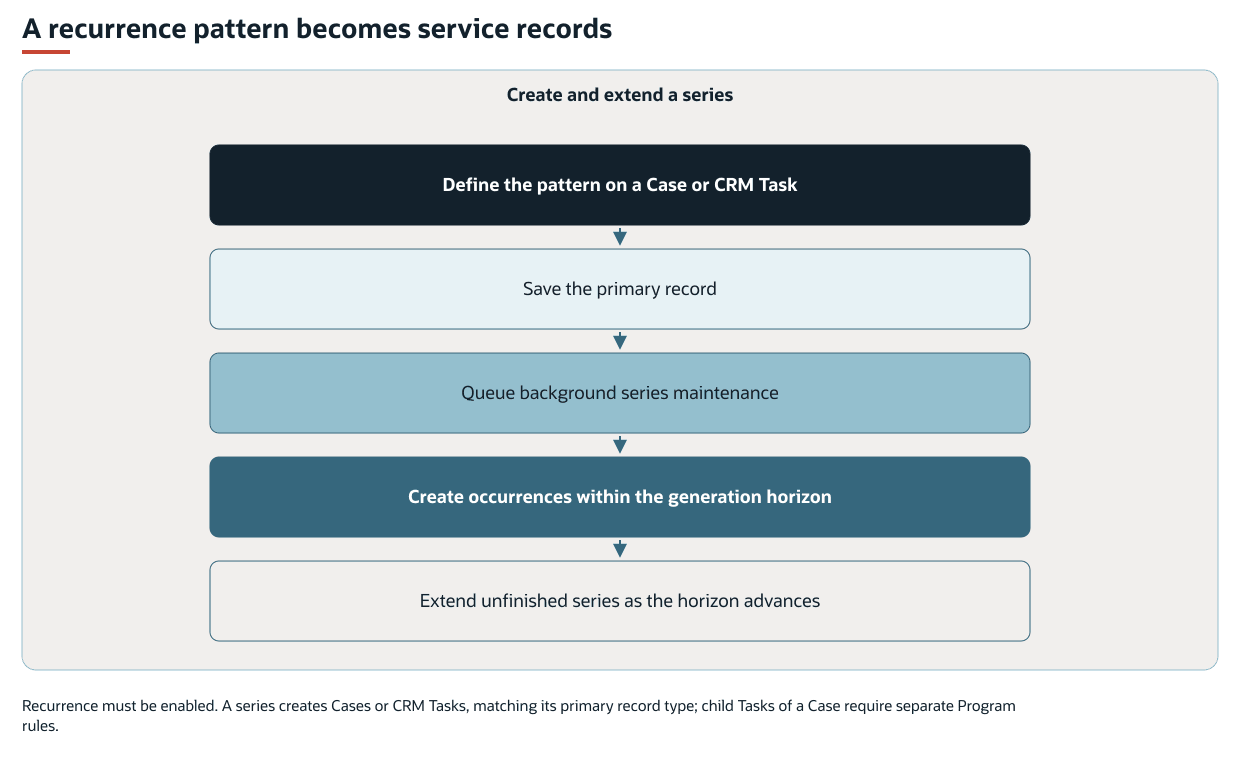
Existing definitions can continue processing after those controls are hidden, as explained under Configuration.
Recurrence is disabled by default. When enabled for the account, the Recurrence section is available on both case and task forms. Selecting a recurrence Type and saving the record requests creation of the series. An empty Type on a record without recurrence leaves that record nonrecurring. Initial recurrence controls start with interval 1 and no end condition.
FSM creates later records using the series' stored field values and calculated dates. The standard copied fields include customer/company, priority, assignment, relevant FSM type, Asset, and time-zone information. The case and task field lists differ, and administrators can add copied fields. Recurrence does not copy every field or every related record from the primary.
The following table describes the recurrence patterns.
|
Pattern |
Behavior |
|---|---|
|
Daily |
Repeats at the selected interval in calendar days. |
|
Weekly |
Repeats at the selected interval in weeks on the selected weekdays. |
|
Monthly |
Repeats at the selected interval in months. Uses a day of the month or selected weekdays in the first, second, third, fourth, or last part of the month. |
|
Yearly |
Repeats at the selected interval in years, using the month determined by the Field Service Start Date and the selected monthly pattern. |
A series can have no end, end after a specified number of occurrences, or end by a specified date. The occurrence count includes the primary case or task. With the default generation horizon, FSM creates occurrences up to 90 days ahead, subject to the series' end conditions. FSM extends an open-ended series when the generation window advances. It does not create the series indefinitely in one operation. The calculation starts at the series' start date, so missing past occurrences can also be created. Missing past occurrences whose indexes are recorded as deleted are not recreated.
Generated tasks begin as Not Started. Generated cases use status internal ID 1, the standard Not Started status. Recurrence maintenance uses that same case status ID. Account status labels can differ.
Prerequisites
Recurrence needs valid data for the records it creates. Assignment and other copied references must remain acceptable to NetSuite when each occurrence is saved. Enabling recurrence does not validate all future records in advance.
When each recurring case needs child tasks, separately configure the applicable Program rules and their task defaults. Successful case generation alone does not establish that the required tasks can be created.
Key Behaviors
This section describes how the feature responds to different conditions and actions.
Individual edits can remain exempt from later series updates. Forward changes update eligible occurrences and can create a separate forward series. See FSM Recurrence Changes and Forward Propagation.
Deletion does not use the same Not Started restriction as field and date propagation. Started or completed work can be affected, and deletion failures can leave partial changes. See FSM Recurrence Deletion and Retirement Behavior.
Record Interactions
The following table explains the records used by recurrence.
|
Record |
Role in Recurrence |
|---|---|
|
Case or CRM task |
Holds an occurrence's service details, recurrence link ( |
|
Field Service Recurrence ( |
Stores the calendar pattern, generation state, copied values, and deleted indexes. |
|
Tasks related to a generated case |
Can be created through the separately configured Case Program rules. |
Generated records are of the same record type as the series' primary. You work through case and task recurrence controls. The supporting Field Service Recurrence record is hidden from normal NetSuite UI access. Recurrence does not clone the original case's child tasks.
Recurrence and FSM Program are distinct capabilities. A recurring case can trigger Program rules that create the service tasks required for each case occurrence. See Recurring Cases with Program for that combined scenario.
Recurrence and Program have separate requests, processing, and errors. A case can exist with missing or partially created tasks. See FSM Recurring Cases with Program Tasks for matching behavior, examples, and task boundaries.
Processing Model and Lifecycle
Saving recurrence parameters or requesting propagation queues background work. Case and Task User Events capture the request, and Field Service Scheduled : Recurrence (customdeploy_nx_recurrence) processes it. Shared scheduled processing also requests recurrence maintenance so unfinished series can be extended.
Processing first handles pending definition changes, then reassociates records when a forward series is formed, then creates or reconciles occurrences. Deletion of a recurrence definition follows removal of its linked instances. These changes can require more than one background execution.
An FSM version change also requests recurrence processing during account upgrade. If the recurrence deployment can run and eligible definitions remain, processing can resume. A long pause can leave missing historical occurrences eligible as well as future work. The generation horizon supplies an upper date boundary, not a rule to ignore the past.
The Recurrence Instances list on a case or task shows the records linked to its series. The Updating recurring instances banner indicates assessed pending work, even if its message describes processing as running. It does not establish that the scheduled deployment is currently executing. Absence of the banner does not establish completion, because errors can exclude outstanding work from assessment.
The following table explains how definition and occurrence fields distinguish requests from results.
|
Indicator |
What It Establishes |
|---|---|
|
Create/Update Instances ( |
The definition has requested maintenance. |
|
Propagate Changes ( |
The occurrence has pending forward-series association work. |
|
Last Create Date ( |
Records maintenance bookkeeping. It does not prove that an occurrence was created on that run. |
|
Completed ( |
A finite series has all its expected occurrences, allowing for recorded deletions. |
Unfinished definitions also qualify for periodic maintenance when Last Create Date is empty or from an earlier day. Completed does not mean that the cases or tasks have been completed. Open-ended series remain unfinished for generation purposes.
The requested record changes and resulting series are the evidence of the business outcome. Script execution status and logs establish whether the deployment ran. A completed execution does not establish that every requested change succeeded. Shared execution and deployment information belongs in FSM Script Reference.
Errors and Blocked Work
An active, unrecovered error for the recurrence deployment can exclude its linked recurrence definition from further assessment. FSM can also skip a failed action and continue other eligible work. Consequently, a series can be partly created, updated, or deleted even when remaining work is blocked.
An error can identify the recurrence definition or a case or task involved in an action. Its linked records and action determine which work is blocked. A remaining request flag or a cleared flag alone is insufficient to establish a complete series result.
Stored references can become invalid between creation of a pattern and a later background run. Recurrence provides no automatic substitute assignee or general repair of inactive data. Correcting a source record may also leave existing exempt occurrences, saved template values, or separate Program task rules needing attention.
An unrecovered recurrence error can exclude the definition from template correction and forward-series processing as well as generation. Saving a corrected assignee and choosing Yes may leave a pending change that cannot be assessed until the blocking error is addressed.
Recurrence and Program failures need separate assessment. For example, an invalid assignee on a generated case can block recurrence creation. An invalid assignee supplied by a Program rule can leave an existing case without its expected tasks. Program error exclusions can affect other cases associated with the same customer or project, so the effect can extend beyond one occurrence.
An occurrence's recurrence link is cleared before background deletion is attempted. If deletion then fails, the record can remain outside the series list. Absence from that list is therefore insufficient proof of deletion. Affected record IDs and related work must also be checked.
Clearing processing fields is not a documented substitute for correcting an error. Error data and state meanings belong in Field Service Error Record. Shared execution and retry behavior belong in FSM Script Reference.
Configuration
For the supported settings, defaults, and examples, see Configuring FSM Case and Task Recurrence.
Administrators can enable recurrence, add fields to the case and task copied-field lists, supply field-comparison mappings, and change the future generation horizon. For the published setting reference, see Recurrence Config.
The account-level enablement controls both case and task recurrence interfaces. The copied-field lists do not provide separate switches for showing recurrence only on cases or only on tasks.
Disabling the recurrence interface does not delete existing definitions or occurrences and does not establish that their background generation has stopped. Ending or deleting a series has different data consequences from hiding its controls.
Limitations and Constraints
The hidden definition and the separate processing stages introduce operational limits as well as the supported record and calendar boundaries.
The hidden recurrence definition has no standard management page or supported bulk retirement action. Hiding controls or interrupting a deployment does not establish permanent retirement. See FSM Recurrence Deletion and Retirement Behavior.
Record and Calendar Boundaries
The following boundaries affect use of the feature:
-
Recurrence supports cases and CRM tasks. This topic does not establish recurring projects, project tasks, or NetSuite work order transactions.
-
Daily intervals use calendar days. Recurrence does not automatically skip weekends or public holidays. Weekly patterns can select particular weekdays.
-
Use positive whole-number intervals and occurrence counts. Input presence checks do not establish comprehensive range validation.
-
Monthly days 29-31 and yearly February 29 do not have an explicit skip or last-day fallback rule. Do not assume that a date unavailable in a month or year is handled according to a particular business convention.
-
Recurrence calculates dates and copies assignment information. It does not check resource availability or resolve scheduling conflicts.
-
Generated cases and tasks use the preferred custom form. Recurrence does not provide a separate generated-record form setting.
-
Standard NetSuite Copy of a recurring task is not recommended because it can produce unexpected recurrence behavior.
-
Copy with Parent is not an implemented recurrence action.
-
Changing a task's date, time, or assignee by dragging it on the Schedule Board changes that task only. It does not change the recurrence pattern or future occurrences.