Compound tax rules for state and city taxes and VAT coexistence in Brazil
Update Oracle Tax Configuration to support compound tax rule calculations for Brazil during the transition period, when the new VAT coexists with existing state ICMS and city ISS taxes. Calculate taxes when state and city tax bases are compounded, meaning their taxable bases include other taxes, as required by Brazil's VAT reform. This feature eliminates the need to reconfigure transaction tax setups by enabling precedence and compounding to be defined directly in the tax configuration.
Tax administrators in Brazil can update the compounding precedence for transaction-enabled ICMS and ISS taxes that are already used in tax formulas during the VAT transition. Date-effective tax reporting-code associations retain the previous precedence for the applicable period and apply the updated precedence afterward, supporting the coexistence of current taxes and new VAT taxes.
Use the Compound Tax Rules for Current State and City Taxes and New VAT Coexistence in Brazil feature together with the Derived Factor Formula for Complex Inclusive Taxes to:
- Associate an alternate compounding precedence with an affected tax for a defined effective period.
- Update a tax’s Compounding Precedence when the feature is enabled, and the alternate-precedence setup applies. The application retains the previous precedence until its effective end date, and applies the updated precedence afterward.
- Calculate taxes using the applicable previous or updated precedence based on the transaction effective date.
- Create tax formulas using the updated precedence after the alternate precedence setup takes effect.
For more information about the Derived Factor Formula for Complex Inclusive Taxes, please refer to the Oracle Fusion Cloud Financials 25D What's New.
Example:
Tax Setup for 2026
The ICMS tax doesn't include the CBS and IBS taxes in its taxable basis.
The customer opted to set up the CBS and IBS as inclusive taxes.
| Compounding Precedence | Tax | Reporting Only | Inclusive | Taxable Basis | Comment |
|---|---|---|---|---|---|
| 100 | ICMS | N | S | Standard | |
| 200 | ICMS_RPT | Y | N | Compound, Prior Tax, ICMS | Negative 100% rate. Used to subtract the ICMS from the taxable basis for PIS/COFINS. |
| 300 | PIS | N | S | Compound, Line Amt, ICMS_RPT | Taxable basis is Line Amount – ICMS |
| 400 | COFINS | N | S | Compound, Line Amt, ICMS_RPT | Taxable basis is Line Amount – ICMS |
| 500 | PIS_COFINS_ICMS_RPT | Y | N | Compound, Prior Tax, PIS + COFINS + ICMS | Negative 100% rate. Used to subtract the ICMS, PIS, and COFINS from the taxable basis for CBS/IBS. |
| 600 | CBS | N | N | Compound, Line Amt, PIS_COFINS_ICMS_RPT | Taxable basis is Line Amount +(–PIS-COFINS-ICMS) |
| 700 | IBSUF | N | N | Compound, Line Amt, PIS_COFINS_ICMS_RPT | Taxable basis is Line Amount +(–PIS-COFINS-ICMS) |
| 800 | IBSMUN | N | N | Compound, Line Amt, PIS_COFINS_ICMS_RPT | Taxable basis is Line Amount +(–PIS-COFINS-ICMS) |
| 3000 | IPI | N | N | Standard |
Tax Setup for 2027
The customer decided that the ICMS includes the CBS and IBS taxes in its taxable basis. It requires a higher compounding precedence for the ICMS tax.
The CBS and IBS must be set as exclusive.
The PIS and COFINS taxes are planned to be obsolete.
| Compounding Precedence | Tax | Reporting Only | Inclusive | Taxable Basis | Comment |
|---|---|---|---|---|---|
| 600 | CBS | N | N | Standard | |
| 700 | IBSUF | N | N | Standard | |
| 800 | IBSMUN | N | N | Standard | |
| 2000 | ICMS | N | Y | Compound, Line amount with special rate factor, Adjust with negative special rate factor ICMS+CBS+IBSMUN+IBSUF+PIS+COFINS | |
| 3000 | IPI | N | N | Compound, Line Amt, +PIS+COFINS+ICMS |
To support the above setup, add the Tax Reporting Type ORA_ZX_ALT_COMP_PRECED_TYPE with the code 100, which represents the original ICMS tax compounding precedence, then update the Compounding Precedence to 2000 to create and use new tax formulas in the tax calculation.
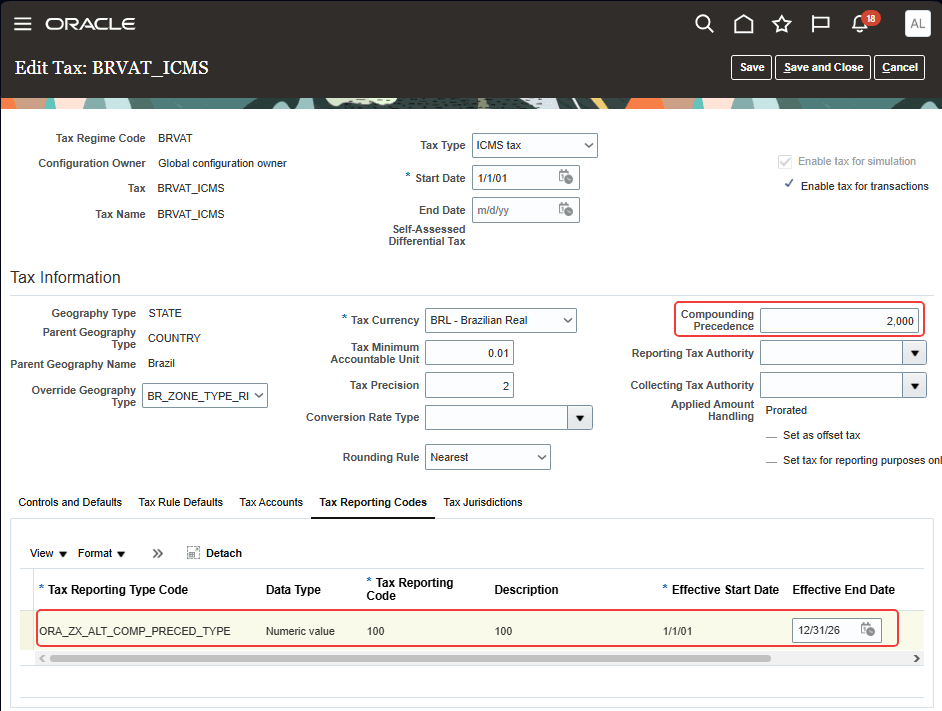
Tax compounding precedence setup example
These are the business benefits:
- Helps organizations avoid reimplementing affected tax configurations during Brazil’s VAT transition.
- Supports accurate tax calculations while current taxes and new VAT taxes coexist.
Steps to enable and configure
Use the Opt In UI to enable this feature. For instructions, refer to the Optional Uptake of New Features section of this document.
Offering: Financials
-
Use the Opt In UI to enable this feature. For instructions, refer to the Optional Uptake of New Features section of this document.
-
For each affected Brazil tax, add the alternate tax compounding precedence reporting type ORA_ZX_ALT_COMP_PRECED_TYPE on the Tax Reporting Codes tab.
-
Enter the previous compounding precedence and set the effective end date through which that precedence remains applicable.
-
Update the tax’s Compounding Precedence to the value required for the new VAT coexistence calculation, then create the corresponding tax formulas.
-
Review the effective dates before saving.
Note: Review the effective dates for the previous tax compounding precedence carefully before saving, as you cannot change the Effective Start Date field after the record is saved.
Tips and considerations
- An incorrect update start date can require a data fix to correct.
- Taxes without the alternate-precedence setup continue to use their configured compounding precedence.
- After the precedence is updated, new tax formulas can’t use the previous precedence.
Access requirements
No new access requirements.