Exadata Warehouse
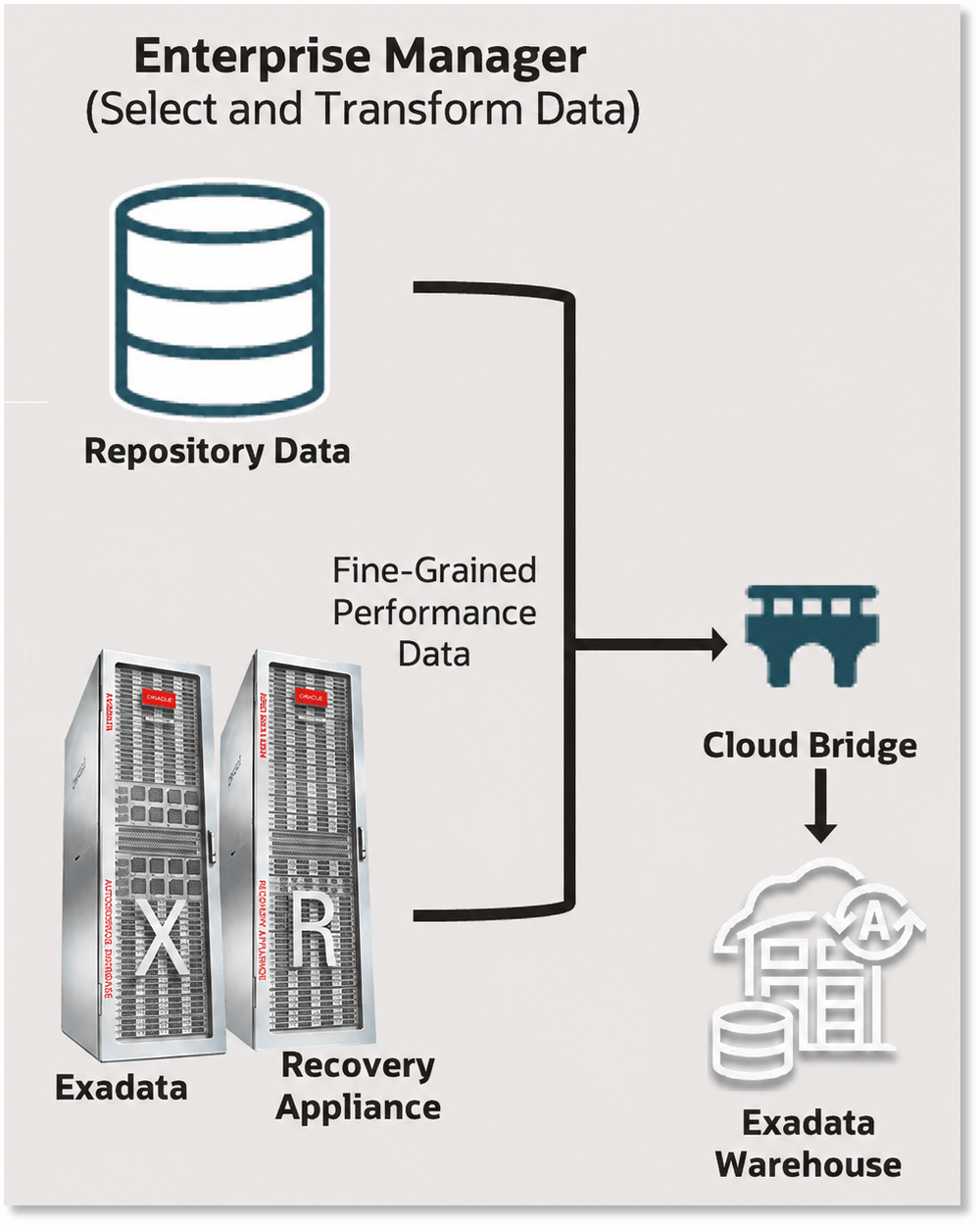
Exadata Warehouse in Enterprise Manager serves as a centralized repository for fine-grained performance metric data collected from Oracle Engineered Systems such as Exadata Database Machine and Zero Data Loss Recovery Appliance (ZDLRA), deployed on-premises or in the cloud.
It provides long-term retention of historical and forecast data for performance and capacity analysis and planning. Exadata Warehouse can be hosted on any database target discovered in Enterprise Manager, such as an on-premises database or a multicloud database.
Fine-grained data from Exadata components, such as storage servers and compute servers, is uploaded to Exadata Warehouse. Exadata Warehouse generates periodic forecasts based on historical data, which are available for queries and export. Older forecast data points are retained for comparison. Because Exadata Warehouse resides in a database that you choose, the uploaded data remains accessible even after data uploads for the systems are paused or terminated.
The following image illustrates how data flows into Exadata Warehouse after the configuration is complete:
Capabilities of Exadata Warehouse include:
-
Analyzing resource usage for databases running on Exadata and Recovery Appliance platforms across the enterprise, both on-premises and in the cloud.
-
Forecasting future demand for resources based on historical trends.
With Exadata Warehouse, resource utilization of Exadata systems can be analyzed to identify spare capacity for new workloads. Exadata Warehouse is available starting with Enterprise Manager 13c Release 5 Update 7 (13.5.0.7). Expanded warehouse-hosting support, including on-premises databases, is available starting with Enterprise Manager 24ai Release 1 Update 12 (24.1.0.12). Exadata Warehouse requires the Exadata Management Pack or the Zero Data Loss Recovery Appliance Management Pack, as applicable to the source targets.
Key functionality of fine-grained metric ingestion and forecasting includes:
-
Ingesting metrics into a customer-owned database.
-
Storing fine-grained metric data with per-minute granularity, with up to 1,440 data points per metric per day, if available.
-
Back-filling metric data to accommodate periods when monitoring of Exadata through Enterprise Manager is interrupted.
-
Generating automated forecasts and roll-ups that are updated periodically.
-
Forecasting data using machine learning with seasonality models.
-
Generating forecasts for up to the next three months by analyzing nine months of historical data, subject to data availability.