8.2.2 Exact Rule
This topic provides systematic instructions to create Exact rule.
- Navigate to the Create Reconciliation Rule screen.
Table 8-5 Create Reconciliation Rule - Exact Rule - Field Description
Field Name Description Exact option These fields appear if you select the Exact option. Reconciliation Rule You should add either one double sided condition with invoice/cash flow and payment; or one or more single sided conditions along with a double sided condition, for invoice/cash flow and for payment. Add Condition Indicates an option to add a condition for Exact reconciliation. Add Group Indicates an option to add a group of conditions that are clubbed together by logical operator ‘AND’ or ‘OR’. AND / OR Indicates the logical operator to be used for clubbing the conditions for creating the Exact reconciliation rule. Select Entity Select the required entity for building the condition. The following options are available: For Invoice-Credit Note reconciliation:
- Invoice
- Credit Note
- Invoice and Credit Note
For Invoice-Payment reconciliation:
- Invoice
- Payment
- Invoice and Payment
For Cash Flow-Payment reconciliation:
- Cash Flow
- Payment
- Cash Flow and Payment
Single-Sided Condition You can create single-sided conditions by selecting a specific entity (Invoice/ Cash-Flow or Payment) and then comparing an attribute of this entity with a specific value. A single sided condition should always be created along with at least one double sided condition.
The following fields appear for a single sided condition.
Select Attribute Select the attribute of the entity to be compared. Relational Operator Select the relational operator or pattern to be used for comparison. The options available are: - =
- <
- >
- !=
- Starts with
- Ends with
Value Specify the value that the attribute is to be compared with. Match Case Select the toggle to match the value with case sensitive. Double-Sided Condition You can create double-sided conditions by selecting a specific entity (Invoice/Cashflow and Credit Note/Payment) and then comparing an attribute of one entity with a relevant attribute of the other entity. For example, for the Invoice and Payment double-sided condition, the Net Invoice Amount can be compared with the Payment Amount. The following fields appear for a double-sided condition.
Entities Select the entities combination for creating the double-sided condition. Select Pattern Select the pattern to be used for the attribute (of the first entity) to be compared. The options available are: - Exact Attribute
- Text Between Two Positions – On selecting this option, two fields appear where you can enter the position (numerical values). The attribute text between these positions is used for comparison.
- Likewise Match – On selecting this option, the relational operator defaults to Contains In and Right Hand Side pattern will be defaulted to Likewise Match
Select Attribute Select the attribute of the first entity to be compared. Relational Operator Select the relational operator to be used for comparison. The options available are: - =
- >
- <
- !=
- Contains In – This option appears only if the Select Pattern is selected as Likewise Match.
Select Pattern Select the pattern to be used for the attribute (of the second entity) to be compared. The options available are: - Exact Attribute
- Text Between Two Positions – On selecting this option, two fields appear where you can enter the position (numerical values). The attribute text between these positions is used for comparison.
- Likewise Match – On selecting this option, the relational operator defaults to Contains In and Left Hand Side pattern will be defaulted to Likewise Match.
Select Attribute Select the attribute of the second entity to be compared. Match Case Select the toggle to match the value with case sensitive. - If you select the Exact option in the Rule Type field, then in
the Reconciliation Rule section, build condition(s) as per requirement,
as follows.
- Once a condition is defined, click
 to save it.
- Once a condition is defined, click
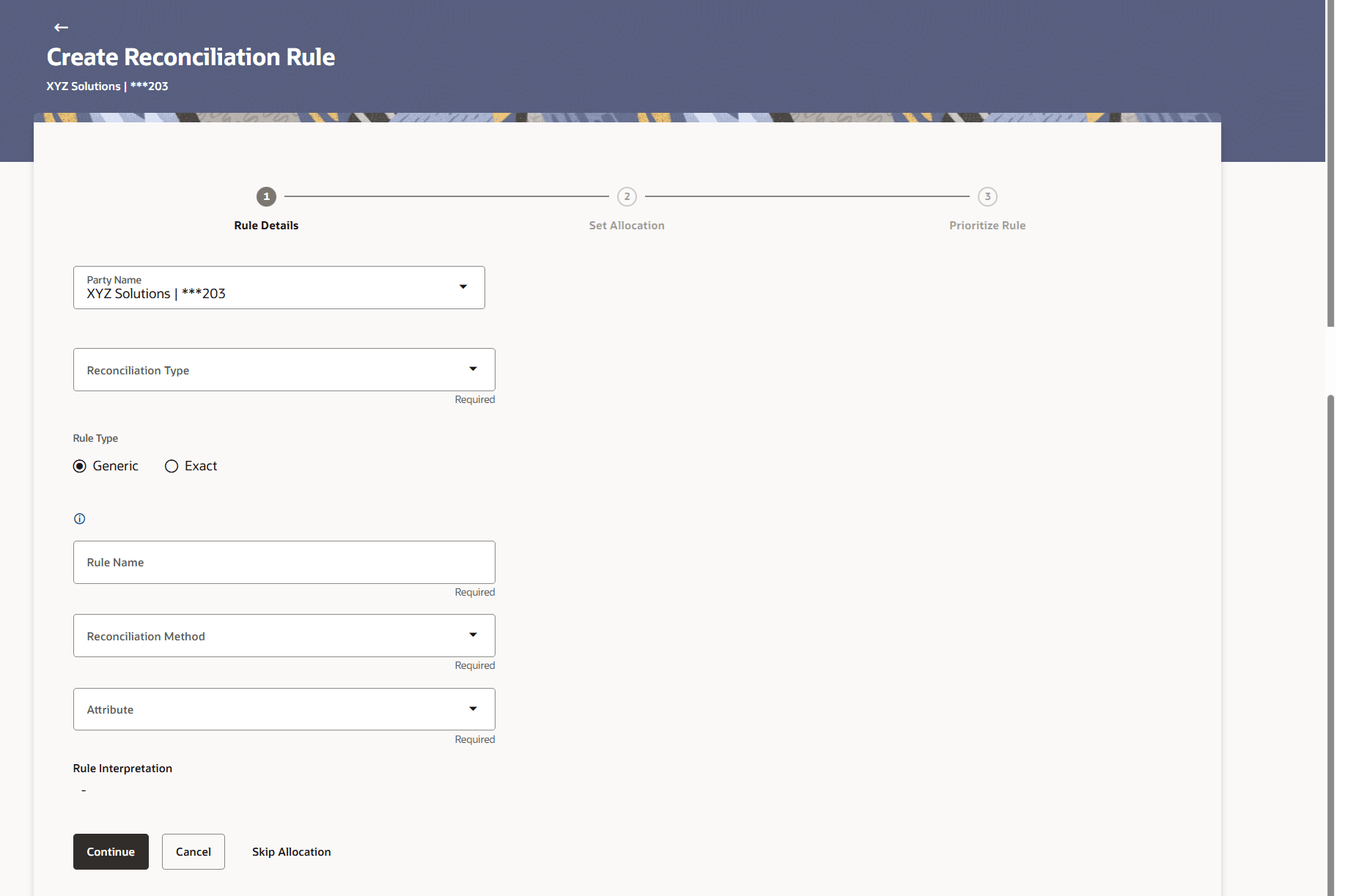
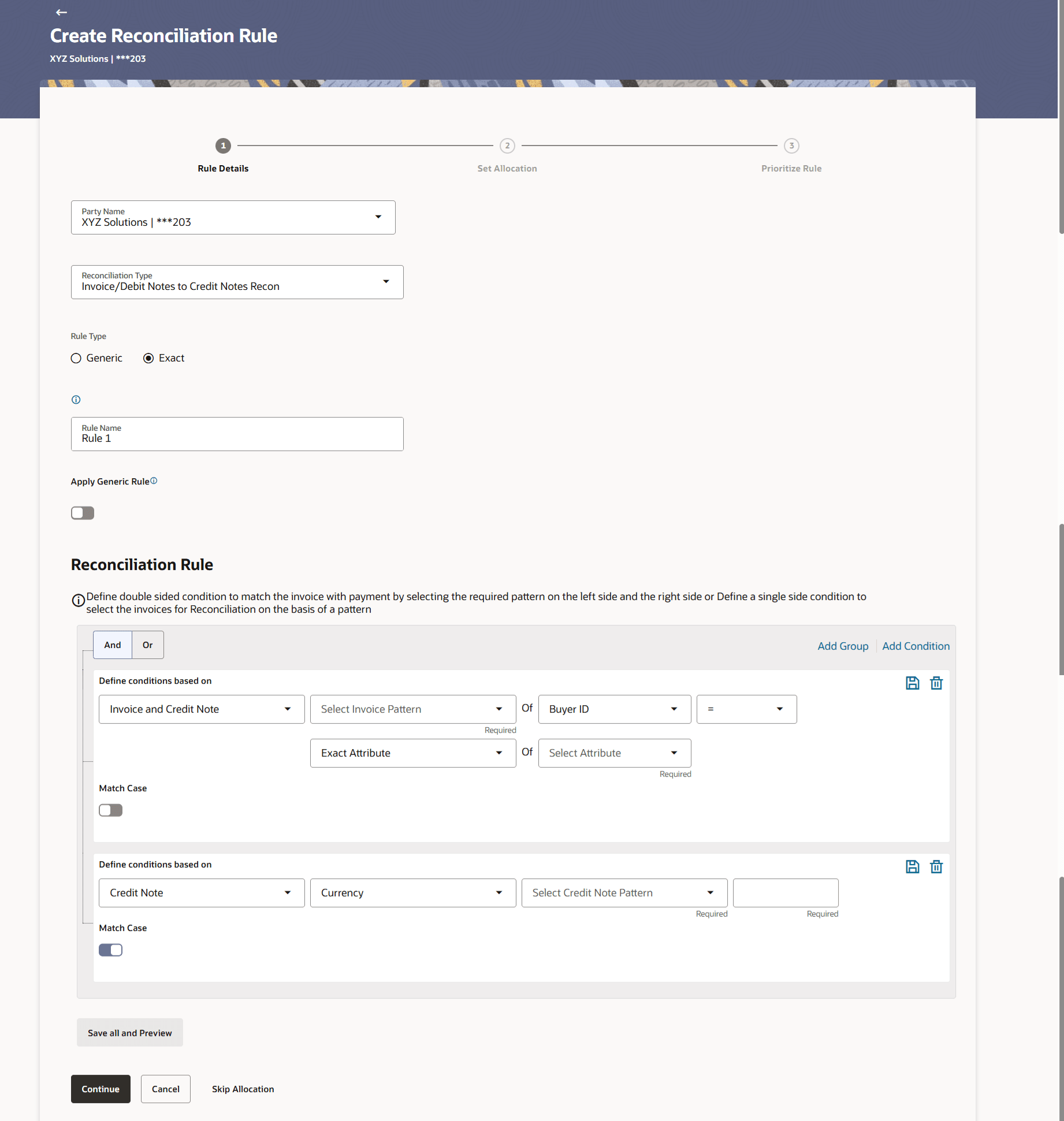
Figure 8-14 Set Allocation – Account
Based Figure 8-15 Set Allocation – Attribute
Based Table 8-6 Set Allocation Field Description Note: Set Allocation step is not applicable for Reconciliation
type Invoice/Debit Note and Credit Note. Please skip the step to proceed
to Prioritize Rule step.
Field Name
Description
Party Name
Displays the name and ID of the logged-in corporate
party.
Set Allocation
In this step, you can set the percentages to be allocated to specific virtual
accounts. You must ensure that the sum of the allocated percentages should be
100.
Allocation Basis
Select whether allocation should be virtual accounts-based or
attributes-based.
Narration
Specify the narration for reconciliation rule creation.
Account Based Allocation
This section appears if you select the Account Based option in the
Allocation Basis field.
Serial Number
Displays the serial number of the allocation account.
Allocation Account
Select a virtual account to assign an allocation
percentage.
Percentage
Specify the percentage of payment to be allocated to the virtual
account.
Action
Click
 to add further virtual accounts. Or click
  to delete an added account.
Attribute Based Allocation
This section appears if you select the Attribute Based option in the
Allocation Basis field. This option can be used to allocate specific
percentages of the payment towards specific attributes. The amount corresponding
to the payment percentage set, is allocated to the virtual accounts mapped to
these attributes.
Serial Number
Displays the serial number of the attribute.
Allocation Entity
Select the entity whose attribute should be considered for
setting an allocation percentage.
Allocation Attributes
Select the attribute for which the allocation percentage should
be set.
Percentage
Specify the percentage of payment to be allocated to the
attribute.
Action
Click
to add further attributes. Or click to delete an added attribute.
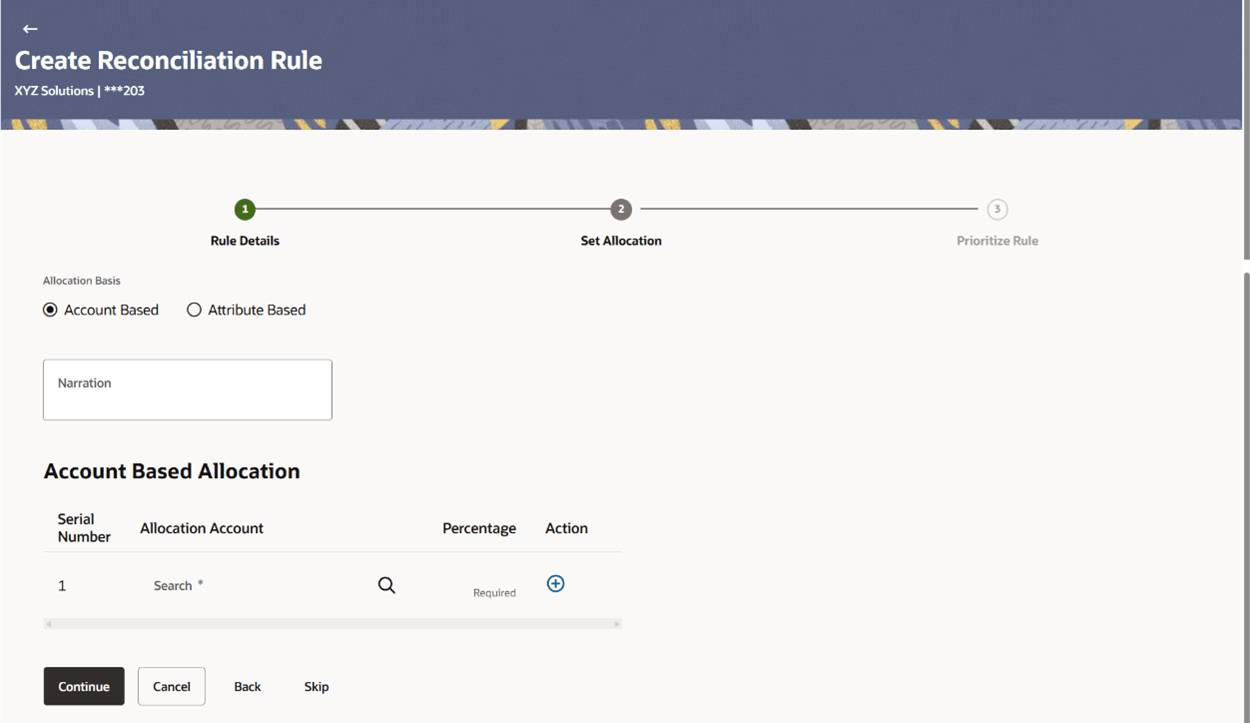
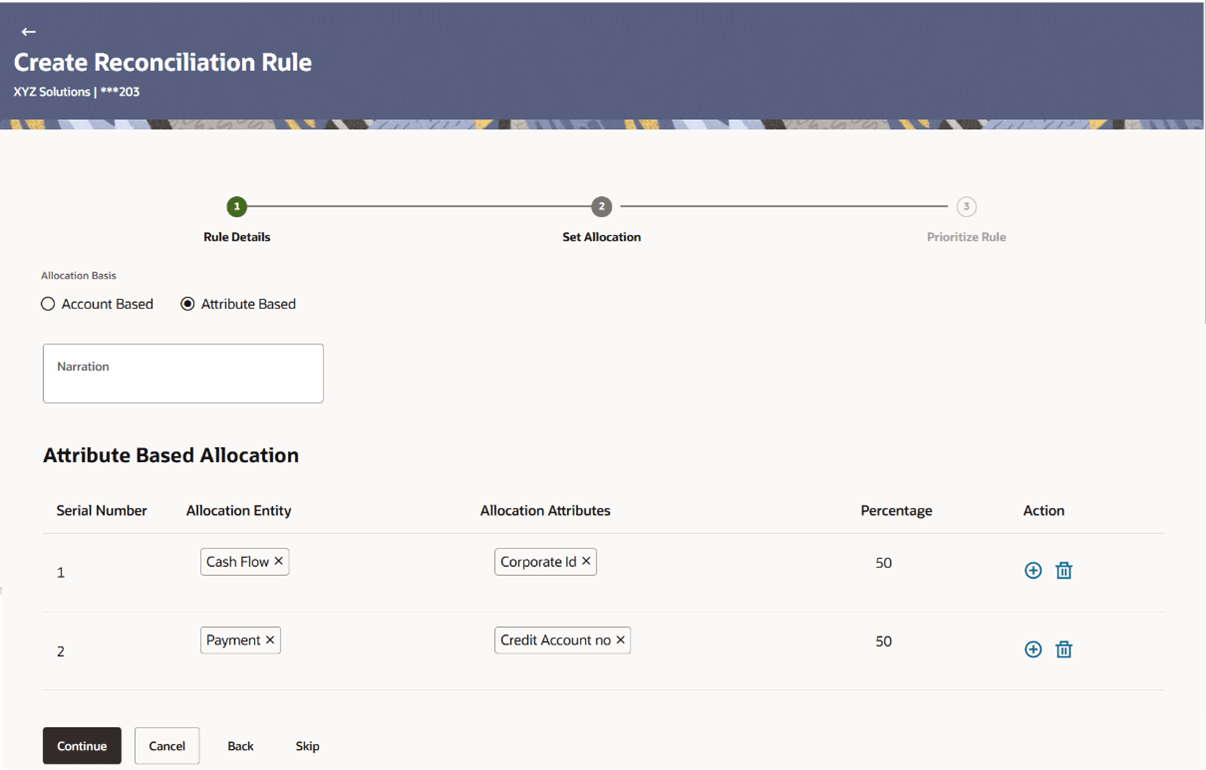
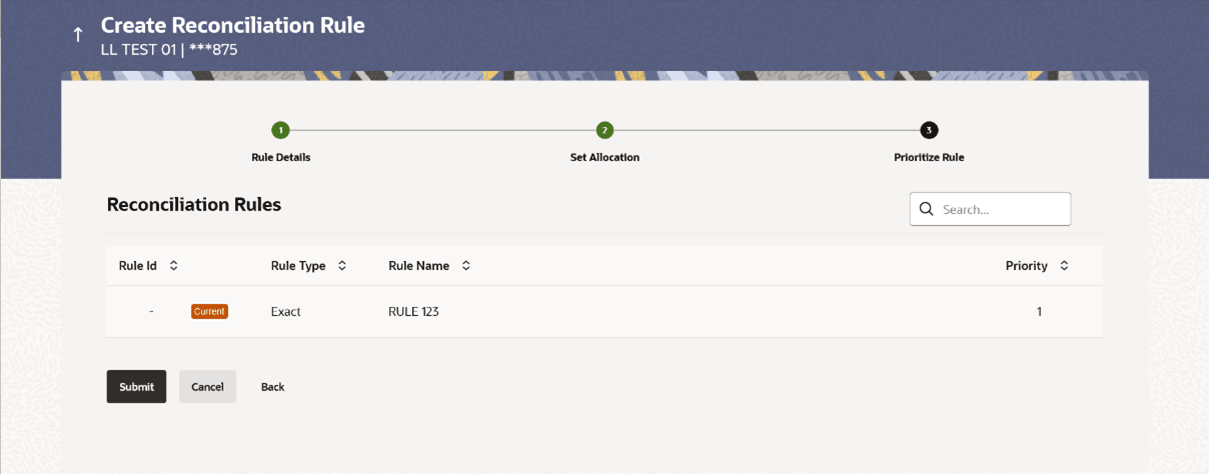
Figure 8-16 Prioritize Rule Table 8-7 Prioritize Rule - Field Description The keyword “Current” is
displayed beside the rule being created. The keyword
“Modified” is displayed beside any rule whose priority has been
changed. Note: For an existing rule, click Edit icon to edit and modify the priority, if required.
Field Name
Description
Party Name
Displays the name and ID of the logged-in corporate
party.
Prioritize Rule
This section displays Prioritize Rule details related
fields.
Reconciliation Rules
A list of existing rules is displayed. You can set the priority on the rule
being created, and also modify the priority on an existing rule, if required. For
the rule being created, the keyword ‘Current’ is displayed beside it. For a
rule whose priority is modified, the keyword ‘Modified’ is displayed beside
it.
Search
Indicates an option to search for a specific reconciliation
rule.
Rule Id
Displays the unique rule ID. For the rule being created, this
field appears blank. An ID is assigned once the rule is created. The IDs of the
other rules in this column are hyperlinks, which when clicked display the rule
details in an overlay window. For more information, refer the Recon Rule
overlay window section below.
Rule Type
Displays whether the rule is a generic or an exact one.
Rule Name
Displays the name assigned to the rule.
Priority
Indicates the priority assigned to the rule.
- Click Submit to submit the transaction. The Review screen
appears. Or, do one of the following:
- Click Cancel to cancel the transaction.
- Click Back to go to the previous screen.
Figure 8-17 Create Reconciliation Rule - Review Screen (Exact)
Figure 8-18 Create Reconciliation Rule - Review Screen (Generic)
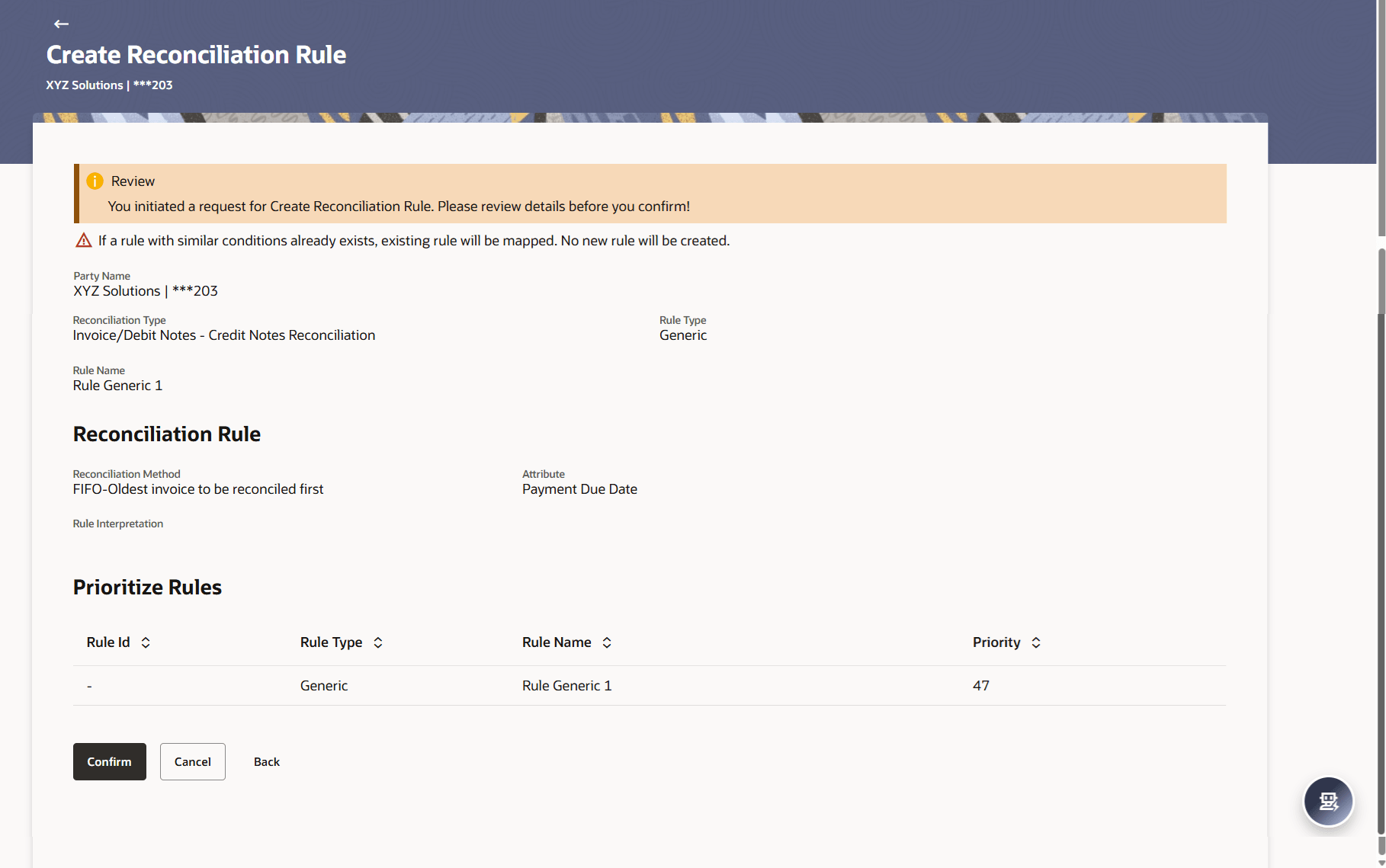
Figure 8-19 Create Reconciliation Rule - Review Screen 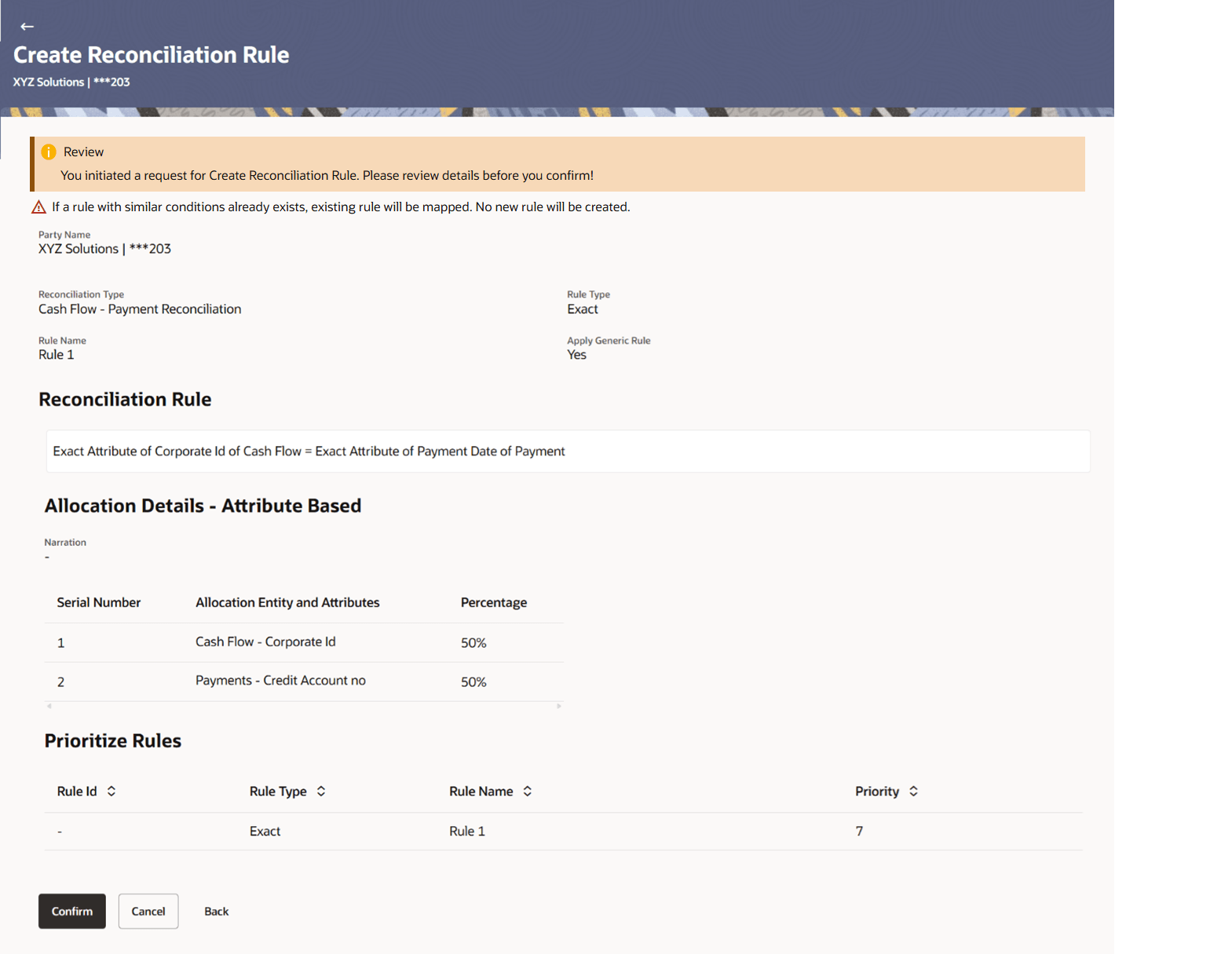
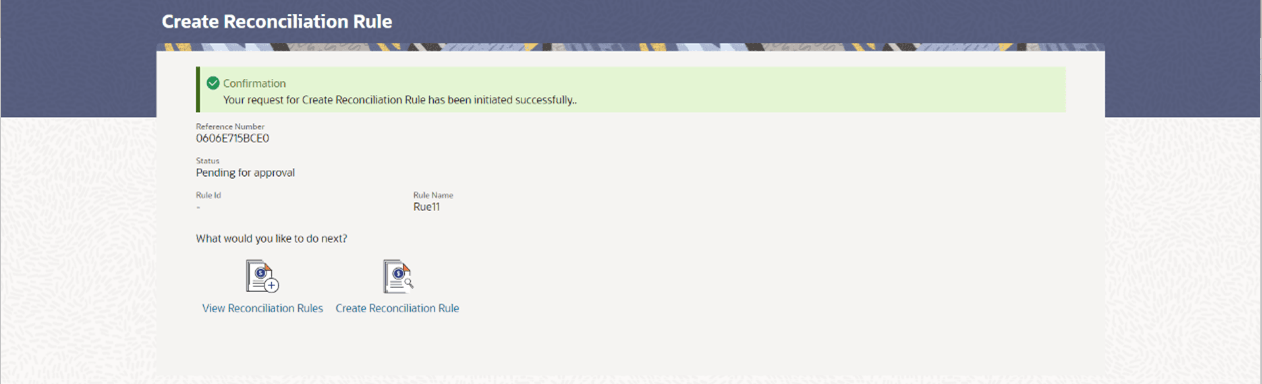
- In the Review screen, verify the details and click Confirm. A
Confirmation message appears, with the reference number and status of the transaction. Or,
do one of the following:
- Click Cancel to cancel the transaction.
- Click Back to go to the previous screen.
Figure 8-20 Create Reconciliation Rule – Confirmation
Parent topic: Create Reconciliation Rule