Disaggregation Main Insight
The Disaggregation Main Insight module uses personalized insights about a specific end use in the customer's home to encourage participation in a utility promotion. It highlights categories where the customer's usage exceeds the regional average, helping to motivate adoption of the promotion and reduce overall energy use. The module can feature the customer's largest end use category or a utility selected category that aligns with the promotion. Oracle Utilities Opower collaborates closely with utilities to develop marketing modules that enhance the overall report experience.
Appears in: Promotion Report
Requirements
Utility Requirements
| Category | Description |
|---|---|
| Required Cloud Service | Energy EfficiencyCloud Service |
| Scale | Not applicable. |
Customer Requirements
| Category | Description |
|---|---|
| Billing Frequency | Monthly, bi-monthly, or quarterly. |
| Data Delivery Frequency | Not applicable. |
| Data Requirements |
Energy disaggregation data is required to get an estimate of the categories where a customer uses the most energy. Minimum: The minimum data requirement is average energy use data for the households in a utility's region. This data is typically obtained from public data sources. The module then uses the customer's responses to the Home Energy Analysis survey to adjust the average energy use values and yield personalized disaggregation results. Recommended: The recommended approach is to use weather data and at least six historical bills, as this will provide more accurate disaggregation results. Additional data requirements may apply depending on the utility's setup, configuration, and whether any advanced data science models are used. |
| Data History |
|
| Data Coverage | Not applicable. |
| Fuel Type | Electric-only, gas-only, dual fuel. |
User Experience
This section describes the user experience of the Disaggregation Main Insight.
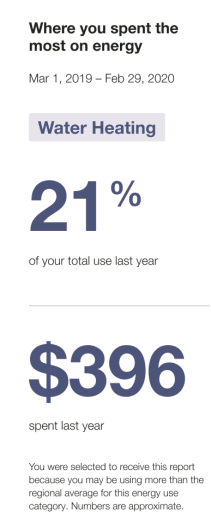
Header: Introduces the main insight and explains how it relates to the customer's energy use.
Date Range: Specifies the time period the insights are based on, typically the year prior to the report period.
End Use Category: Identifies the specific end use that the promotion focuses on.
Usage Insight: Shows the selected end use as a percentage of the customer's total energy use, displayed as a whole number using standard rounding.
Usage Insight Label: Provides context for the usage percentage displayed.
Spend Insight: Indicates how much the customer spent on the selected category during the specified date range, shown as a whole number using standard rounding.
Spend Insight Label: Adds context by describing the time period and meaning of the dollar amount. Disclaimer: Explains why the customer is receiving the report.