3 Get Started with Oracle AI Data Platform
Oracle AI Data Platform helps you quickly build, orchestrate, and manage end-to-end data workflows across your organization. This guide walks you through the essential steps to create your first AI Data Platform and start working with data in a governed and scalable environment.
Topics:
- Requirements for AI Features
- Storage Encryption Options
- Create Your First Oracle AI Data Platform
- Access an Oracle AI Data Platform
- Access Oracle AI Data Platform from a URL
- Understanding the Workspace and UI Flow
- Next Steps After Setup
- Edit an Oracle AI Data Platform
- Delete an Oracle AI Data Platform
- Session Management
- IAM Policies for Oracle AI Data Platform
- Pricing
Requirements for AI Features
In order to use AI features in Oracle AI Data Platform, you need to provision an Oracle Autonomous AI Lakehouse instance.
As part of creating your AI Data Platform instance, an Oracle Autonomous AI Lakehouse must be created and configured. You can choose to create the Autonomous AI Lakehouse instance as part of creating your first AI Data Platform instance or choose to use an existing Autonomous AI Lakehouse instance. If you are using an existing Autonomous AI Lakehouse, you must also provide the password for the ADMIN user of that instance.
Note:
Existing Autonomous AI Lakehouse instances must be at least 26ai or above. When you create a new Autonomous AI Lakehouse instance as part of creating your AI Data Platform instance, it is automatically configured as 26ai or above.The Autonomous AI Lakehouse instance serves as the foundational data layer for AI workloads within AI Data Platform and is used as the default vector store for all AI-native capabilities. The Autonomous AI Lakehouse instance requires Oracle Autonomous AI Lakehouse version 26ai or later and is mandatory for enabling AI features in AI Data Platform, including:
- Knowledge Bases (KB),
- Agent Flows,
- and AI Compute.
Note:
If your tenancy has reached one or more Autonomous AI Lakehouse quotas, you can't create a new Autonomous AI Lakehouse instance when creating your AI Data Platform instance. In that case, you must either select an existing Autonomous AI Lakehouse instance or contact your support team to request a quota increase.You must have the following IAM policies enabled for AI features:
Allow Oracle AI Data Platform service to call LLMs hosted on the OCI GenAI service:
allow any-user to use generative-ai-family in tenancy where all { request.principal.type='aidataplatform'}
Note:
Depending on when your AI Data Platform was created, your principal type may be'datalake' instead of 'aidataplatform'. You can check your principal type by viewing the details of your AI Data Platform OCID.
allow group <aidpAdminGroup> to manage autonomous-databases in <aidp compartment>Storage Encryption Options
You can use Oracle-managed encryption keys, or you can choose your own customer-managed key (CMK) from OCI Vault when your organization requires direct control over key lifecycle and rotation.
Oracle AI Data Platform encrypts data at rest by default. When you configure your first AI Data Platform instance, you can choose to keep the default Oracle-managed encryption keys, or you can choose your own CMK from OCI Vault when your organization requires direct control over key lifecycle and rotation. Use Oracle-managed keys when you want the simplest setup and don't need to manage key material yourself. Use customer-managed keys when your security policy requires you to control the vault, key rotation process, access boundaries, or audit trail for the encryption key.
Customer-Managed Key Prerequisites (Preview)
Before you select a customer-managed key, make sure the following prerequisites are in place:
- You have permission to view OCI Vaults and keys in the target compartment. For more information configuring vaults and keys in OCI, see Configuring IAM Policies.
- You have an OCI Vault available in the same region as your AI Data Platform deployment.
- You have a master encryption key in that vault.
- The key is enabled and available for use.
- You must choose an AES symmetric master key with a 256-bit length.
Default Behavior – Oracle Managed Keys
If you don't select a customer-managed key, AI Data Platform uses Oracle-managed keys automatically. This is the default option and requires no additional vault configuration. Choose this option when:
- You want the fastest provisioning path.
- Your team doesn't need to manage or rotate the encryption key directly.
- Your security policy allows Oracle-managed encryption for service data at rest.
Considerations Before Choosing Customer-Managed Keys
Customer-managed keys provide more control, but they also add operational responsibility.
- If the vault or key becomes unavailable, encryption-dependent operations can fail.
- If the key is disabled, deleted, or scheduled for deletion, access to protected data can be impacted.
- Key rotation, compartment design, and IAM policies become part of your operational runbook.
- Provisioning or update flows can take longer than the default Oracle-managed path.
Troubleshooting
If you don't see the customer-managed key option when setting up your AI Data Platform instance, check the following:
- Confirm that the feature is enabled in your tenancy.
- Confirm that you have permission to read vaults and keys.
- Confirm that the vault and key are in the same region as the AI Data Platform instance.
Limitations
You cannot change your encryption keys after creating an AI Data Platform instance. In order to change encryption strategy, you must create a new AI Data Platform instance and move the code to that.
Create Your First Oracle AI Data Platform
Before you create your first Oracle AI Data Platform, you need to ensure you have the correct IAM permissions.

Before creating or using an AI Data Platform, check the following:
- You have the appropriate permissions for the compartment where you want to create the AI Data Platform. For more information, see Managing Compartments.
- If you already have tag-defaults set for your compartment you may face issues while creating an AI Data Platform instance in that scope. For more information, see Known Issues.
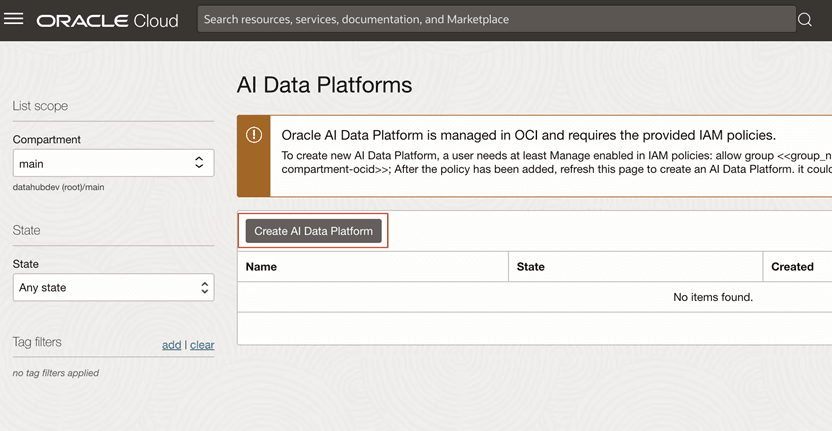
- Click AI Data Platform.
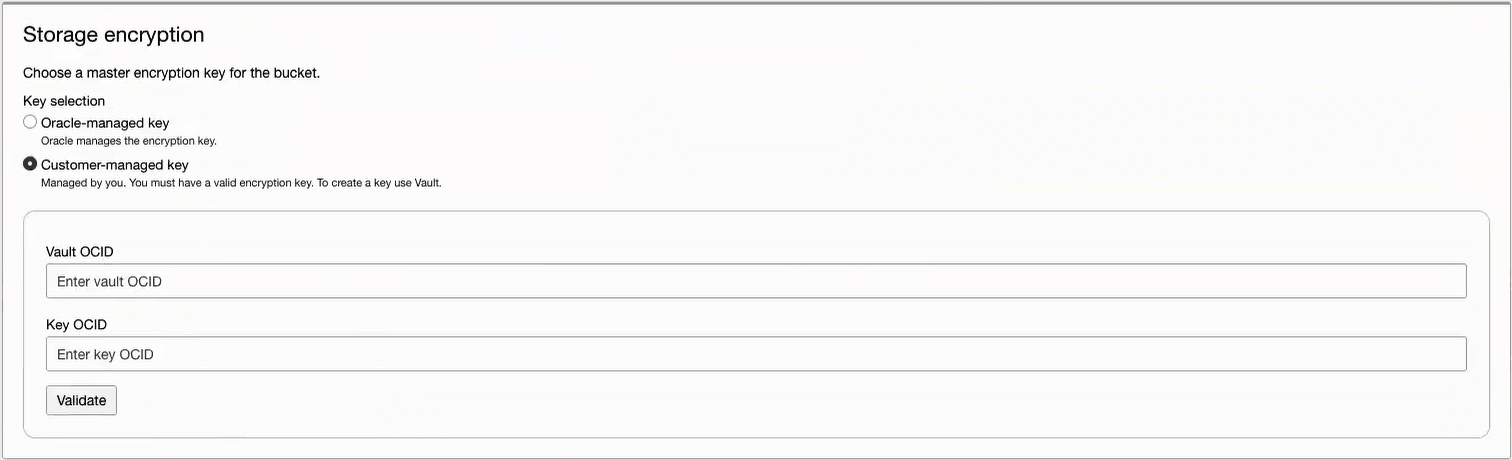
- Select whether encryption keys are Oracle-managed (default setting) or customer-managed.
- Oracle-managed key: This is the default option and requires no additional vault configuration.
- Customer-managed key: Select if your organization requires direct control over key lifecycle and rotation. You need to provide the Vault OCID and Key OCID for your encryption key. Click Validate to confirm the provided OCIDs are valid.
Access an Oracle AI Data Platform
You can access any Oracle AI Data Platform that you or a role you belong to have been provided permissions for.
- In the Home section of OCI, click Analytics & AI.
- Click AI Data Platform.
- Click the AI Data Platform you want to access.
Access Oracle AI Data Platform from a URL
You can access your Oracle AI Data Platform instance directly from a URL.
The URL for your Oracle AI Data Platform uses the following format, where tenant_name is the name of the OCI account you use to log in and domain_name is the domain you select:
https://<hash>.datalake.oci.oraclecloud.com/#?&tenant=<<tenant_name>>&domain=<<domain_name>>You can also get a direct link to your instance by right-clicking your AI Data Platform instance name on the home page and clicking Copy Link.
You can share your AI Data Platform instance URL with other users. Those users need to have appropriate permissions to access the instance. For more information, see About Permissions.
Understanding the Workspace and UI Flow
Once you've created or accessed your Oracle AI Data Platform, the user interface helps you navigate and manage all key components seamlessly inside the instance.
Left Navigation Overview
When inside an AI Data Platform, the left sidebar contains:
- Home - Brings you back to the dashboard
- Master Catalog - View all registered data assets across workspaces
- Workspace - Direct access to workspace details
- Select Workspace - Drop-down to switch between different workspaces
- Inside a workspace, you’ll see:
- Workflow - Design and schedule data workflows
- Compute - Manage Spark compute environments
- Inside a workspace, you’ll see:
- Data Sharing - Share data with other services supporting Delta Share protocol
- Auto populate catalog - Automatically ingest metadata from connected sources
- Notifications - Search and filter system messages you receive
- Roles - Configure access control (RBAC)
- Audit logs - Search and filter the history of objects in your AI Data Platform
Next Steps After Setup
Once you have created your Oracle AI Data Platform, you can prepare it for regular use.
When you have your AI Data Platform created and have accessed it for the first time, these are the next steps to ensure its ready for use:
- Review IAM Policies and Roles - Ensure correct access is set up for users and groups via the Roles tab. For more information, see Roles.
- Set Up Compute - Configure Spark compute in the Compute tab to run your workflows efficiently. For more information, see Compute.
- Ingest and Organize Data - Start by creating a Catalog to organize your data sources. For more information, see Data Management.
- Explore Notebooks - Use notebooks for ad hoc exploration, transformations, or machine learning tasks. For more information, see Notebooks.
Edit an Oracle AI Data Platform
You can edit the details of an Oracle AI Data Platform instance you own.
- In the Home section of OCI, click Analytics & AI.
- Click AI Data Platform.
- Click
 Actions next to your AI Data Platform and click Edit.
 - Modify the details and click Save.
Delete an Oracle AI Data Platform
You can delete unused or redundant Oracle AI Data Platform instances you own.
- In the Home section of OCI, click Analytics & AI.
- Click AI Data Platform.
- Click Actions next to your AI Data Platform and click Delete.
- Select whether to delete:
- All managed data in the Master Catalog
- All files and folders in all workspaces
- Enter Delete where prompted. Click Delete.
Session Management
Oracle AI Data Platform enforces session management controls to ensure a secure and reliable user experience.
The session lifetime for AI Data Platform is 8 hours. User sessions automatically expire after this session lifetime. This behavior aligns with the Oracle Cloud Infrastructure (OCI) security standards and reduces the risk of unauthorized access by ensuring that session tokens are not valid indefinitely.
After 8 hours, users must re-authenticate to continue working in the instance.
These controls are designed to balance usability with strong security and governance practices across the platform.