FSM Case Unbilled Amount Calculation
Field Service Management (FSM) calculates time, expense, and sales order amounts associated with a case. These summaries help you monitor charges and follow up on billing. FSM updates the case amounts through background processing.
The amounts are reporting summaries. Calculating these amounts does not create an invoice or determine which charges Case Invoicing will select.
How It Works
FSM reads the related source records, saves three category amounts on the case, and displays their combined total. Each update recalculates the categories from the source records rather than adding the latest change to the previous amounts.
The following diagram shows the sources of the saved case amounts:
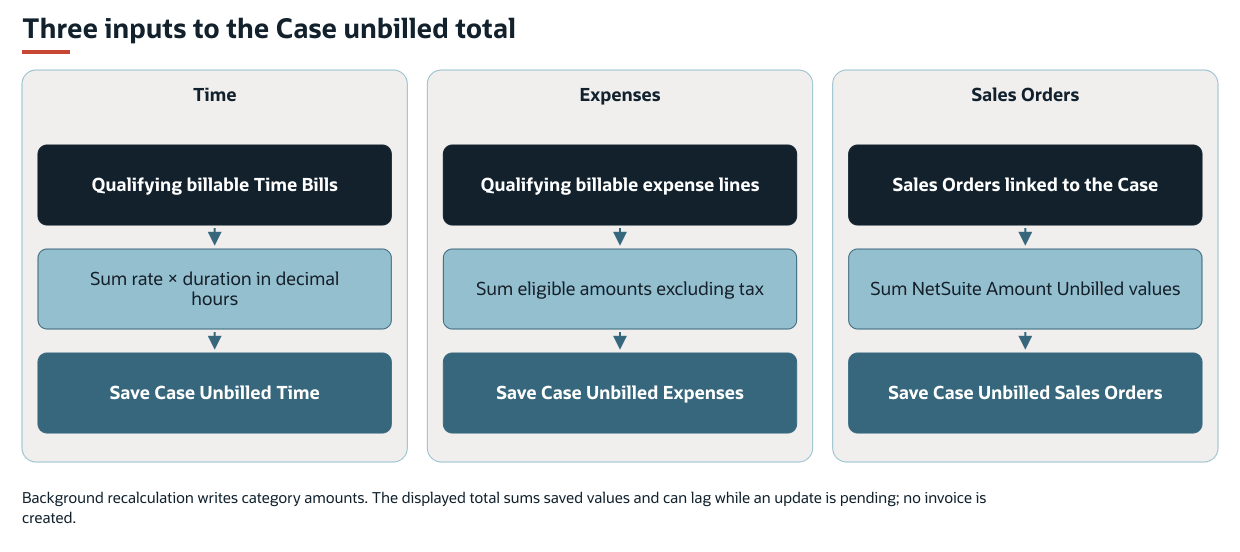
The following table describes the categories. Labels can differ between case forms. The field IDs identify the same values.
|
Amount |
Source and Calculation |
Case Field |
|---|---|---|
|
Unbilled Time |
FSM includes qualifying billable time bills with a positive duration that link directly to the case or to one of its CRM tasks. NetSuite time status also limits which entries FSM includes. FSM sums each entry's Rate multiplied by its duration in decimal hours. |
|
|
Unbilled Expenses |
FSM includes billable expense lines on expense reports linked to the case. The lines must have no applying transaction. FSM excludes tax lines and subtracts the line's tax amount from its amount. This category is calculated only when NetSuite Expense Reports is enabled. |
|
|
Unbilled Sales Orders |
Amount Unbilled values in NetSuite for sales orders linked to the case through their Field Service Case field ( |
|
When a category has no contributing amount, FSM writes zero for that category. With Expense Reports disabled, Unbilled Expenses is zero.
Unbilled Total
Unbilled Total (custevent_nx_unbilled_total) is the sum of the three saved category amounts. On the supplied case form, this total is labeled Amount Unbilled. The amount fields are read-only on the supplied form. The total reflects those saved amounts, so it can still reflect earlier source data when an update is pending.
Key Behaviors
The calculation follows these rules:
-
The sales order calculation includes case-linked orders even when the orders are not selected in the case's Transaction field. That field selects the potential invoice source separately.
-
Billable consumables that have not yet been added to a sales order do not contribute to Unbilled Sales Orders. FSM reads sales orders for this category, rather than consumable records.
-
The calculation for Unbilled Time can include entries linked directly to a case without a task link. The automatic update request for a time bill follows its task's case link, as described in Update Requests.
-
Background calculation does not require the case to be closed or its tasks to be completed. Those statuses are not part of the calculation's record-selection conditions.
The amounts and invoice content use different selection rules. A positive total does not guarantee that Generate Invoice appears or that an invoice includes every reported charge. See FSM Case Invoicing for invoice availability and content rules.
Processing Model and Lifecycle
Update Unbilled on the case requests a recalculation. Background processing selects eligible cases and clears the box after successfully writing the category amounts. Saved amounts can remain unchanged until that write succeeds. The request and pending banner do not establish that processing is running.
For update triggers, case selection conditions, error exclusions, and completion indicators, see FSM Case Unbilled Amount Processing.
Configuration
For the supported settings, defaults, and examples, see Configuring FSM Case Unbilled Amount Calculation.
Related configuration affects the source data used in these summaries. FSM Billing Rules explains how billing rules can set Billable on time and expense records and affect time rates. The calculation uses the saved time bill rate. It does not reapply billing rules or calculate invoice pricing.
For record relationships and model mappings, see FSM Record Model Configuration. Those settings do not provide a separate configuration of this feature's calculation filters or formulas.
Limitations and Constraints
The calculation has the following limitations:
-
The saved category amounts are not a real-time view of every source-record change. Opening a case does not itself recalculate these amounts.
-
Moving a source record to a different case does not automatically request an update of the former case's amounts. Changing its task relationship has the same limitation. Changing a task's case link does not itself request an unbilled recalculation. Previously saved amounts can therefore remain on an affected case.
-
A record can contribute only through the relationships and selection conditions used for its category. Billable alone does not establish that a time bill is included.
-
Creating an invoice does not confirm that the case amounts have already been refreshed. Calculation does not create transactions, apply charges to an invoice, or mark source records billed.
Related Processes and Procedures
For information about using Unbilled Closed Cases to follow up on billing, see FSM Operations and Operational Tracking.