A.1 Integrate with the Database Tools MCP Server
The Database Tools Model Context Protocol (MCP) Server lets MCP clients run SQL queries against Oracle AI Database. The MCP Server authenticates each end user to the database with an OCI IAM auth token.
An OCI IAM auth token is a scoped proof-of-possession token that is issued by OCI IAM for database authentication and bound to a public key. Before sending the token to the database, the database client signs it with the private key associated with the token's public key, proving that the sender is the rightful holder of the token. Unlike a bearer token, this token cannot be replayed by a party that does not hold the private key. See Authenticating and Authorizing IAM Users for Oracle AI Database in Oracle AI Database Security Guide.
Learn how you can integrate the Database Tools MCP Server with Oracle Deep Data Security (Deep Sec) so that each query returns only the specific rows, columns, or cells that the requesting end user is authorized to see.
A.1.1 The Authentication Flow
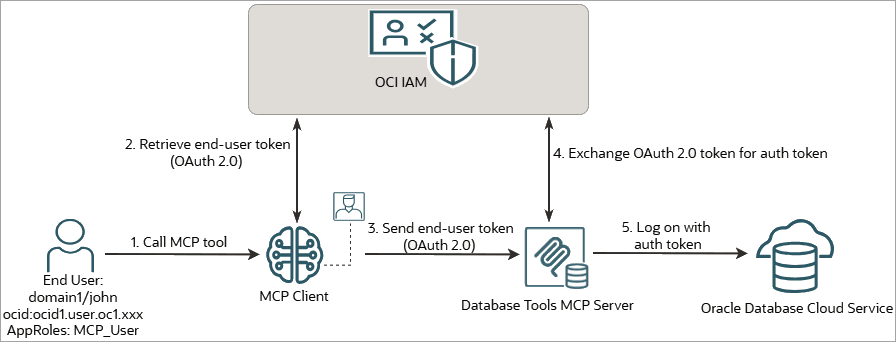
This integration pattern uses the following authentication and enforcement flow.
- The MCP client obtains an OAuth 2.0 token for the end user from OCI IAM, and sends the end-user token to the Database Tools MCP Server.
- Through OCI IAM, the Database Tools MCP Server exchanges the OAuth 2.0 token for an OCI IAM auth token issued to the same end user.
- The Database Tools MCP Server connects to the database using the end user's OCI IAM auth token.
- The database validates this token through OCI IAM. If no mapped
global database user or application identity of the same name as the
connecting user exists, and the end user holds the
CREATE
                            SESSION
privilege through a data role, the database permits the session creation as a direct logon of the end user. - Subsequently, the database establishes an end-user security context on the session: it enables the data roles mapped to the end user's OCI IAM groups, and enforces the data grants defined for those roles on every SQL statement that the MCP server runs in the session.
A.1.2 Scope and Related Documentation
Learn about the integration scope, architectural boundaries, and related OCI IAM or Database Tools documentation for this integration.
- This integration pattern is supported only on Oracle Cloud database platforms that support OCI IAM database authentication, such as Oracle Base Database Service, Oracle Autonomous AI Database Serverless, Oracle Autonomous AI Database Dedicated, Oracle Exadata Database Service, Oracle Exadata Cloud@Customer, and Oracle Exadata Database Service on Exascale Infrastructure.
- This section covers only the database-side configuration
related to Deep Sec. Creating and securing
the Database Tools connection, the MCP server, the MCP toolsets, the MCP
clients, the MCP application roles, and the OCI IAM policies is external to
this guide. Use the following OCI IAM or Database Tools documentation for
those tasks.
Configuration Area OCI IAM or Database Tools Documentation MCP server overview and tutorial
Working With the Database Tools Model Context Protocol (MCP) Server
Tutorial: Set Up a Database Tools MCP Server and Integrate with an MCP ClientPrerequisites, Database Tools connection, and IAM authentication
Prerequisites (Database Tools MCP Server)
Create a Database Tools Connection Using Token-Based Authentication
Integrating IAM Authentication with Database Tools Connections
MCP server, toolsets, and client registration
Creating a Database Tools MCP Server
Connecting to an MCP ServerSecurity, roles, and identity propagation
Security (Database Tools MCP Server)
Authorization and Authentication
Role-Based Access Control for MCP Server Tools and Reports
Database Session Identity and Role PropagationOCI IAM policies and troubleshooting
Configuring OCI IAM for Oracle DBaaS
Policies for Database Tools MCP Server
Troubleshooting MCP Servers
A.1.3 Prerequisites: OCI IAM and MCP Server Setup
The OCI IAM and MCP Server setup controls which end users can invoke the Database Tools MCP Server and use its Database Tools connection, and which OCI IAM group memberships are propagated to the database for authorization. The database then validates the OCI IAM auth token and uses the configured data role mappings and privileges to determine whether the end user can create a session and access protected data.
- The target database is an Oracle Cloud database that supports OCI IAM database authentication.
- The end users or groups that query the database through the MCP
client are assigned the appropriate MCP application roles, such as
MCP_User, on the Database Tools MCP Server. - You have recorded the exact names of the OCI IAM groups that
your Deep Sec data roles will map to. For a
group in the default identity domain, the domain prefix is optional. For a
group in a non-default identity domain, record it as
<domain>/<group_name>and reuse the same string in theIAM_GROUP_NAMEdata role mapping. - The OCI IAM policies are configured for the MCP Server runtime
identity model in use. The policies must allow the end users to invoke the
MCP Server and use its Database Tools connection, and allow the MCP Server
to obtain OCI IAM auth tokens for the end users. The required permissions
are listed here.
Granted to the MCP users or their groups:
database-tools-mcp-servers-invocationdatabase-tools-connections, optionally scoped to the Database Tools connection that the MCP Server uses.database-connections
Granted to the MCP Server principal:
database-tools-db-connect-obo—for example, granted as anany-userpolicy constrained byrequest.principal.idto the MCP Server OCID.
Additionally,
secret-bundlesread access is required when secrets or keystores are used. The grantee depends on the runtime identity model; for example, it can be the MCP users' group or the connection principal.For the exact policy statements, including resource-scope or compartment-scope options and the supported runtime identity models, see Policies for MCP Server.
- The Database Tools connection that the MCP Server uses is
configured for OCI IAM token-based authentication, with the connection's
iam.db.token.scopeset to the same scope as, or a more restrictive scope than, the scope your OCI IAM policy grants for database connections. At runtime, the MCP Server exchanges the end user's OAuth 2.0 token for an OCI IAM auth token and connects to the database as that end user. See Create a Database Tools Connection Using Token-Based Authentication.
Note:
- Do not use
IAM_OAUTH_GROUPin the data role mappings for this integration.IAM_OAUTH_GROUPapplies only to OCI IAM group claims carried in an OAuth 2.0 access token, which are resolved within the identity domain set byIDENTITY_PROVIDER_OAUTH_CONFIG.domain_url. OCI IAM auth token group mappings useIAM_GROUP_NAME. - For the OCI IAM auth token flow, cross-domain mappings within a tenancy are supported, but cross-tenancy mappings are not.
A.1.4 Configure the Database for OCI IAM Auth Tokens
On Oracle AI
Database, run the statements in this section as a named user with the DBA role. On Oracle Autonomous AI Database, run them as the ADMIN user. Complete the steps in order.
A.1.5 Verify the Integration
When the Database Tools MCP Server connects with an OCI IAM auth token, the identity of the established security context is the end user.
-- Verify the active end-user identity
SELECT ORA_END_USER_CONTEXT.username FROM dual;

-- Verify the enabled data roles
SELECT role_name FROM V$END_USER_DATA_ROLE;
For the full set of diagnostic views, see Oracle Deep Data Security Data Dictionary Views.
To understand how the database server manages an end-user security context established by direct logon, see How the Database Server Manages an End-User Security Context.