A About the SS7 Protocol Suite
The SS7 protocol suite is a set of telephony signaling protocols that are used to establish and terminate telephone calls on public switched telephone networks. The SS7 protocol suite provides additional services as well, including number translation, local number portability, prepaid billing mechanisms, short message service (SMS), and a variety of other services.
Each protocol within a suite usually has a particular purpose. Such modularization makes design and assessment of the protocols easier. Because each protocol module usually communicates with two others, they are ordinarily considered as layers in a protocol stack. The lowest-layer protocol performs the low-level, physical interaction with the network hardware. Higher layers add more features.
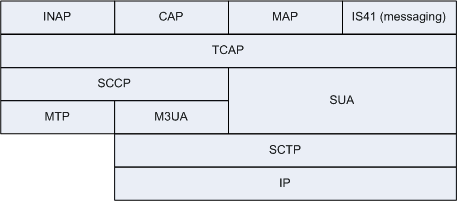
Figure A-1 illustrates the SS7 protocol suite:
The INAP Protocol
The INAP protocol is the signalling protocol that is used in Intelligent Networks (INs). INAP was developed by the International Telecommunications Union (ITU), and is recognized as an international standard. The functionality of INAP has been defined and implemented by the ITU in segments called capability sets. The first version was Capability Set 1 (CS-1) and Capability Set 2 (CS-2) is currently available.
INAP communicates between a service switching point (SSP), network media resources (intelligent peripherals), and a centralized network database called a service control point (SCP). The SCP encompasses operator or third-party-derived service logic programs and data.
The CAP Protocol
The CAMEL Application Part (CAP) protocol is a signalling protocol in the IN architecture and is layered on top of the TCAP protocol. It makes possible the implementation of carrier-grade, value added services like unified messaging services, prepaid services, fraud control, and Freephone (800 number calls) in both the Global System for Mobile Communication (GSM) voice and General Packet Radio Service (GPRS) data networks. CAMEL is a means of adding intelligent applications to mobile networks. It builds upon established practices in the fixed-line telephony business that are generally considered part of the INAP CS-2 protocol.
The MAP Protocol
The Mobile Application Part (MAP) protocol supplies an application layer for nodes in the following networks:
-
GSM (mobile) networks
-
Universal Mobile Telecommunications System (UMTS) networks
-
GPRS networks
The nodes in these networks use the MAP protocol to communicate with each other so they can provide services to mobile phone users. These services include mobility services such as location management to support roaming, call handling, SMS for text messaging, packet data protocol (PDP) services for GPRS, and operation and maintenance, as well as other services.
The IS-41 Protocol
The Interim Standard 41 protocol enables mobile, cellular telecommunications operations between different networks. It is similar to GSM and supports capabilities such as handover between networks, roaming authentication, and SMS delivery. It includes the Visitor Location Register (VLR) and Home Location Register (HLR) databases.
The TCAP Protocol
The TCAP protocol provides a presentation layer that facilitates the distribution of intelligent network services. The presentation layer deals with data format, operating system compatibility, and encapsulating data to send over the network. Fundamentally, TCAP simplifies simultaneous communications between subsystems on the same machines by using transaction IDs to associate multiple messages with a particular transaction.
In intelligent networks TCAP transports INAP and in mobile phone networks it transports MAP. See "Using TCAP Primitives" for more information.
The SCCP Protocol
The Signaling Connection Control Part (SCCP) protocol is a routing protocol that routes TCAP messages to their proper database. SCCP provides connectionless and connection-oriented network services. SCCP provides subsystem numbers that enable messages to be addressed to specific applications or subsystems at signaling points. SCCP is the transport layer for TCAP-based services such as calling card, local number portability, wireless roaming, personal communications services (PCS), and freephone (800 numbers).
The M3UA Protocol
M3UA stands for Message Transfer Part Level 3 (MTP3) User Adaptation Layer. The M3UA protocol enables the SS7 protocol User Part SCCP, as well as others, to run over internet protocol instead of telephony equipment. The M3UA protocol is generally transmitted by using the services of Stream Control Transmission Protocol (SCTP).
The SUA Protocol
SUA stands for the SCCP User Adaptation layer. The SUA protocol facilitates the transfer of SCCP user messages, such as TCAP, between the signalling gateway and the application server process (ASP).
The SCTP Protocol
The Stream Control Transmission Protocol (SCTP) is a transport-layer protocol that delivers in-sequence messages. It performs path selection and provides fail-over support for duplicated paths in the network.
The SCTP protocol was originally designed to transport telephony over the internet, but it has evolved to have other purposes as well.
The Internet Protocol
The Internet Protocol (IP) provides routing for data packets from source to destination hosts based on IP addresses. It facilitates the internetworking that constitutes the internet and defines structures that enclose data and add the source and destination addresses. Because it is often used together with the Transport Control Protocol, it is frequently referred to as TCP/IP. It runs on top of data link interfaces such as Ethernet and Wi-Fi, operating at layer 3 of the OSI model, which is the network layer. The network layer provides routing and switching functionality to transmit data between nodes.