FSM Service Time Tracking
Field Service Management (FSM) captures service time and stores it as NetSuite time bills. Automatic tracking uses Start and Complete activities from FSM Mobile. The Time tab provides a separate way to enter service items and hours.
Time bill creation, task completion, billing rules, and invoicing are separate outcomes. This topic explains time capture and processing. For task and case status changes, see FSM Case and CRM Task Status Automation.
How It Works
Automatic Track Service Time is disabled by default. When enabled, it applies to everyone using FSM Mobile and displays service-time confirmation dialogs for Start and Complete. The entered activity times can differ from the task's Field Service Start and Field Service End timestamps, which are captured when the action is confirmed.
Automatic tracking is disabled by default, and the Time tab is configured separately. The following diagram shows the independent automatic and manual paths for creating time bills:
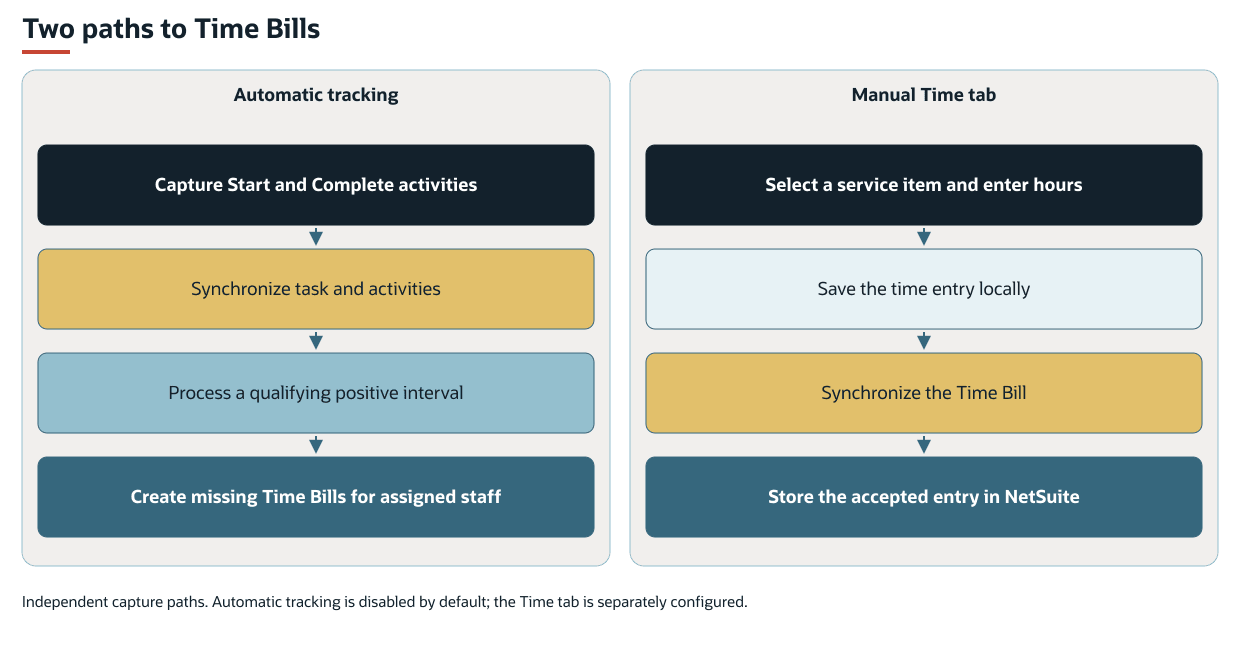
The automatic path is service activities → background time processing → time bills. An eligible CRM task needs a task type with a Service Time Item and Start and Complete activities that produce a positive duration. FSM calculates one start-to-completion interval and creates missing time bills for the task's assigned employee and team.
The Time tab works independently of automatic tracking. When available, the Time tab lets you enter time against a service item and save it for synchronization to NetSuite. Disabling automatic tracking does not remove the Time tab or previously saved time.
Prerequisites
Automatic tracking requires the following setup and data:
-
Track Service Time is enabled for the account.
-
The work is a CRM task with an FSM task type.
-
The task type has a Service Time Item.
-
Start and Complete activity dates and times produce a positive duration.
-
The task's employee, team, customer or project, and service item data are valid for creating NetSuite time entries.
For the supported setup, see Setting Up the Track Service Time Feature.
Key Behaviors
This section describes how the feature responds to different conditions and actions.
Activity Capture
The Start and Complete dialogs initially use the current time for their respective activities. Before completion, you can use the Started button to update the recorded start time. The Complete dialog captures the completion time and prevents confirmation when it is earlier than the recorded start time. Cancel closes the dialog without confirming the action or creating the corresponding activity.
These service-activity times are used to calculate automatic time. Changing these times does not replace the task action timestamps.
With automatic tracking enabled, FSM Mobile prevents starting another job when a job has been started and remains incomplete.
Automatic tracking measures elapsed time from Start to Complete. It does not separately calculate breaks or travel time.
Automatic Time Bills
FSM creates missing automatic time bills for the task's assigned employee and team. Reopening a task or changing its activities does not reverse existing time bills. For duration rounding, entry matching, and processing details, see Automatic Time Bill Processing in FSM.
Entries Through the Time Tab
The standard Time tab lists your entries for the current task. When permitted, you can add, edit, or delete entries through the tab. Its service-item choices are active items made available for FSM Mobile. A time entry requires a service item and Hours. Hours are validated against the tab's configured limits. Invalid entries cannot be saved from the tab.
A local Save queues the entry for synchronization. It does not by itself establish that NetSuite has accepted the time bill. When Project Management is enabled, the standard Time tab prevents changes after the task is completed. Access and completion restrictions can also depend on the tab configuration.
Manual entries are separate from automatic activity-based entries. Entering the same work through both paths can result in separate time bills.
For manual Time tab entries, a synchronization error can leave a save or deletion pending. A local change or a completion display therefore does not establish the final NetSuite result.
Record Interactions
The following table lists the records that supply capture data and store or receive the results.
|
Record |
Role in Service Time Tracking |
|---|---|
|
CRM task |
Supplies the Task Type, assigned employee, team, customer or project, asset, and time-processing request. |
|
Field service activity |
Stores the service Start or Complete date and time, activity employee, and related task. |
|
Field service activity type |
Identifies the Start Task and Complete Task activities used for automatic capture. |
|
Field service task type |
Supplies the Service Time Item for automatic time bills. |
|
Time bill |
Stores the resulting employee, duration, service item, customer or project, task, and asset links. Automatic entries use the task's Field Service End Date as the time-entry date. |
|
Employee |
Receives the generated time entries, which can be viewed from the employee record. |
FSM calculates the automatic duration from the activity dates and times but uses the task's Field Service End Date for the time bill date. This date is separate from the task's Field Service End completion timestamp and the Complete activity date.
Billing rules determine the Billable result and applicable pricing when their requirements are met. Time capture does not itself generate an invoice. See FSM Billing Rules and FSM Case Invoicing.
Processing Model and Lifecycle
Task synchronization and activity synchronization are separate. FSM Mobile can show a task as completed before background time processing and NetSuite status updates finish.
The Field Service Log Activity Time box identifies tasks awaiting time processing. A cleared box means processing finished its assessment, which can happen without creating a time bill. After clearing the request, FSM requests status processing. For request triggers, processing results, and error effects, see Automatic Time Bill Processing in FSM.
Configuration
For the supported settings, defaults, and examples, see Configuring FSM Service Time Tracking.
Account configuration enables or disables automatic tracking. Task type setup selects its Service Time Item. Disabling tracking stops automatic creation and the one-active-job start restriction. Existing activities and time bills remain in place.
Outstanding time requests can be assessed and cleared when automatic tracking is disabled. Enabling it again does not guarantee that those requests will be replayed.
For feature setup, see Setting Up the Track Service Time Feature. For the account control, see Configuring FSM Service Time Tracking.
Time tab presentation, item selection, access, and entry limits are configured separately. Use these references for the settings:
-
FSM Mobile Resource Properties Reference - resource access and completion controls.
-
FSM Mobile Element Reference - Hours validation properties.
-
FSM Searches and Field Mapping - service-item selection and field mappings.
Limitations and Constraints
Automatic Track Service Time supports only CRM tasks. It does not support project tasks.
Track Service Time is enabled at the account level and applies to everyone using FSM Mobile. Its account setting cannot limit automatic tracking to CRM tasks without affecting project tasks. Do not enable automatic tracking when both CRM tasks and project tasks are displayed in FSM Mobile.
A task type's Service Time Item determines eligibility for automatic time bills. It does not limit the FSM Mobile tracking dialogs or the one-active-job restriction to CRM tasks. Consider the account's FSM Mobile task types before enabling the feature.
These restrictions apply to automatic Start and Complete tracking. The standard Time tab provides separate manual time entry and is not controlled by the Track Service Time setting.
Administrative tasks shown in FSM Mobile should remain unstarted, with all tabs enabled, so these tasks do not interfere with service-time tracking.
Automatic capture produces one elapsed interval for a task. It does not turn every activity or repeated Start and Complete cycle into a separate period of work.
Existing-entry matching reduces repeat creation for the same captured interval. It does not detect overlapping work entered manually.
Related Processes and Procedures
The following topics explain the supported capture and viewing activities: