データ侵害や進化し続けるデータ保護およびプライバシ規制の時代において、組織はデータベースが安全であることを確信することがこれまで以上に重要になっています。ただし、データベースが正しく構成されているか、誰がアクセスできるか、どこに機密データが格納されているかを把握することは困難です。Oracle Database Security Assessment Tool (DBSAT)は、データベースの構成、操作または実装によってリスクが発生する領域を識別するのに役立ちます。DBSATは、これらのリスクを軽減するための変更と制御を推奨します。
なぜセキュリティ評価が必要なのか。
正しく構成されていないデータベースは、データベース侵害の主要な原因です。人為的なエラーによって、データベースをすべての人に開放したり、攻撃者が構成ミスを悪用して機密データに不正にアクセスしたりする可能性があります。これにより、評判と収益が壊滅的な影響を受ける可能性があります。データベース構成にリスクが伴う場所を知ることは、そのリスクを最小限に抑えるための最初のステップです。
Oracle Database Security Assessment Toolについて
Oracle Database Security Assessment Tool(DBSAT)は、Oracle Databasesのセキュリティ状態を強化することを目的とした軽量のコマンドライン・ユーティリティです。これにより、リスクの識別に役立つようにデータベース構成、ユーザー・アカウント、その権限、適用されているセキュリティ・ポリシー、および機密データの場所が分析されます。
DBSATを使用すると、規制遵守の取り組みが促進され、セキュリティのベスト・プラクティスの導入が促進されて、リスクの軽減に役立ちます。DBSATは、アクティブなOracleサポート契約を結んでいるお客様の場合は無料です。
Oracle Database Security Assessment Toolを使用する利点
DBSATを使用すると、次のことが可能です。
-
現在のセキュリティ状況を短時間で簡単に評価し、Oracle Database内の機密データを特定する。
-
実績のあるOracle Databaseセキュリティに関するベスト・プラクティス、CISベンチマークの推奨事項およびSecurity Technical Implementation Guides (STIG)のルールを使用してリスク・エクスポージャを減らす。
-
セキュリティ結果を利用して、EU GDPRなどの規制の順守を加速させる。
-
Oracle Databasesのセキュリティ状態を向上させ、セキュリティに関するベスト・プラクティスを推進する。
ノート:
DBSATは、測定できるような形でシステム・パフォーマンスを低下させることのない軽量なユーティリティです。
DBSATレポート結果は、次の目的で使用できます。
-
短期リスクの即時最小化
-
包括的なセキュリティ戦略の実施
-
規制コンプライアンス・プログラムのサポート
-
セキュリティに関するベスト・プラクティスの推進
Oracle Database Security Assessment Toolのコンポーネント
DBSATは、次のコンポーネントで構成されています。
-
Collector:
Collectorは、SQL問合せを実行し、オペレーティング・システム・コマンドを実行して評価対象となるシステムからデータを収集します。これは、主にデータベース・ディクショナリ・ビューに問い合せることで実行されます。収集されたデータは、分析フェーズでDBSAT Reporterによって使用されるJSONファイルに書き込まれます。コレクタがリモートで実行された場合、オペレーティング・システムのデータは収集されないことに注意してください。すべての関連データを収集するには、データベース・サーバーで実行することをお薦めします。
-
Reporter:
Reporterは、収集されたデータを分析し、Oracle Database Security AssessmentレポートをHTML、Excel、JSONおよびテキスト形式で生成します。Reporterは、任意のマシン(PC、ラップトップ、サーバー)で稼働できます。Reporterの実行は、データベース・サーバーや、Collectorと同じマシンに限定されません。
-
Discoverer:
Discovererは、SQL問合せを実行して、構成ファイルで指定された設定に基づいて評価対象となるデータベースからメタデータを収集します。これは、主にデータベース・ディクショナリ・ビューに問い合せることで実行されます。収集したデータは、その後、Oracle Database Sensitive Data AssessmentレポートをHTML、CSVおよびJSON形式で生成するために使用されます。Discovererは、任意のマシン(PC、ラップトップ、サーバー)で稼働できます。Discovererの実行は、データベース・サーバーや、CollectorまたはReporterと同じマシンに限定されません。
次の図に、Oracle Database Security Assessment Toolのコンポーネント、ソースおよびレポーを示します。
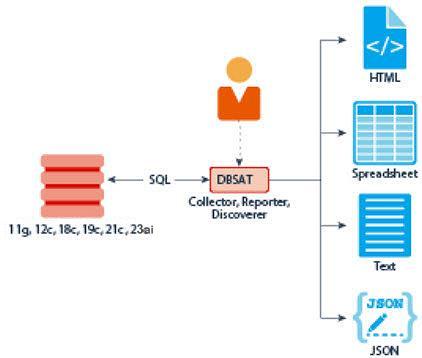
DBSATでは、デフォルトで、暗号化した出力ファイルが生成されます。それらのファイルを復号化するには、dbsat extractコマンドを使用する必要があります。
Collector、ReporterおよびDiscovererの詳細は、CollectorおよびReporterの使用を参照してください。
サポートされているオペレーティング・システム
データベース構成の収集の問合せは、サポートされているほとんどのOracle Databaseプラットフォームで実行できます。ただし、DBSATでは、Windowsプラットフォームで実行されているデータベースの場合やCollectorがリモートで実行されている場合は、オペレーティング・システム(OS)データは収集されません。
DBSATの動作対象は、次のとおりです。
- Linux x86-64およびLinux 64ビットARM
- Windows x64
次のプラットフォームの場合は、JDK 17を使用できません。そのため、-nフラグの使用によって、出力を暗号化せずにCollectorを実行する必要があります:
- Solaris x64
- Solaris SPARC64
- IBM AIX (64ビット)
- Linux on zSeries (64ビット)
- HP-UX IA (64ビット)
サポートされているデータベース・バージョン
DBSATは、Oracle Database Standard Edition 2およびOracle Database Enterprise EditionのOracle Database 11.2.0.4以降のリリースでオンプレミスまたはクラウドで実行できます。Autonomous Database (Serverless、DedicatedおよびCloud@Customer)、Autonomous JSON Database、Oracle Exadata Database Service (DedicatedおよびCloud@Customer)、Oracle Base Database Service (BaseDB Enterprise EditionおよびStandard Edition)に対してDBSATを実行することもできます。一部の所見では、これらのデータベースに対して様々なチェックを実行し、ターゲットを絞った注釈を提供します。ターゲット固有のチェックおよび推奨事項の詳細は、「付録A」を参照してください。
セキュリティ要件
-
このようなファイルを格納するディレクトリが適切な権限で保護されるようにする。
-
このようなファイルが対象となる推奨事項を実施した後、ファイルを安全に削除する。
-
他のユーザーとは(デフォルトで)暗号化された形式で共有する。
-
DBSATユーザーにユーザー権限を短期的に付与し、不要となったら取り消す。
DBSATユーザー権限の詳細は、Collectorの前提条件を参照してください。DBSATのベスト・プラクティスの詳細は、「ベスト・プラクティス」を参照してください
注意:
このツールは、システムの潜在的な機密データおよび脆弱性の特定を支援することを目的としています。さらに、このツールによって生成された出力には、潜在的に機密性の高いシステム構成データや、熟練した攻撃者がシステムへの侵入に使用する可能性がある情報が含まれる場合があります。生成されたレポートを含め、このツールの出力が自社のポリシーに従って処理されることを確実に実行する全責任があります。
Oracle Database Security Assessment Toolの前提条件
Unix/LinuxシステムのDBSATは、BASHシェルで実行する必要があります。サーバーにこのシェルがない場合は、このシェルをインストールするか、DBSATを所有している別のサーバー(またはWindowsを実行しているラップトップからデータベースに接続できる場所)からリモートで実行できます。
Collectorの前提条件
必要なデータをすべて収集するには、データベースをホストするサーバーでDBSAT Collectorを実行します。コレクタは、オペレーティング・システム・コマンドを使用して、データベースのみでは提供できないプロセスおよびファイル・システム情報を収集します。また、(Oracle DatabaseまたはInstant Clientを介して) SQL*Plusを使用して(Oracle DatabaseまたはInstant Clientを介して) ORACLE_HOME内のファイルおよびディレクトリに対して読取り権限を持つOSユーザーとしてOracle DBSAT Collectorを実行し、OSコマンドを使用してファイル・システム・データを収集して処理する必要があります。TDEを使用している場合は、ウォレットが開かれていることを確認してください。
Oracle DBSAT Collectorは、データベース・ビューに問い合せることで、ほとんどのデータを収集します。これらのビューから選択するのに十分な権限を持つユーザーとしてデータベースに接続する必要があります。DBSATユーザーに次の権限を付与します。
-
CREATE SESSION -
SYS.REGISTRY$HISTORYに対するREADまたはSELECT -
ロール
SELECT_CATALOG_ROLE -
ロール
DV_SECANALYST(Database Vaultが有効な場合、またはDatabase Vault Operations Controlが有効な場合) -
ロール
AUDIT_VIEWER(12c以降) -
ロール
CAPTURE_ADMIN(12c以降) -
SYS.DBA_USERS_WITH_DEFPWDに対するREADまたはSELECT SYS.DBA_AUDIT_MGMT_CONFIG_PARAMS上のREADSYS.DBA_CREDENTIALS上のREADSYS.DBMS_SQL上のEXECUTE
ノート:
デフォルトでは、DBSAT Collectorにより、出力ファイルが暗号化されて機密データが保護されます。このためには、システムにJDK 17以上をインストールする必要があります。AIX、SolarisおよびHP-ItaniumではJDK 17を使用できないため、これらのプラットフォームでの実行時はdbsat collect -n を使用して暗号化を無効にします。
評価対象のOracle Databaseがこれらのプラットフォームのどれかで実行されている場合は、次の2つのオプションがあります:
-nを指定してデータを収集し、そのファイルをJDK 17があるシステムに転送し、そこでReporterを実行します。- JDK 17がインストールされておりデータベースに接続できるシステムから、リモートで
dbsat collectを実行します。
暗号化されていないファイルは必ず注意して扱い、使用後に安全に削除してください。
最小権限を持つユーザーを作成するためのサンプル・スクリプト
スクリプトを使用して、Oracle Database Security Assessment Tool Collectorを実行するために必要な最小権限を持つユーザーを作成できます。
目的
DBSAT Collectorスクリプトを実行するために必要な権限を持つDBSATユーザーを作成します。
サンプル・スクリプト
create user dbsat_user identified by dbsat_user;
--If Database Vault is enabled, connect as DV_ACCTMGR to run this command
grant create session to dbsat_user;
grant select_catalog_role to dbsat_user;
grant select on ctxsys.ctx_indexes to dbsat_user;
grant select on sys.registry$history to dbsat_user;
grant read on sys.dba_audit_mgmt_config_params to dbsat_user;
grant select on sys.dba_users_with_defpwd to dbsat_user;
grant read on sys.dba_credentials to dbsat_user;
grant execute on sys.dbms_sql to dbsat_user;
grant audit_viewer to dbsat_user; // 12c and later
grant capture_admin to dbsat_user;// 12c and later covers sys.dba_priv_captures, sys.priv_capture$, sys.capture_run_log$
--If Database Vault is enabled, connect as DV_OWNER to run these commands
  grant DV_SECANALYST to dbsat_user;
  exec dbms_macadm.authorize_audit_viewer('dbsat_user'); // 23ai and later
  exec dbms_macadm.add_auth_to_realm('Oracle Label Security', 'dbsat_user', null, dbms_macutl.g_realm_auth_participant);
Reporterの前提条件
ReporterはJavaプログラムであり、実行にはJava Runtime Environment (JRE) 17 (jdk17)以降が必要です。
JAVA_HOME環境変数を設定する必要があり、システム上のインストール・ディレクトリ(binディレクトリとlibディレクトリを含む)を指している必要があります。例:
$ export JAVA_HOME=/usr/lib/jvm/jdk-17.0.14-oracle-x64/ノート:
DBSATのReporterコンポーネントには、少なくともJDK17が必要です。AIX、SolarisおよびHP-Itaniumプラットフォームの場合、使用可能な最新のJDKはバージョン11です。JDK17のないプラットフォームの場合、収集したJSONの暗号化は実行できません。ユーザーは、-nオプションを使用し、明示的にzipまたはその他のコマンドを使用して同じものを暗号化する必要があります
Oracle JDKまたはOracle JREを使用するOracle製品のOracle顧客は、Oracle Java SE Subscriptionを別途購入することなく、使用権許諾されたOracle製品での使用のためにOracle Java SEの更新、パッチおよびツールをダウンロードし使用する権利を有します。顧客は、Oracle製品に必要なJava SEバージョンをダウンロードする権利のみを有します。詳細は、データベース・ライセンス情報ユーザー・マニュアルを参照してください。
Discovererの前提条件
DiscovererはJavaプログラムであり、実行にはJava Runtime Environment (JRE) 17 (jdk17)以降が必要です。
JAVA_HOME環境変数を設定する必要があり、システム上のインストール・ディレクトリ(binディレクトリとlibディレクトリを含む)を指している必要があります。例:$ export JAVA_HOME=/usr/lib/jvm/jdk-17.0.14-oracle-x64/Discovererは、データベース・ディクショナリ・ビューからメタデータを収集し、機密データを検出するために指定されたパターンと照合します。Discovererは、これらのビューから選択するのに十分な権限を持つユーザーとしてデータベースに接続する必要があります。DBSATユーザー権限の詳細は、Collectorの前提条件を参照してください。
ノート:
DBSATのDiscovererコンポーネントには、少なくともJDK17が必要です。AIX、SolarisおよびHP-Itaniumプラットフォームの場合、使用可能な最新のJDKはバージョン11です。これらのプラットフォームの場合は、JDK17をサポートしている別のラップトップまたはサーバーからリモートでDiscovererを実行する必要があります。
Discovererは、行数を取得する場合、表の統計情報に依存します。正確な行数の結果を取得するには、DBSATユーザーがDiscovererを実行する前に、データベース管理者がDBMS_STATSを実行する必要があります。
Oracle Database Security Assessment Toolのインストール
これらのコマンドはLinux/Unix用です。Windowsでインストールを行う場合は、Windows用の同等のコマンドを使用します。
DBSATがデータベース・サーバーにインストールされます。
Collector、ReporterおよびDiscovererは、/home/oracle/dbsatディレクトリから実行できます。
また、このディレクトリをPATHに追加し、ツールを実行するたびにディレクトリに移動するステップを省くこともできます。
CollectorおよびReporterの使用
Collector、ReporterおよびDiscovererコンポーネントを使用して、Oracle Database Security AssessmentレポートおよびOracle Database Sensitive Data Assessmentレポートを生成できます。
Oracle Database Security Assessmentレポート
CollectorおよびReporterコンポーネントを使用して、Oracle Database Security Assessmentレポートを生成します。
次の図に、CollectorおよびReporterのコンポーネントとアーキテクチャを示します。
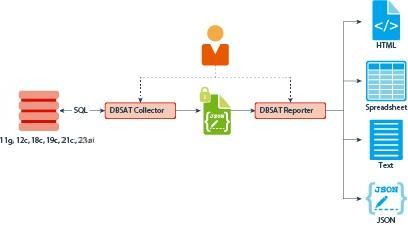
Collectorの実行
Collectorは、データベースに問い合せて、Reporterによって分析されるデータを収集します。
ノート:
Collectorはデータベースに接続します。Collectorを実行する前に、ターゲット・データベースおよびリスナーが稼働していることを確認してください。Reporterの実行
Reporterは、Collectorによって収集されたデータを分析し、データベースのセキュリティを改善するための推奨事項を作成します。
dbsat reportを使用して起動できます。
ノート:
DBSATの推奨事項は、個々のアプリケーションにあわせて調整されるわけではありません。アプリケーション要件がDBSATと異なる場合は、多くの場合、そのまま結果を受け入れる必要があり、他の制御によって結果を軽減できます。リスクが高すぎて受け入れることができないかぎり、通常、アプリケーション要件はDBSATの推奨事項より優先されます。Oracle Database Security Assessmentレポート
CollectorおよびReporterコンポーネントを使用して、Oracle Database Security Assessment (DBSAT)レポートをHTML、Excel、JSONおよびテキスト形式で生成します。すべてのレポートには同様の情報が含まれますが、形式は異なります。
HTMLレポートでは、詳細なアセスメント結果をナビゲートしやすい形式で示します。Excel形式では、HTMLレポートに含まれる詳細出力がない各結果の概要を示します。また、追跡および優先度付けのために列を追加できます。テキスト形式のレポートは、別の使用目的で出力の一部をコピーできるので便利です。また、レポート・コンテンツが含まれるJSONドキュメントがフィルタリング、比較、集計および他のツールとの統合をしやすくするために提示されます。
次のデータベース・セキュリティ・アセスメント・レポートの各セクションでは、HTMLレポートを例として使用し、属しているセクション、ルールIDおよび簡単な説明とともに結果を強調表示しています。
レポートの上部には、データ収集日やレポート生成日などのCollectorおよびReporterの実行詳細と、Reporterバージョンに関する情報が表示されます。データベース識別情報の後に、ターゲット・データベースの詳細が表示されます。次に、サマリー表には、セクション/ドメインごとのすべての結果とその重大度レベルが表示されます。
結果
DBSAT Reporterの結果分析は、結果と呼ばれる単位でレポートされ、各結果には次が表示されます。
- ルールID: ルールIDは接頭辞と接尾辞の2つに分かれており、接頭辞はレポート・セクションを識別し、接尾辞は特定のルールを識別します。
- 1行のサマリー: 各チェックの目標とコンテキストを強調する1行のサマリーです。
-
ステータス: ステータスはDBSAT推奨事項の実装に優先順位を付けるのに役立ちます。結果に関連するリスクのレベルを示し、修正について十分な情報に基づいて決定できます。
- 高リスク
迅速な対処が必要です。
- 中リスク
短期間でこれに対処するように計画します。
- 低リスク
スケジュールされた停止時間中に修正することも、その他のメンテナンス・アクティビティにまとめることもできます。
- 評価
手動による分析が必要です。
- アドバイザリ
改善の機会が与えられ、Oracle Databaseで利用できる他のセキュリティ制御についての認識を高めます。
-
合格
リスクが見つかりませんでした。
- 高リスク
- サマリー: 結果のサマリーが表示されます。結果が情報の場合、サマリーには通常、調査されたデータ要素の数のみがレポートされます。
- 詳細: 結果のサマリーを説明する詳細情報(通常は評価されたデータベースからの結果)の後に、変更に関する推奨事項が示されます。
- 注釈: ルールの理由と推奨される改善措置について説明します。
- 参考: 結果が、Oracle Database 19c STIG V1R1、Oracle Database 19c CIS Benchmark v1.2の推奨事項、またはGDPRの条項/詳説に関連するOracle推奨プラクティス(ORP)である場合は、それがここで説明されます。
- ドキュメント: 評価されたOracle Databaseがバージョン19cまたは23aiである場合は、DBSATで、各結果の注釈に関連するドキュメント・リンクが表示されます。
セキュリティ・フレームワークと推奨プラクティス
DBSATでは、Oracleデータベースでの潜在的なセキュリティ・リスクを識別するために、Oracle推奨プラクティス、Center for Internet Security (CIS)ベンチマーク、および米国国防総省情報システム局(DISA)のOracle Database用セキュリティ技術導入ガイドライン(STIG)が統合されています。
最初はDBSATでは主にSTIGとCISベンチマークに焦点が当てられていましたが、バージョン3.0以降では、Oracle独自の推奨プラクティスに沿った結果にも重点が置かれています。
一部のチェックは、Oracle推奨プラクティス(ORP)としてのみ表されます。これは、リリース・サイクルの違いやOracleの内部動作のより深い理解など、様々な要因による可能性があります。たとえば、Oracleでは新機能がリリースされますが、標準に含めるには何年もかかる場合があります。例として、Oracleは2021年にOracle Database 19cで段階的パスワード・ロールオーバーを導入しましたが、2024年4月まではSTIGまたはCISには反映されませんでした。
多くの場合、複数のセキュリティ・フレームワークで同様の要件がカバーされ、それに応じてDBSATで結果がタグ付けされます。たとえば、データベース・ユーザー・アカウントのデフォルト・パスワードの回避がCISとSTIGの両方で推奨されている場合、DBSATでは、その結果が、両方のフレームワークのタグでマークされます。これはOracle推奨プラクティスであるため、それにはORPタグでもフラグが付けられます。
DBSATのタグ付けシステムにより、ユーザーはコンプライアンス標準に関連する結果に集中できます。STIGのコンプライアンス、CISベンチマークの遵守、Oracleのベスト・プラクティスとの整合性のいずれを求めている場合でも、ユーザーは特定の要件に基づいて結果を簡単に検索し、優先順位を付けることができます。
- STIG 19c V1R1
- Oracle Database 19c CISベンチマークv1.2.
- Oracle推奨プラクティス
- EUの一般データ保護規則(EU GDPR) 2016/679の条項および詳説
ノート:
推奨事項は、データベース・セキュリティに関するベスト・プラクティスを反映しており、設計およびデフォルトによるデータ保護に関する戦略の一部となります。
EU GDPRのタグ付きの結果は、EU GDPRの条項および詳説、同様の要件を持つその他のデータ・プライバシ規則に対処するのに役立つ技術を強調しています。技術的な制御のみでは、コンプライアンスには不十分です。すべての結果に合格してもコンプライアンスは保証されません。
セクション
- データベース・セキュリティの基本
- ユーザー・アカウント
- 権限およびロール
- 監査
- 暗号化
- 認可制御
- ファイングレイン・アクセス制御
- データベース構成
- ネットワーク構成
- オペレーティング・システム
Oracle Database Security Assessmentレポート — サマリー
Oracle Database Security Assessmentレポート - サマリー・セクションには、次の情報が含まれます。
| セクション | 説明 |
|---|---|
|
評価日時 |
データが収集された日付および最後のデータベース・セキュリティ・アセスメント・レポートが生成された日付が表示されます。DBSAT Reporterのバージョンも表示されます。 |
|
データベース識別情報 |
DBSATによって評価されたデータベースの詳細が表示されます。 |
|
サマリー |
分析結果の概要が表示されます。 |
図1-3 Oracle Database Security Assessmentレポート — サマリー
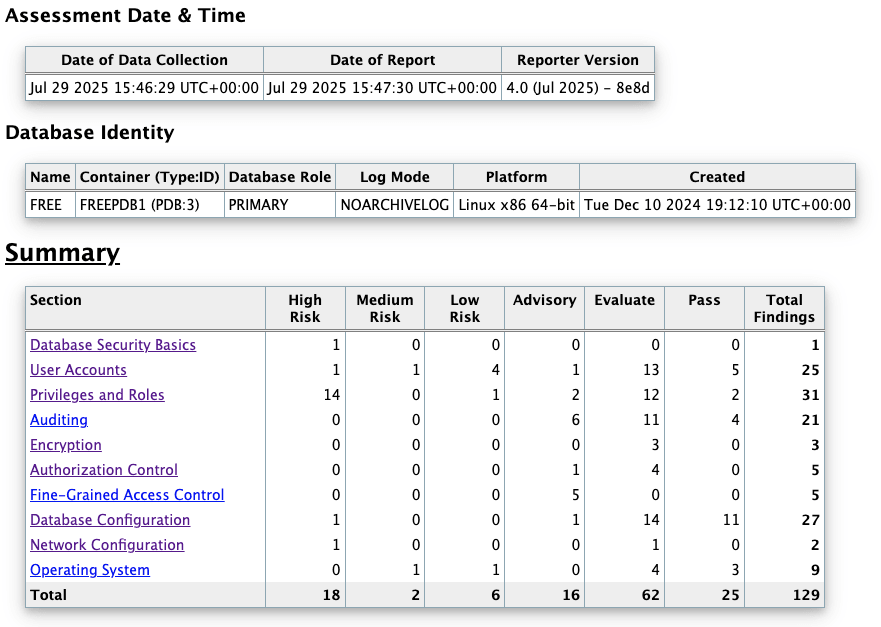
サマリーセクションの次には、データベース・セキュリティの基本セクションが表示されます。
Oracle Database Security Assessmentレポート — データベース・セキュリティの基本
Oracle Database Security Assessmentレポート — データベース・セキュリティの基本セクションは、次の情報が含まれています:
| セクション | 結果ID | 説明 | リンク |
|---|---|---|---|
|
データベース・バージョン |
- |
CollectorおよびReporterによって評価されたデータベースのバージョンが表示されます。使用されているセキュリティ・オプション、およびデータベースの起動時間が含まれています。 |
- |
|
使用されているセキュリティ機能 |
- |
セキュリティ機能およびそれらが使用中かどうかが表示されます。 |
- |
|
パッチ・チェック |
INFO.PATCH |
インストールされているパッチ、およびそのデータベースが危険にさらされているCVEについて、情報が表示されます。 セキュリティ修正がリリースされたら適用して、データベース・ソフトウェアを最新の状態に保つことが重要です。オラクルは、定期的な四半期スケジュールで、リリース更新の形式で包括的なパッチを発行します。パッチ・セット更新およびバンドル・パッチは、12.1.0.2までのデータベース・バージョンで使用可能でした。 |
次の図では、Oracle Database Security Assessmentレポート — データベース・セキュリティの基本セクションの例を示します。
図1-4 Oracle Database Security Assessmentレポート — データベース・セキュリティの基本
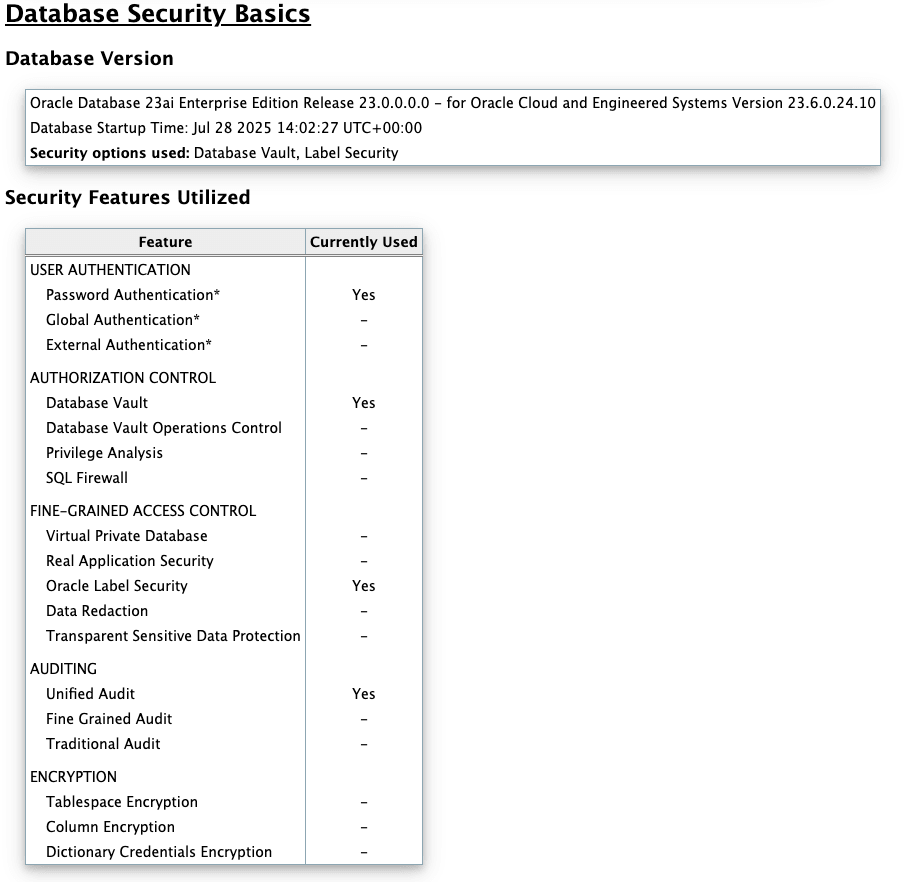
データベース・セキュリティの基本セクションの次には、ユーザー・アカウントセクションが表示されます。
Oracle Database Security Assessmentレポート — ユーザー・アカウント
Oracle Database Security Assessmentレポート - ユーザー・アカウント・セクションには、次の情報が表示されます。
| 名前 | 結果ID | 説明 | リンク |
|---|---|---|---|
|
ユーザー・アカウント |
- |
ユーザー・アカウントおよび各アカウントの次の情報が表示されます。
|
- |
|
DEFAULTプロファイルを持つユーザー |
USER.DEFAULTPROFILE | DEFAULTユーザー・プロファイルのパスワードとリソース・パラメータ、およびその中のユーザー数を表示します。 | |
|
デフォルト・パスワードのユーザー |
USER.DEFPWD |
デフォルト・パスワードのユーザー・アカウントに関する情報が表示されます。 Oracleの事前定義済アカウントのデフォルトのアカウント・パスワードはよく知られています。デフォルト・パスワードのアクティブなアカウントがあれば攻撃者が簡単に侵入できますが、よく知られたパスワードはロック済アカウントでも変更しておいてください。 |
|
|
パスワードが期限切れのユーザー |
USER.EXPIRED |
パスワードが期限切れのユーザー・アカウントに関する情報が表示されます。 ユーザーがパスワードを定期的に変更するようにパスワード期限を使用します。パスワードの有効期限が切れたアカウントのロックを解除すると、特にアカウントが古くなるにつれて、セキュリティ・リスクが発生する可能性があります。パスワードは期限切れですが、アカウントのロックが解除されているため、古いパスワードを知っているユーザーが簡単に使用できます。長期間使用されていないアカウントを調査して、アクティブのままにしておくかどうかを判断してください。 |
|
|
非アクティブ・ユーザー |
USER.INACTIVE |
使用されていないユーザー・アカウントおよび非アクティブ時にロックされるように構成されていないアカウントに関する情報が表示されます。 ユーザー・アカウントが使用されなくなると、システムの攻撃可能面を不必要に増やしてしまいますが、それに見合うメリットはありません。さらに、アカウントを定期的に使用していなければ、認可されていない使用に気づかない可能性が高くなります。30日を超えて使用されていないアカウントは調査して、アクティブのままにしておくかどうかを判断してください。ユーザーに割り当てられたプロファイルの |
|
|
サンプル・スキーマ |
USER.SAMPLE |
データベース内の可能性のあるサンプル・スキーマ( サンプル・アカウントは開発者向けの簡単な例としてOracleが提供するよく知られたアカウントです。通常これらは本番データベースでは使用しませんが、データベースの攻撃可能面を不必要に増やすことになるため削除してください。 |
|
|
アプリケーション所有者アカウント |
USER.APPOWNER |
アプリケーション所有者とみなされるアカウント、およびアプリケーション所有者がアクセスできるオブジェクトのデータベースをチェックします。データベース内のほとんどのオブジェクトを所有するOracle管理されていないユーザーは、アプリケーション所有者とみなされます。これにより、次のことがチェックされます。
|
|
|
共有アカウント |
USER.SHARED |
複数の管理権限およびプロキシ・ユーザーを持つユーザーを表示します。 |
|
|
オブジェクト付きユーザー |
USER.OBJOWNER |
オブジェクトを所有し、それらのオブジェクトへのアクセス権を他のユーザーに付与できるアプリケーション・ユーザーを表示します |
|
|
オブジェクト所有権の承認済ユーザー |
USER.OBJAUTHZ | オブジェクトを所有するoracle管理でないユーザーを表示します | |
|
セキュリティ・オブジェクトを持つユーザー |
USER.SECURITYOBJS |
セキュリティ・オブジェクトを所有するユーザーを表示します |
|
|
付与オプションを持つユーザー |
USER.GRANTOPTION |
|
|
|
機密データを持つユーザー |
USER.SENSITVEDATA |
TSDPで機密としてマークされた列を持つ表を所有するユーザーと、それらの表にアクセスできるユーザーを表示します。 機密情報へのセキュアなアクセスを確保するには、これらのユーザーを確認します。個々のアカウントに直接アクセスするのではなく、ロールを介してデータへのアクセス権を付与することをお薦めします。 |
|
|
SYSTEMまたはSYSAUX表領域のユーザー・スキーマ |
USER.TABLESPACE |
Oracle提供の予約済表領域をデフォルトの表領域として使用しているか、それらにオブジェクトを格納してある、通常のユーザー・アカウントについて情報が表示されます。
|
|
|
大/小文字を区別するパスワード |
USER.PASSWORDCASE |
大/小文字を区別するパスワードが有効かどうかが表示されます。 大/小文字を区別するパスワードを使用すると大文字と小文字の両方が含まれるため、しらみつぶしに検索してパスワードを推測しようとする攻撃者が検索する必要があるパスワードの組合せが大幅に増えるので、使用することをお薦めします。 ノート: 21cでは、SEC_CASE_SENSITIVE_LOGONがサポート終了となるため、USER.PASSWORDCASEは表示されなくなる見込みです
|
|
|
旧バージョンのパスワード |
USER.AUTHLEGACY |
廃止されたパスワード・ベリファイアを使用しているユーザー・アカウントに関する情報が表示されます。 ユーザー・アカウントごとに、複数のベリファイア(ユーザー・パスワードのハッシュ)がデータベースに保存されている場合があります。各ベリファイアでは、異なるバージョンのパスワード認証アルゴリズムがサポートされています。クライアントでサポートされている最新のアルゴリズムでユーザーを認証できるように、データベースでサポートされている最新バージョンのパスワード・ベリファイアをすべてのユーザー・アカウントに含めてください。すべてのクライアントを更新したら、廃止されたベリファイアを削除してユーザー・アカウントのセキュリティを向上できます。XMLデータベースの認証には、HTTPパスワード・ベリファイアが使用されます。このアクセスが必要ではないユーザー・アカウントからは、 |
|
|
ユーザー・プロファイル |
- |
ユーザー・プロファイルに関する情報が表示されます。 |
- |
|
パスワードの複雑度要件のないユーザー |
USER.PASSWORDFUNCTION |
パスワードの複雑度を検証する機能があるプロファイルとないプロファイルに関する情報が表示されます。パスワードの複雑度を検証する対象でないユーザーも表示されます。 パスワード検証機能は、ユーザーのパスワードが複雑さの最小要件を満たしていることを確認するために使用します。これには、長さ、数字や句読点文字の使用、前のパスワードとの差異などの要素が含まれる場合があります。Oracleが提供する事前定義済関数やカスタムPL/SQL関数を使用できます。パスワード検証機能はすべてのユーザー・プロファイルに含めてください。 |
|
|
ログイン試行失敗後のアカウントのロック |
USER.NOLOCK |
ユーザー・プロファイルのログイン試行の失敗の強制に関する情報が表示されます。 一般的なパスワード・セットのすべての可能性を単純に試行して、ユーザーのパスワードを推測しようとする攻撃者もいます。この攻撃に対する防御として、 |
|
|
パスワードの期限切れが近いユーザー |
USER.TOEXPIRE |
30日以内にパスワードが期限切れになるユーザー・アカウントについて情報が表示されます。 期限切れが近いアカウントを確認し、必要に応じてそのパスワードを変更して、中断のないデータベース・アクセスを維持する必要があります。 |
|
|
パスワード存続期間無制限のユーザー |
USER.NOEXPIRE |
ユーザー・プロファイルのパスワード有効期間の強制に関する情報が表示されます。 ユーザーがパスワードを定期的に変更するようにパスワードに期限を設定します。一時アカウントを自動的に無効にするメカニズムも提供されています。失効しないパスワードは長期間にわたって変更されない可能性があります。パスワードを定期的に変更する必要がないと、同じパスワードを複数のアカウントにユーザーが使用する可能性も高くなります。 |
|
|
同時セッションが無制限のユーザー |
USER.SESSIONS |
|
|
|
無制限のセッション・アイドル時間 |
USER.IDLETIME |
このチェックでは、UNLIMITED IDLE TIMEのユーザーがリストされます |
|
| 段階的パスワード・ロールオーバーがあるユーザー | USER.PASSWORDROLLOVER |
段階的パスワード・ロールオーバーに関する情報が表示されます。 段階的パスワード・ロールオーバーを使用すると、管理者は停止時間をスケジュールしなくてもアプリケーションのデータベース・パスワードを変更できます。段階的パスワード・ロールオーバー機能が登場する前、データベース管理者はデータベース・パスワードがローテーションしている間アプリケーションを停止しておく必要がありました。これは、パスワードの更新にデータベース側とアプリケーション側の両方で変更が必要になったためです。段階的データベース・パスワード・ロールオーバーにより、アプリケーションで新しいパスワードが構成されるまで、アプリケーションは古いパスワードを引き続き使用できます。これを行うために、データベース管理者は、 |
|
|
一時ユーザー |
USER.TEMP |
DEFAULTプロファイルに関連付けられたユーザーが表示されます。 一時タスクを実行するために特別に作成されたユーザーは、その目的のために調整されたプロファイルに配置する必要があります。 |
|
|
本番データベースの開発ユーザー |
USER.DEV |
本番システムに開発者アカウントはありません。そのようなアカウントがデータベースに存在するかどうかを確認します。 |
|
|
アドバンスト・レプリケーション・ユーザー |
USER.REPCAT |
Oracle Advanced Replicationが使用されているかどうかを確認し、レプリケーションに使用されるdblinkをリストします。
|
- |
|
最小クライアント認証バージョン |
USER.AUTHVERSION |
時間の経過とともに、ユーザー・アカウントのパスワード認証用に、よりセキュアなアルゴリズムがOracleのリリースでサポートされるようになっています。古いクライアント・ソフトウェアとの互換性を維持するために、以前のバージョンのパスワードもデータベースで引き続きサポートされています。 |
|
|
パスワードをリセットする必要がある新規ユーザー |
USER.NEW |
アカウント作成後にログインしていないユーザー・アカウントについて情報が表示されます。 アカウントの作成時またはリカバリ時に新しいパスワードをすぐに選択する必要があるようにデータベース管理システムが構成されていることを確認する必要があります。 |
ドキュメント・リンクなし |
|
ローカルで管理されているアカウント |
USER.LOCALAUTH |
これはSTIG固有のチェックです。ローカルで管理されている(パスワードベースの認証を使用)、oracle管理でないアカウントについて情報が表示されます。 STIGでは、データベースによって管理されているすべてのユーザー・アカウントが、明示的に承認されている必要があり、システム・ドキュメントに含まれている必要があります。リストされているアカウントの正当性と承認について、システム・ドキュメントを確認する必要があります。 |
ドキュメント・リンクなし |
|
PKIベースの認証 |
USER.EXTERNALAUTH |
外部で認証されたユーザー・アカウントについて情報が表示されます。 |
ドキュメント・リンクなし |
ノート:
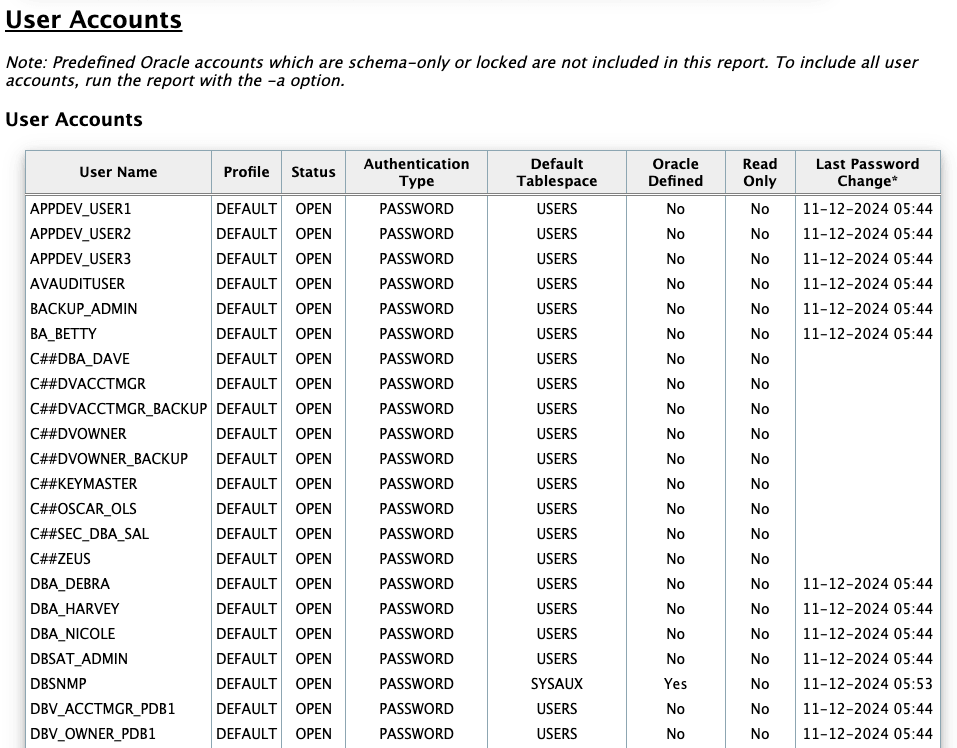
スキーマ専用またはロックされている事前定義済のOracleアカウントは、このレポートに含まれません。すべてのユーザー・アカウントを含めるには、-aオプションを指定してレポートを実行します。
次の図に、Oracle Database Security Assessmentレポート — ユーザー・アカウント・セクションの例を示します。
図1-5 Oracle Database Security Assessmentレポート — ユーザー・アカウント
ユーザー・アカウント・セクションの次には、権限およびロール・セクションが表示されます。
Oracle Database Security Assessmentレポート — 権限およびロール
Oracle Database Security Assessmentレポート - 権限およびロール・セクションには、次の情報が表示されます。
| 名前 | 結果ID | 説明 | リンク |
|---|---|---|---|
|
パスワード・ベリファイア表に対するアクセス権 |
PRIV.ACCESSVERIFIERS |
ユーザーに付与されているパスワード・ベリファイア表に対するアクセス権が表示されます。 これらの権限があるユーザーは、ユーザー・パスワード・ベリファイアを含むオブジェクトにアクセスできます。ベリファイアをオフライン攻撃で使用すればユーザーのパスワードを発見できる場合があります。 |
|
|
管理権限SYS*権限を持つユーザー |
PRIV.SYSADMIN |
ユーザー・アカウントに付与されている管理権限が表示されます。 管理権限のあるユーザーは保守作業を実行できますが、データベースがオープンしていないときに発生する可能性がある作業もこれに含まれます。 |
|
|
DBAロールを持つユーザー |
PRIV.DBA |
DBAまたはPDB_DBAロールを付与されたユーザー・アカウントが表示されます。 DBAロールは非常に強力で、多くのセキュリティ保護をバイパスするために使用できます。これは、信頼できる少数の管理者にのみ付与する必要があります。さらに、説明責任上の理由から、信頼できるユーザーごとに個別のアカウントを作成してください。他の強力なロールと同様に、絶対に必要な場合以外は、管理オプションでDBAロールを付与しないでください。 |
|
|
強力なロールを持つユーザー |
PRIV.BIGROLES |
最大のデータ・アクセス権限があるロールを付与されたユーザー・アカウントが表示されます。 DBAロールと同様に、これらのロール( |
|
|
システム権限付与 |
PRIV.SYSTEM |
ユーザーに付与されているシステム権限が表示されます。 システム権限があれば、データにアクセスしたり、データベース全体に対する管理操作を行えます。最小権限の原則に従って、これらの権限は慎重に付与してください。受け手が他のユーザーに権限を付与する必要がある場合にのみ、管理オプションを使用してシステム権限を付与してください。
|
|
|
スキーマ権限の付与 |
PRIV.SCHEMA |
ANYシステム権限とスキーマレベルの権限があるユーザー・アカウントについて情報が表示されます。 これにより、 |
|
|
PUBLICに付与されたシステム権限 |
PRIV.SYSPUBLIC |
|
|
|
PUBLICに付与されたロール |
PRIV.ROLEPUBLIC |
|
|
|
PUBLICに付与された列権限 |
PRIV.COLPUBLIC |
|
|
|
PUBLICからアクセス可能なオブジェクト |
PRIV.OBJPUBLIC |
PUBLICからアクセス可能なオブジェクトを表示します。 |
|
|
PUBLICに付与された暗号化パッケージ |
PRIV.ENCRYPTPACKAGEPUBLIC |
DBMS_CRYPTO、DBMS_OBFUSCATION_TOOLKITおよびDBMS_RANDOM付与をPUBLICに表示します。 |
|
|
PUBLICに付与されたスケジューラ・ジョブ・パッケージ |
PRIV.JOBSCHPACKAGEPUBLIC |
DBMS_SCHEDULERおよびDBMS_JOB EXECUTE付与をPUBLICに表示し、スケジューラ/JOBシステム権限(CREATE JOB、MANAGE SCHEDULER、CREATE EXTERNAL JOB、CREATE ANY JOB)付与をPUBLICに表示します。 |
|
|
PUBLICに付与された資格証明パッケージ |
PRIV.CREDPACKAGEPUBLIC |
DBMS_CREDENTIALパッケージのEXECUTE権限をPUBLICに表示します。また、ユーザーに対するCREATE CREDENTIALおよびCREATE ANY CREDENTIALの権限付与も確認します。 |
|
|
PUBLICに付与されたファイル・システム・パッケージ |
PRIV.FILESYSTEMPACKAGEPUBLIC |
DBMS_LOB、UTL_FILEおよびDBMS_ADVISORパッケージのEXECUTE権限をPUBLICに表示します。また、ユーザーに対するCREATE ANY DIRECTORYおよびDROP ANY DIRECTORYのシステム権限付与も確認します。 |
|
|
PUBLICに付与されたネットワーク・パッケージ |
PRIV.NETPACKAGEPUBLIC |
DBMS_LDAP、UTL_HTTP、UTL_INADDR、UTL_SMTPおよびUTL_TCPパッケージに対するEXECUTE権限をPUBLICに表示します。また、ACL経由でパッケージを実行する権限があるユーザーも確認します。 |
|
|
PUBLICに付与されたSQLパッケージ |
PRIV.QUERYPACKAGEPUBLIC |
DBMS_XMLQUERY、DBMS_XMLSAVE、DBMS_XMLSTORE、DBMS_REDACT、DBMS_XMLGENおよびDBMS_SQLパッケージに対するEXECUTE権限をPUBLICに表示します。 |
|
|
PUBLICに付与されたJAVA権限 |
PRIV.JAVAPACKAGEPUBLIC |
DBMS_JAVAおよびDBMS_JAVA_TESTパッケージに対するEXECUTE権限をPUBLICに表示します。また、ユーザーへのJAVA_ADMINロールの付与も確認します。 |
|
|
幅広いデータ・アクセス権限 |
PRIV.ANYSYSTEM |
システム権限(ANY)が付与されているユーザー・アカウントについて情報が表示されます。 |
ドキュメント・リンクなし |
|
アクセス権限の付与 |
PRIV.CONTAINERACCESS |
コンテナ権限付与が設定されている共通ユーザーについて情報が表示されます。このチェックは、CDB$ROOTに対してのみ実行されます。 |
|
|
すべてのロール |
PRIV.ALLROLES |
ユーザーに付与されているすべてのロールが表示されます。 関連する権限のグループを管理する場合、特に特定のタスクまたは職務に権限が必要な場合には、ロールを使用するのが便利です。定義範囲が広いロールは、個々の受け手に必要以上の権限を与える可能性があるため注意が必要です。受け手が他のユーザーのロールの変更や付与を行う必要がある場合にのみ、管理オプションを使用してロールを付与してください。 |
|
|
アカウント管理権限 |
PRIV.ACCOUNTMGMT |
ユーザーに付与されているアカウント管理権限が表示されます。 ユーザー管理権限( |
|
|
ロールおよび権限の管理権限 |
PRIV.ROLEPRIVMGMT |
ユーザーに付与されている権限管理権限が表示されます。 権限管理権限( |
|
|
データベース管理権限 |
PRIV.DBMGMT |
ユーザーに付与されているデータベース管理権限が表示されます。 データベース管理権限( |
|
|
監査管理パッケージ |
PRIV.AUDITMGMTPKG |
ユーザーに付与されている監査管理ツールのアクセス権が表示されます。
|
|
|
監査管理権限 |
PRIV.AUDITMGMT |
ユーザーに付与されている監査管理権限が表示されます。 監査管理権限( |
|
|
監査オブジェクトに対するアクセス権 |
PRIV.ACCESSAUDITOBJ |
ユーザーに付与されている監査オブジェクトに対するアクセス権が表示されます。 これらの権限があるユーザーは、監査情報を含むオブジェクトに直接アクセスして変更できます。これらのオブジェクトにアクセスできると、悪意のあるユーザーが他のユーザーの権限設定を推測したり、監査レコードを置換または削除して監査情報を操作できる可能性があります。 |
|
|
アクセス制御除外権限 |
PRIV.ACCESSEXEMPT |
現在有効なアクセス制限除外権限が表示されます。 除外権限( |
|
|
制限付きオブジェクトに対する書込みアクセス権 |
PRIV.RESTRICTEDOBJ |
ユーザーに付与されている制限付きオブジェクトに対するアクセス権が表示されます。 これらの権限があるユーザーは |
|
|
他のユーザーになり替わることができるユーザー |
PRIV.IMPERSONATEUSER |
他のユーザーに偽装する権限を付与されたユーザー・アカウントが表示されます。
|
|
|
一括でのデータ抽出の権限 |
PRIV.EXFILTRATION |
クライアントやサーバーのデータに対してアクセスやコピーをする権限を付与されたユーザー・アカウントが表示されます。 これらのPL/SQLパッケージ( |
|
|
コード・ベース・アクセス制御 |
PRIV.CBAC |
CBACロールが付与されているすべてのプログラム・ユニットを表示します。 コード・ベース・アクセス制御(CBAC)を使用すると、プログラム・ユニットに追加の権限を付与できます。CBACを使用して、PL/SQLファンクション、プロシージャまたはパッケージにデータベース・ロールをアタッチできます。これらのデータベース・ロールは実行時に有効で、呼び出すユーザーの環境の必要な権限でプログラム・ユニットを実行できます。 |
|
|
Java権限 |
PRIV.JAVAPERMISSIONS |
データベース内でJavaクラスを実行する権限を付与されたユーザー・アカウントが表示されます。 Java権限では、データベース・ユーザーがデータベース・サーバー内でJavaクラスを実行できるかどうかを制御できます。Javaコードを実行するデータベース・ユーザーには、データベース内のリソースにアクセスするデータベース権限とJavaセキュリティの許可の両方が必要です。これらのリソースには、表やPL/SQLなどのデータベース・リソース、ファイルやソケットなどのオペレーティング・システムのリソース、Oracle JVMのクラス、ユーザーがロードしたクラスが含まれます。各ユーザーのこれらの許可が必要最小限の範囲に限定されていることを確認してください。 |
- |
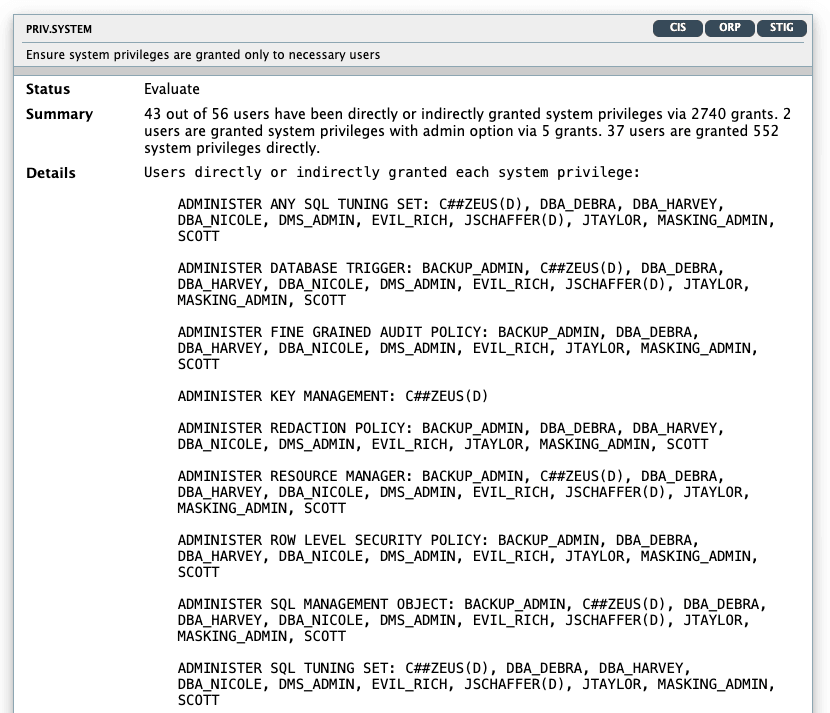
次の図に、Oracle Database Security Assessmentレポート — 権限およびロール・セクションの例を示します。
図1-6 Oracle Database Security Assessmentレポート — 権限およびロール
権限およびロールセクションの次には、監査セクションが表示されます。
Oracle Database Security Assessmentレポート — 監査
Oracle Database Security Assessmentレポート - 監査・セクションには、次の情報が表示されます。
| 名前 | 結果ID | 説明 | リンク | |
|---|---|---|---|---|
|
監査管理構成パラメータ |
- |
監査管理構成パラメータに関する情報を表示します |
- | |
|
監査レコード |
AUDIT.ENABLED |
監査証跡に関する情報が表示されます。 監査はすべてのシステムのセキュリティ保護に欠かせません。監査証跡では、高い権限が付与されたユーザーの活動をモニタリングできます。 |
||
|
統合監査ポリシー |
AUDIT.UNIFIEDPOLICIES |
統合監査ポリシーが有効かどうかが表示されます。 Oracle Database 12.1以降で使用できる統合監査では、複数の監査証跡が1つの統合ビューにまとめられています。また、効果的な監査ポリシーを指定するための新しい構文も導入されています。 |
||
|
ファイングレイン監査 |
AUDIT.FGA |
ファイングレイン監査ポリシーが有効かどうかが表示されます。 ファイングレイン監査ポリシーでは、特定の表の列へのアクセスや特定の条件で発生するアクセスなど、非常に具体的なアクティビティを記録できます。これは、通常のアクティビティに関する不必要な監査レコードを取得せずに、予期しないデータ・アクセスをモニターするために有用な方法です。 |
||
|
監査条件 |
AUDIT.CONDITION |
すべての監査ポリシーを条件付きで一覧表示し、有効になっている場合は、有効になっているユーザーまたはロールをリストします。 |
||
|
監査管理(SYS*)ユーザー |
AUDIT.ADMINACTIONS |
有効な監査ポリシーで
|
||
|
監査ユーザー・ログオンおよびログオフ |
AUDIT.CONNECTIONS |
有効な監査ポリシーでデータベース接続を監査するかどうかが表示されます。 将来のフォレンジック分析を支援するために、データベースに対して成功したユーザー接続を監査する必要があります。接続試行の失敗は、データベースに攻撃者がアクセスしようとしていることを早期に警告する役割を果たす場合があります。 |
||
|
監査データベース管理アクティビティ |
AUDIT.DBMGMT |
有効な監査ポリシーでデータベース管理に関するアクションを監査するかどうかが表示されます。 データベース機能の管理に影響するアクションは常に監査する必要があります。リストされている各アクションまたは権限を、少なくとも1つの有効な監査ポリシーに含めてください。 |
- | |
|
監査アカウント管理アクティビティ |
AUDIT.ACCOUNTMGMT |
アカウント管理活動を監査するかどうかを表示します。 |
||
|
監査システム権限 |
AUDIT.SYSTEMPRIVS |
有効な監査ポリシーでシステム権限を監査するかどうかに関する情報を表示します。 |
||
|
システム権限を持つ監査ロール |
AUDIT.ROLESYSTEMPRIVS | システム権限を持つロールを監査する統合監査ポリシーに関する情報を表示します。 | ||
|
監査権限管理 |
AUDIT.PRIVMGMT |
有効な監査ポリシーで権限管理に関するアクションを監査するかどうかが表示されます。 追加の権限をユーザーやロールに付与すると、ほとんどのセキュリティ保護に影響する可能性があるため、監査する必要があります。リストされている各アクションまたは権限を、少なくとも1つの有効な監査ポリシーに含めてください。 |
||
|
監査SQL文 |
AUDIT.STATEMENTS |
有効な監査ポリシーにより監査されたSQL文に関する情報が表示されます。従来の監査ポリシーを持つターゲットに適用されます。 |
- | |
|
監査オブジェクト・アクション |
AUDIT.SENSITIVEOBJS |
有効な監査ポリシーにより監査されたオブジェクト・アクセスに関する情報が表示されます。 |
||
|
監査シノニム管理アクティビティ |
AUDIT.SYNONYMS |
シノニム管理アクティビティ(CREATE ANY SYNONYM、CREATE PUBLIC SYNONYM、CREATE SYNONYM、DROP PUBLIC SYNONYM、DROP SYNONYM)が監査されるかどうかに関する情報を表示します。 |
- | |
|
監査条件 |
AUDIT.CONDITION |
すべての監査ポリシーを条件付きで一覧表示し、有効になっている場合は、有効になっているユーザーまたはロールをリストします。 |
udit.fga | |
|
共有アカウントの監査 |
AUDIT.SHAREDPROXY |
USER.SHAREDにリストされているユーザーが監査されているかどうかを確認します。 |
||
|
監査記憶域 |
AUDIT.TABLESPACE |
異なる監査証跡によって使用される表領域に関する情報を表示します。次のチェックが実行されます。
|
||
|
監査証跡のクリーン・アップ |
AUDIT.CLEANUPJOBS |
監査証跡をクリーン・アップし、存在しないクリーン・アップ・ジョブをチェックする有効なジョブをリストします |
||
|
データ・ポンプの監査 |
AUDIT.DATAPUMP |
データ・ポンプのエクスポートおよびインポートが監査されているかどうかを表示します。 |
||
|
STIGアクションの監査 |
AUDIT.STIGPOLICY |
Oracleでは、監査可能なイベント要件( |
||
|
Audit Database Vault |
AUDIT.DATABASEVAULT |
Database Vaultを管理できるが監査されないユーザーを表示し、Database Vaultアクションを監査できるポリシーをリストします |
||
|
Oracle Label Securityの監査 |
AUDIT.LABELSECURITY |
OLSの監査に使用される有効な監査ポリシーに関する情報を表示します。
|
ノート:
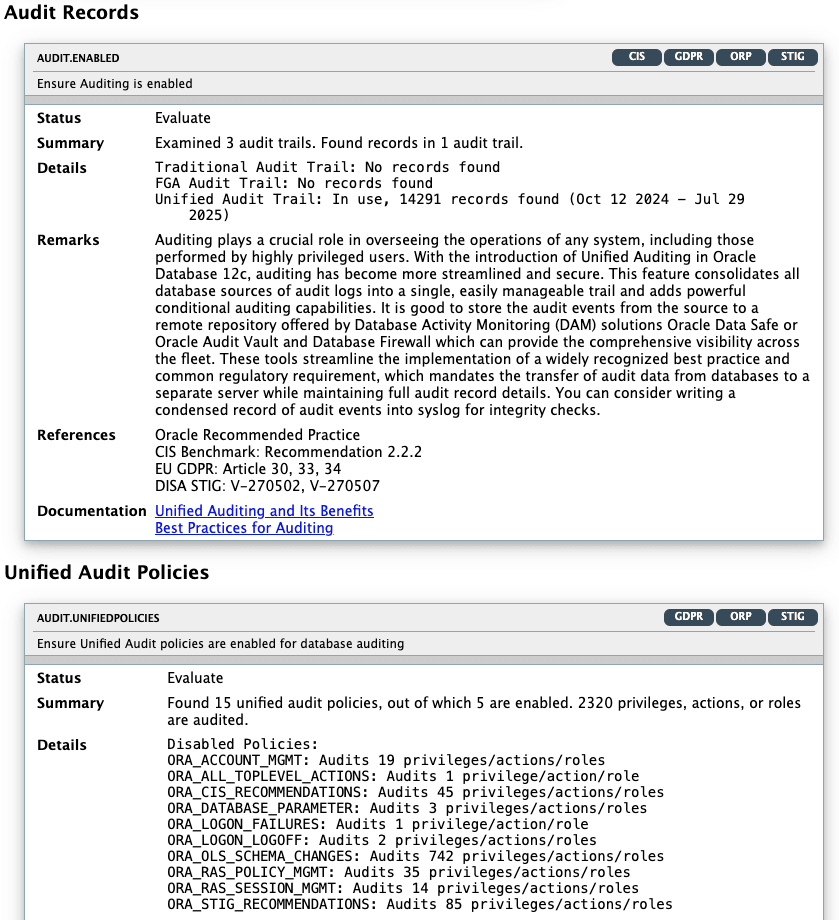
監査所見の詳細は、データベースに統合監査と従来の監査のどちらが導入されているかによって異なる場合があります。Oracle Database 12.2以降、ベスト・プラクティスは統合監査を使用することです。また、従来の監査は、Oracle Database 23aiでサポートが終了しました。次の図に、Oracle Database Security Assessmentレポート — 監査・セクションの例を示します。
図1-7 Oracle Database Security Assessmentレポート — 監査
監査セクションの次には、暗号化セクションが表示されます。
Oracle Database Security Assessmentレポート — 暗号化
Oracle Database Security Assessmentレポート - 暗号化セクションには、次の情報が表示されます。
| 名前 | 結果ID | 説明 | リンク |
|---|---|---|---|
|
透過的データ暗号化 |
ENCRYPT.TDE |
列または表領域の暗号化が使用されているかどうかが表示されます。また、暗号化されている表領域と暗号化されていない表領域、およびマスター暗号化キーが最後にローテーションされてから経過した日数が表示されます。 ほとんどの規制下にある環境では、機密データの暗号化が必須要件になっています。透過的データ暗号化では、保存時にデータが自動的に暗号化され、取得時に復号化されます。このようにして、データベースをバイパスしてデータ・ファイルを直接読み取る攻撃から機密データを保護します。 |
|
|
暗号化キー・ウォレット |
ENCRYPT.WALLET |
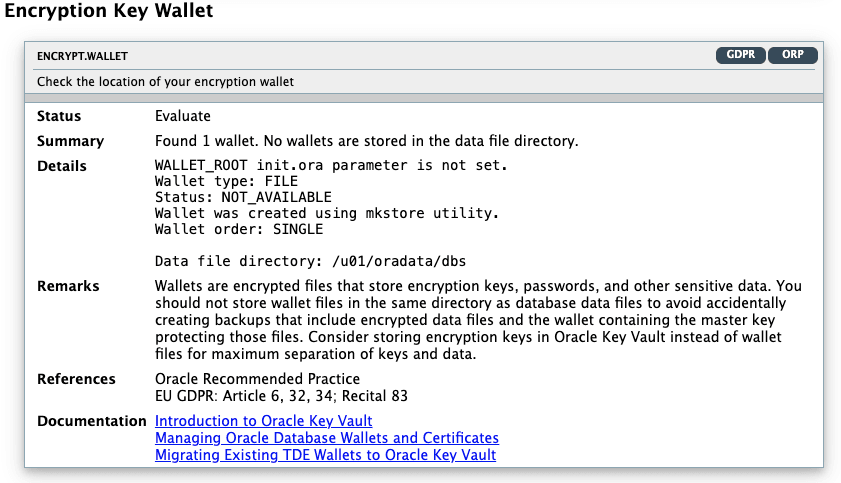
ウォレット情報が表示されます。 ウォレットは、暗号化キー、パスワードおよび他の機密データを保存するために使用する暗号化されたファイルです。暗号化されたデータ・ファイルとそれらのファイルを保護するマスター・キーが含まれたウォレット・ファイルの両方を含むバックアップを不注意で作成することがないように、データベースのデータファイルと同じディレクトリにウォレット・ファイルを保存しないでください。キーとデータを最大限に分離するために、ウォレット・ファイルではなくOracle Key Vaultに暗号化キーを保存することを検討してください。 |
|
| TDEおよびDBMS_CRYPTOのFIPSモード | ENCRYPT.DBFIPS |
TDEとDBMS_CRYPTYOがFIPS準拠モードで実行されているかどうかに関する情報が表示されます。 米国連邦情報処理標準(140-2)は、セキュリティ要件を規定する米国連邦政府のセキュリティ標準です。暗号化モジュールの承認に使用されます。パラメータDBFIPS_140 = TRUEを設定すると、透過的データ暗号化(TDE)およびDBMS_CRYPTO PL/SQLパッケージ・プログラム・ユニットをFIPS準拠モードで実行できます。FIPSモードは主に、米国連邦政府の部門および機関がFIPSまたはSTIGコンプライアンス(あるいはその両方)を満たそうとする場合に使用されます。この設定により、基盤となるFIPS認定のライブラリを使用すると、ライブラリを初めてロードする際に、多少のオーバーヘッドが発生することに注意してください。これは、ライブラリ署名の検証および自己診断の実行によるものです。 |
|
| TLS用FIPSモード | ENCRYPT.TLSFIPS |
米国連邦情報処理標準(140-2)は、セキュリティ要件を規定する米国連邦政府のセキュリティ標準です。SSLFIPS_140パラメータで、Transport Layer Security (TLS)アダプタをFIPSモードで実行するように構成します。SSLFIPS_LIBで、FIPSライブラリの場所を設定します。 |
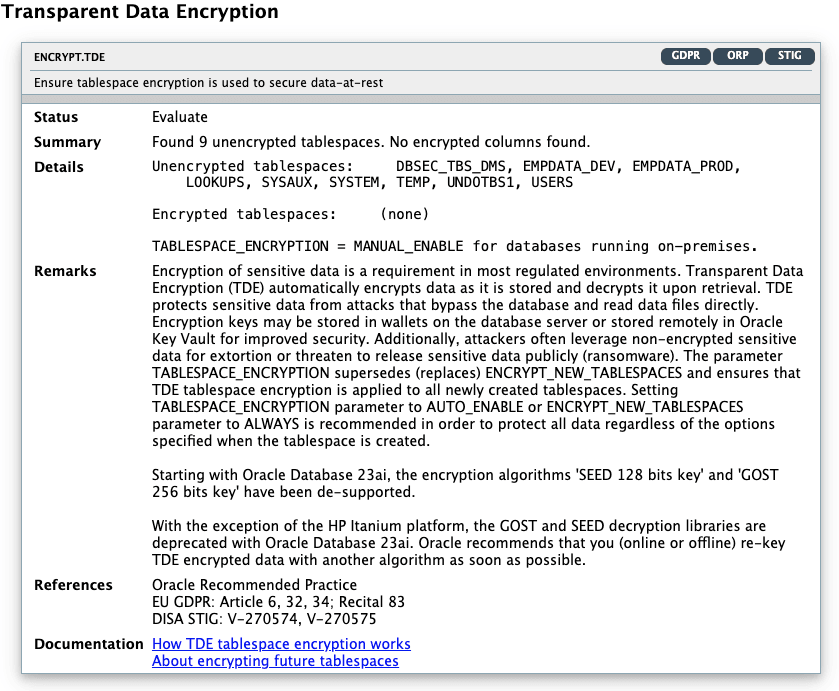
次の図に、Oracle Database Security Assessmentレポート — 暗号化セクションの例を示します。
図 1-8 Oracle Database Security Assessmentレポート - 暗号化キー・ウォレット
暗号化セクションの次には、認可制御セクションが表示されます。
Oracle Database Security Assessmentレポート — 認可制御
Oracle Database Security Assessmentレポート - 認可制御セクションには、次の情報が表示されます。
| 名前 | 結果ID | 説明 | リンク |
|---|---|---|---|
|
Database Vault |
AUTHZ.DATABASEVAULT |
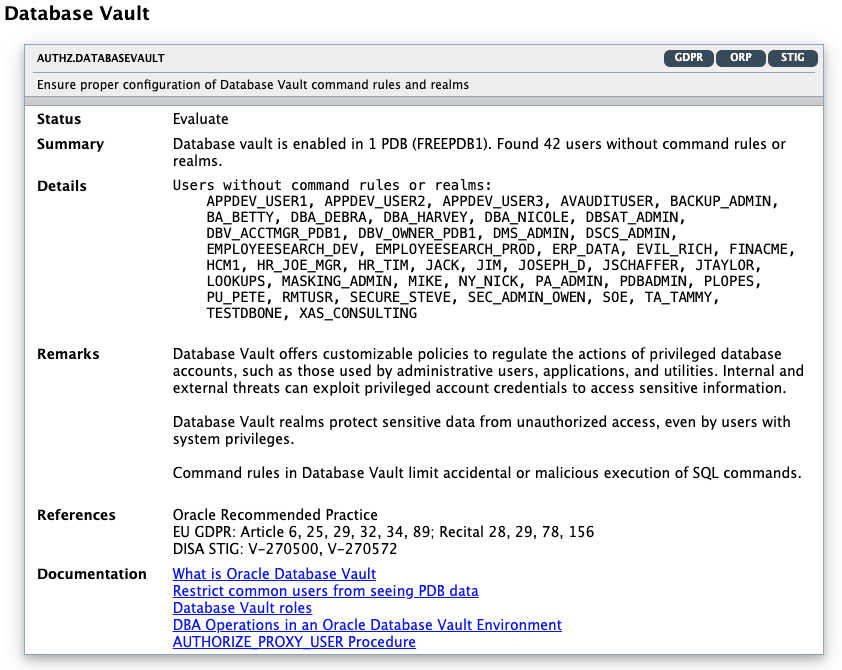
Oracle Database Vaultが有効になっているかどうか、レルムの詳細、コマンド・ルール、そのステータス、および保護されているオブジェクトが表示されます。 Database Vaultには構成可能なポリシーがあり、管理ユーザー、アプリケーションおよびユーティリティによって使用されるアカウントなど、高い権限を持つデータベース・アカウントのアクションを制御できます。攻撃(外部および内部ソースによるもの)では、機密情報にアクセスする権限のあるアカウント資格証明が利用されます。Database Vaultレルムを使用すると、システム権限を持つユーザー・アカウントによるものであっても、機密データ・オブジェクトへの不正アクセスを防ぐことができます。Database Vaultコマンド・ルールは、SQLコマンドの偶発的または悪意のある実行を制限します。また、信頼できるパスにより、IPアドレス、プログラム名、時刻、ユーザー名などのシステム要素を使用して機密データへのアクセスをさらに制限できます。Database Vault Operations Controlを使用すると、自律環境、通常のクラウド環境またはオンプレミス環境で、共通ユーザーによるプラガブル・データベース(PDB)のローカル・データへのアクセスを制限できます。 |
|
|
Database Vaultの職務分離 |
AUTHZ.DATABASEVAULTSOD |
Database Vault固有のロール(DV_OWER、DV_ACCTMGR、DV_PATCH_ADMINなど)があるユーザーについて情報が表示されます。また、特定の操作に対してユーザーが適切に認可されているかどうかが検証され(たとえば、データ・ポンプ・エクスポート/インポートにはロールと特定のDatabase Vault認可が必要である)、Database Vault操作制御が有効になっているかどうかがチェックされます。 |
|
|
権限分析 |
AUTHZ.PRIVANALYSIS |
権限分析ポリシーと、取得プロセスを開始する権限を持つユーザーが表示されます。 権限分析では、実際またはシミュレートされたワークロードで使用された権限が記録されます。実際に使用される権限に関するデータを収集した後、この情報を使用して、不要になった権限付与を取り消したり、ユーザーまたはロールで使用される権限のみを持つロールを作成できます。これは、最小権限モデルを実装し、権限の意図的または偶発的な乱用によるリスクを最小限に抑えるのに役立ちます。 |
|
|
クライアント・スクリプトの認証 |
AUTHZ.PASSWORDSCRIPTS |
パスワードがクライアント・スクリプト、ジョブおよびアプリケーション・ソース・コードに埋め込まれてデータベース・サーバーに接続できる可能性があるパスワード認証済ユーザーをリストします。 |
|
| データ・マスキング | AUTHZ.DATAMASKING |
非本番システムへの転送時にマスキングする必要がある機密データを含む表をリストします。 このチェックでは、TSDPまたは |
次の図に、Oracle Database Security Assessmentレポート — 認可制御セクションの例を示します。
図1-9 Oracle Database Security Assessmentレポート — 認可制御
認可制御セクションの次には、ファイングレイン・アクセス制御セクションが表示されます。
Oracle Database Security Assessmentレポート — ファイングレイン・アクセス制御
Oracle Database Security Assessmentレポート - ファイングレイン・アクセス制御セクションには、次の情報が表示されます。
| 名前 | 結果ID | 説明 | リンク |
|---|---|---|---|
|
データ・リダクション |
ACCESS.DATAREDACTION |
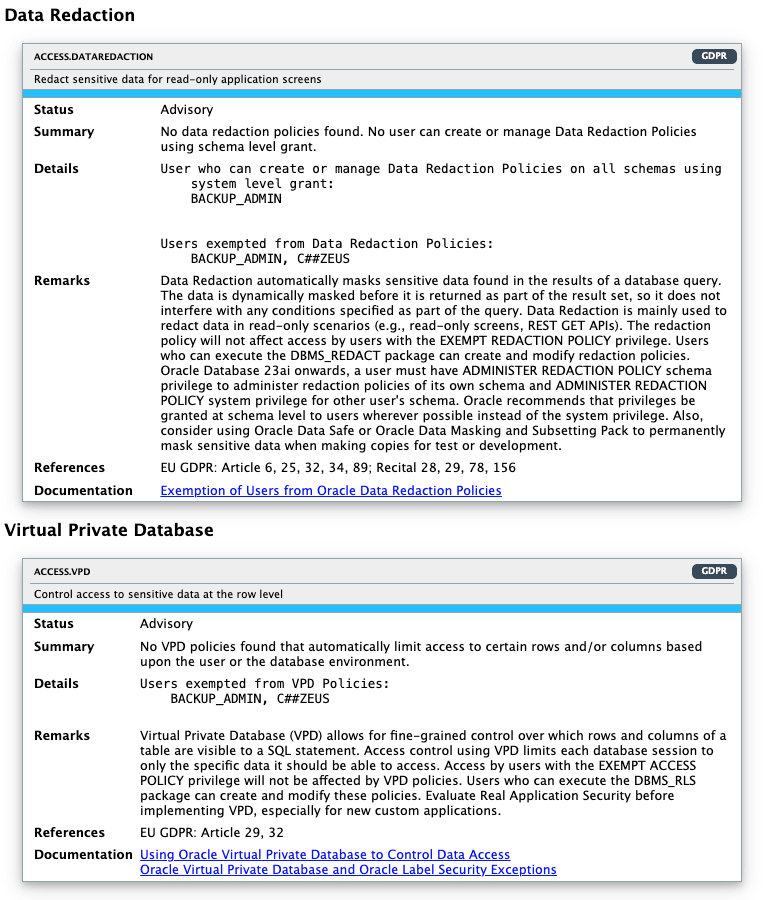
データ・リダクション・ポリシー、除外されたユーザーおよびDBMS_REDACTパッケージに対する権限付与の実行に関する情報が表示されます。 データ・リダクションでは、データベース問合せの結果で見つかった機密データが自動的にマスクされます。 |
|
|
仮想プライベート・データベース |
ACCESS.VPD |
仮想プライベート・データベース・ポリシー、除外されたユーザーおよびDBMS_RLSパッケージに対する権限付与の実行に関する情報が表示されます。 VPDでは、SQL文に対して表示される表の行と列をきめ細かく制御できます。 |
|
|
Real Application Security |
ACCESS.RAS |
Real Application Securityポリシー、除外されたユーザー、およびADMIN_SEC_POLICYとAPPLY_SEC_POLICYを付与されたユーザーに関する情報が表示されます。 Real Application Security (RAS)は、仮想プライベート・データベースの最新かつ高度なバージョンであり、SQL文に対して表示される表の行と列をきめ細かく制御できます。 |
|
|
Label Security |
ACCESS.LABELSECURITY |
Oracle Label Securityが有効がどうかが表示されます。 Oracle Label Securityでは、データ・ラベルまたはデータ分類でデータにタグ付けできます。データのラベルが要求元ユーザーのラベルや安全検査と比較されて、機密データへのアクセスが制御されます。 |
|
|
透過的機密データ保護 |
ACCESS.TSDP |
透過的機密データ・ポリシーおよびそれを管理できるユーザーに関する情報が表示されます。 TSDPはOracle Database 12.1で導入され、機密データを含む各列にデータ・タイプを関連付けることができます。特定のタイプのすべてのインスタンスに様々なデータ・セキュリティ機能をTSDPで適用すれば、均一で一貫した保護を実現できます。 |
次の図に、Oracle Database Security Assessmentレポート — ファイングレイン・アクセス制御セクションの例を示します。
図1-10 Oracle Database Security Assessmentレポート — ファイングレイン・アクセス制御
ファイングレイン・アクセス制御セクションの次には、データベース構成セクションが表示されます。
Oracle Database Security Assessmentレポート — データベース構成
Oracle Database Security Assessmentレポート - データベース構成セクションには、次の情報が表示されます。
| 名前 | 結果ID | 説明 | リンク |
|---|---|---|---|
|
セキュリティの初期化パラメータ |
- |
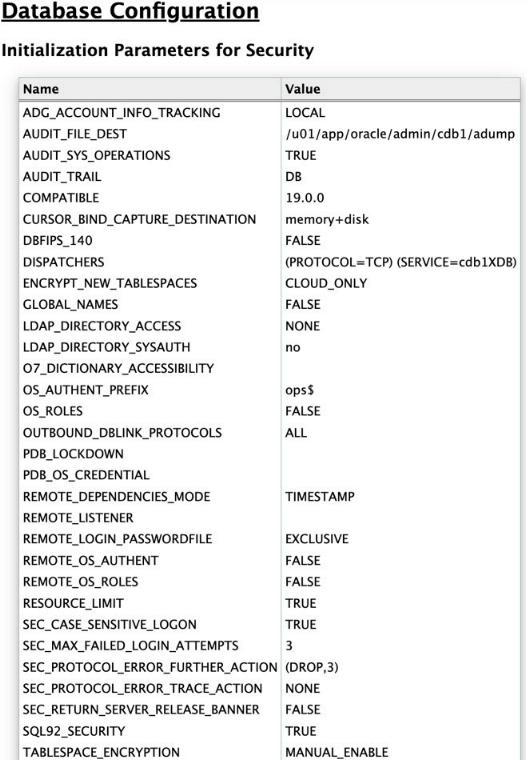
セキュリティ関連のデータベース初期化パラメータとその値が表示されます。 |
- |
|
事前認証済リクエストのURL |
CONF.PREAUTHREQUESTURL |
Autonomous Databaseサーバーレス・データベースの事前認証済URL情報( |
- |
|
認証構成 |
CONF.AUTHN |
ユーザー・アカウント初期化パラメータに関する情報が表示されます。
|
|
|
ロックダウン・プロファイル |
CONF.LOCKDOWNPROFILES | 現在のPDBに対してPDBロックダウン・プロファイルが構成されているかどうかをチェックします。プロファイルが設定されている場合は、制限されている機能とその現在のステータスがリストされます。また、PDB_LOCKDOWNパラメータが設定されているかどうかが検証され、設定されている場合はその値が表示されます。 | |
|
PDB OSユーザー |
CONF.DEFAULTPDBOSUSER | 高い権限を持つOracle OSユーザーがPDB_OS_CREDENTIALパラメータに設定されているかどうかを確認します。 | - |
|
制御ファイル |
CONF.CONTROLFILES |
制御ファイルが多重化されているかどうかを確認し、すべての制御ファイルの場所をリストします。
|
|
|
REDOログ・ファイル |
CONF.REDOLOGS | 定義されたREDOログ・ファイルがベスト・プラクティスに従っているかどうかを確認し、その場所をリストします。REDOログは多重化され、異なる物理ディスクに格納される必要があります。 | |
|
アーカイブ・ログ・モード |
CONF.ARCHIVELOG |
データベースが |
|
|
データベースのバックアップ |
CONF.BACKUP |
データベースのバックアップ・レコードに関する情報が表示されます。 データベースは定期的にバックアップして、システム障害が発生したときにデータが失われないようにしてください。Oracle Recovery Manager (RMAN)では、データベースのバックアップとリカバリのタスクを実行できます。暗号化されていないバックアップ・データをテープやディスクに転送して、オフサイトで保管しないでください。 |
|
|
インスタンス名のチェック |
CONF.INSTANCENAME |
インスタンス名にデータベースのバージョン番号が含まれているかどうかが表示されます。 インスタンス名にOracleのバージョン番号を含めないでください。認証されていないユーザーにサービス名を発見される可能性があります。バージョン番号や他のデータベース製品の情報がサービス名に含まれていると、悪意のあるユーザーがその情報を使用してターゲットを絞った攻撃を開発する可能性があります。 |
- |
|
SQLファイアウォール |
CONF.SQLFIREWALL |
SQL Firewallが有効かどうかを確認し、ポリシーの影響を受けるユーザー、およびポリシーが監視モード、ブロック・モードまたは強制モードであるかどうかを表示します。また、SQLおよびコンテキスト許可リストが強制モードかどうかの詳細も示します。Oracle Databaseバージョン>=23aiにのみ適用されます。 |
|
|
読取り専用ORACLE_HOME |
CONF.READONLYHOME |
|
|
|
ディクショナリ・オブジェクトに対するアクセス権 |
CONF.SYSTEMOBJ |
ディクショナリ・オブジェクトに対するアクセス権が正しく制限されているかどうかが表示されます。
|
- |
|
表データの推測 |
CONF.SQL92SECURITY |
データ推測攻撃が正しく防御されているかどうかが表示されます。 SQL92_SECURITYをTRUEに設定すると、WHERE句で列を参照するUPDATE文およびDELETE文が、同じ列からSELECTする権限がユーザーにあるときのみに正しく動作するようになります。このパラメータをTRUEに設定して、表示する権限がない列の値をユーザーが推測できないようにする必要があります。 |
|
|
パスワード・ファイルに対するアクセス権 |
CONF.PASSWORDFILE |
パスワード・ファイルが正しく構成されているかどうかが表示されます。
|
|
|
ネットワーク通信 |
CONF.NETWORK |
不正な形式のパケットに対するデータベース・サーバー・レスポンスを決定する初期化パラメータに関する情報が表示されます。また、リモート・リスナーの使用状況と、認証されていないクライアント・リクエストに対してデータベース・サーバー・バージョン情報が非表示になっている場合の詳細も含まれています。
認証されないクライアントに返す情報はリモート攻撃に対するサーバーの脆弱性を特定するために使用される可能性があるため、 |
|
|
外部OS認証 |
CONF.EXTERNALOSAUTH |
Oracle Databaseロールがデータベース自体とホスト・オペレーティング・システム(ローカルおよびリモート認証の場合)のどちらによって定義および管理されているかが表示されます。
|
|
|
未使用のコンポーネント |
CONF.DBCOMPONENTS | XOQ、CONTEXT、SDO、DV、OLSなどのコンポーネントがインストール/有効化され、使用されていないかどうかを確認します。 | - |
|
ジョブ詳細 |
CONF.JOBS |
スケジュールされたデータベース・ジョブおよびそれらを管理できるユーザーを確認します。次のチェックが実行されます。
|
- |
|
トリガー |
CONF.TRIGGERS |
ログオン・トリガーに関する情報が表示されます。 トリガーとは、表へのデータの挿入やデータベースの接続など、特定のイベントが発生すると常に実行されるコードのことです。トリガーを無効にすると、トリガーが実現すると期待されている保護や監視もアクティブでなくなるので注意が必要です。 |
|
|
無効な制約 |
CONF.CONSTRAINTS |
無効な制約に関する情報が表示されます。 制約は、データベースに保存されているデータ項目間で特定のリレーションシップを強制および保証するために使用します。制約を無効にすると、制約が確保していた条件が強制されなくなるので注意が必要です。 |
|
|
外部プロシージャ |
CONF.EXTERNALPROCS |
外部プロシージャおよびサービスに関する情報が表示されます。 外部プロシージャでは、他の言語で記述されたコードをPL/SQLから実行できます。外部コードに対する変更はデータベースで制御できないことに注意してください。信頼できるコード・ライブラリのみを実行可能にするように注意してください。データベースでは自分のプロセスを起動して外部プロシージャを実行できますが、この用途のリスナー・サービスを構成して、権限が少ないOSユーザーとして外部コードを実行できるようにすることをお薦めします。リスナー構成では、デフォルト値の |
|
|
ソースコード分析 |
CONF.SOURCEANALYSIS | RAISE_APPLICATION_ERRORおよびDBMS_OUTPUT.PUT_LINE.を使用して、oracle以外のメンテナンス・プロシージャおよびファンクションについてDBA_SOURCEをチェックします。 |
|
|
ディレクトリ・オブジェクト |
CONF.DIRECTORYOBJ |
ディレクトリ・オブジェクトに関する情報が表示されます。 ディレクトリ・オブジェクトでは、データベース内のPL/SQLコードからサーバーのファイル・システムにアクセスできます。データベース・カーネルが使用するファイルに対するアクセスは、データベースの運用を変更してアクセス制御をバイパスできる可能性があるため許可しないでください。 |
|
|
複数アプリケーションの場合のディレクトリ分離 |
CONF.DIRECTORYSEPARATION |
データファイル、REDOログ・ファイルおよび監査ファイル(AUDIT_FILE_DEST)のファイル・パスについて情報が表示されます。 |
- |
|
データベース・リンク |
CONF.DATABASELINKS |
データベース・リンクに関する情報が表示されます。 データベース・リンクでは、他のデータベースの表にアクセスするSQL文をユーザーが実行できます。これにより、リモート・データベースのデータの問合せおよび保存の両方が許可されます。アクセスするデータベースとリンク名が一致するように、 |
|
|
ネットワーク・アクセス制御 |
CONF.NETWORKACL |
ネットワークのアクセス制御リスト(ACL)に関する情報が表示されます。 ネットワークACLでは、UTL_TCPやUTL_HTTPなどのネットワーク・パッケージを使用してデータベース・ユーザーがアクセスできる外部サーバーを制御します。具体的には、データベース・ユーザーは、 |
|
|
XMLデータベース・アクセス制御 |
CONF.XMLACL |
XMLデータベースのアクセス制御リスト(ACL)に関する情報が表示されます。 XML ACLでは、XML DB機能を使用したデータベース・リソースへのアクセスを制御します。Oracle XML DBリポジトリ階層のすべてのリソースにACLが関連付けられています。ACLメカニズムでは、プリンシパル(データベース・ユーザーまたはロール)に対して権限ベースのアクセス制御を指定します。リソースがアクセスされるときには常にセキュリティ・チェックが実行されて、リソースにアクセスするのに十分な権限が要求元のユーザーにあるかどうかがACLによって判断されます。各ユーザーのこれらの権限が必要最小限の範囲に限定されていることを確認してください。 |
|
|
ファイル・システムへのアクセス |
CONF.FILESYS |
パラメータが非推奨でない古いデータベース・バージョンの |
- |
|
トレース・ファイル |
CONF.TRACEFILELIMIT |
トレース・ファイルの初期化パラメータに関する情報が表示されます。 非表示パラメータ |
- |
|
データベース・リソース計画 |
CONF.RESOURCEMANAGER |
DBMS_RESOURCE_MANAGERパッケージでのEXECUTE、およびADMINISTER RESOURCE MANAGERシステム権限があるユーザーがいるかチェックします。既存のリソース・プランもリストされます。 |
|
|
データベース共有メモリー |
CONF.SGA |
Oracleソフトウェア・インストール所有者のみにSGAへの読取りおよび書込みアクセス権があるかどうかをチェックします。ALLOW_GROUP_ACCESS_TO_SGAをチェックします。 |
|
|
Database Vaultの構成 |
CONF.DATABASEVAULT |
Database Vaultの整合性をチェックします。 DVSYSスキーマとDVFスキーマの両方の存在を検証し、無効なDatabase Vaultオブジェクトがあるかチェックし、どのルール・セットにも関連付けられていないルールを識別し、空のルール・セットにフラグを付けます。 |
- |
|
セキュリティ評価 |
CONF.ASSESSMENT |
確認する必要がある、各セクションでの結果の数が表示されます。 |
- |
次の図に、Oracle Database Security Assessmentレポート — データベース構成セクションの例を示します。
図1-11 Oracle Database Security Assessmentレポート — データベース構成
データベース構成セクションの次には、ネットワーク構成セクションが表示されます。
Oracle Database Security Assessmentレポート — ネットワーク構成
Oracle Database Security Assessmentレポート - ネットワーク構成セクションには、次の情報が表示されます。
| 名前 | 結果ID | 説明 | リンク |
|---|---|---|---|
|
セキュリティ関連のSQLNETパラメータ |
- |
セキュリティ関連のSQLNETパラメータが表示されます:
|
- |
|
ネットワーク暗号化 |
NET.ENCRYPTION |
ネットワーク暗号化に関する情報が表示されます。 ネットワーク暗号化では、データベース・サーバーとそのクライアントの間の通信の機密保持および整合性が保護されます。ネイティブ暗号化またはTLSのどちらかを有効にしてください。ネイティブ暗号化の場合は、 |
|
|
クライアント・ノード |
NET.INVITEDNODES |
データベースが任意のクライアントから接続を受け入れるかどうかが表示されます。 データベース・サーバーに接続できるクライアント・ノードを制御するには、 |
|
|
接続制限構成 |
NET.CONNECTIONLIMITS | 認証されていない接続の終了を制御するパラメータの値を確認します。
|
|
|
ネットワーク・リスナー構成 |
NET.LISTENERCONFIG |
ネットワーク・リスナー構成に関する情報が表示されます。 これらのパラメータは、ネットワーク・リスナー構成に対する変更を制限するために使用します。 実行中のリスナーに対するパラメータ変更を防ぐために、
|
- |
|
リスナー・ロギング制御 |
NET.LISTENERLOG |
ネットワーク・リスナー・ロギング構成に関する情報が表示されます。
|
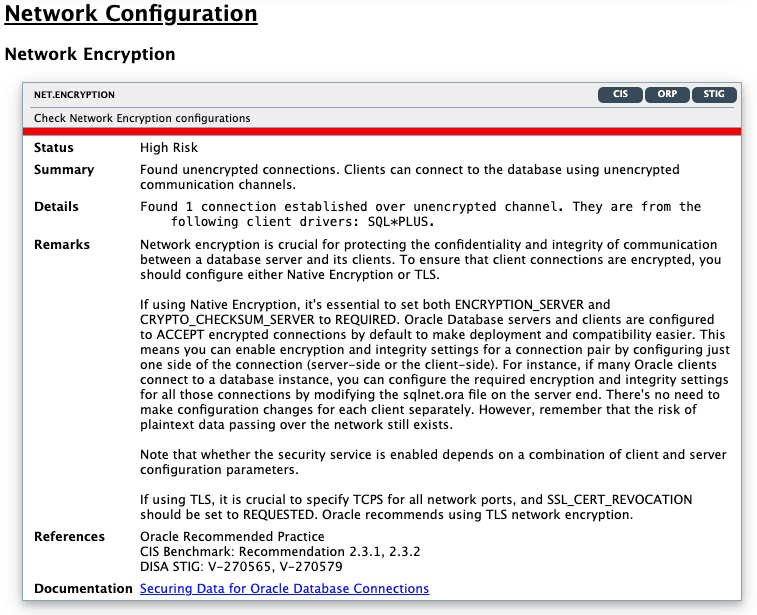
次の図に、Oracle Database Security Assessmentレポート — ネットワーク構成セクションの例を示します。
図1-12 Oracle Database Security Assessmentレポート — ネットワーク構成
ネットワーク構成セクションの次には、オペレーティング・システム・セクションが表示されます。
Oracle Database Security Assessmentレポート — オペレーティング・システム
Oracle Database Security Assessmentレポート - オペレーティング・システム・セクションには、次の情報が表示されます。
| 名前 | 結果ID | 説明 | リンク |
|---|---|---|---|
|
インストール・アカウント |
OS.INSTALLATIONUSER |
このチェックでは、Oracleインストール所有者を指定します。 |
- |
|
OS認証 |
OS.AUTH |
オペレーティング・システム・グループ名と、管理権限を行使できるユーザーに関する情報が表示されます。 OS認証では、指定したユーザー・グループのオペレーティング・システム・ユーザーが管理権限でデータベースに接続できます。ここには、各管理権限を行使できるOSグループ名とユーザーが表示されます。管理権限があるOSユーザーをレビューして、データベースに対する不正、悪意のあるまたは意図しないアクセスを防いでください。 |
- |
|
本番データベースと開発データベースの分離 |
OS.MULTIDB |
同じサーバーで実行されているデータベース/インスタンスを確認します。同じサーバー上で複数のデータベース/インスタンスが実行されている場合は、本番およびテスト/開発データベースをホストしていないことを確認してください。 |
|
|
プロセス・モニター・プロセス |
OS.PMON |
プロセス・モニター(PMON)のプロセスが PMONプロセスは、ユーザー・プロセスをモニターして、プロセスが終了するとリソースを解放します。このプロセスは |
- |
|
エージェント・プロセス |
OS.AGENT |
エージェント・プロセスの所有者がリスナーまたはプロセス・モニター(PMON)のプロセス所有者と重なっていないかどうかが表示されます。 エージェント・プロセスは、データベースおよびリスナー・プロセスとは別のユーザーIDで実行する必要があります。これらのプロセスは、データベースおよびリスナーのプロセスとは別のユーザーIDで実行する必要があります。 |
- |
|
リスナー・プロセス |
OS.LISTENER |
リスナー・プロセスの所有者がエージェントまたはプロセス・モニター(PMON)のプロセス所有者と重なっていないかどうかが表示されます。 リスナー・プロセスは着信ネットワーク接続を受け入れて、適切なデータベース・サーバー・プロセスに接続します。これらのプロセスは、データベースおよびエージェントのプロセスとは別のユーザーIDで実行する必要があります。これらのプロセスはローカルOS認証のみを介して管理してください。 |
|
|
リスナー・ポート |
OS.LISTENERPORTS |
リスナー・ポートが表示されます。 |
- |
|
CMANリモート管理 |
OS.CMANLOCAL |
Oracle Connection Managerがサーバーにインストールされているかどうかを確認し、インストールされている場合は、CMANリモート管理が構成されているかどうかを確認します。 |
|
|
診断先 |
OS.DIAGNOSTICDEST |
DIAGONSTIC_DESTの権限をチェックします。
|
|
|
ORACLE_HOMEのファイル権限 |
OS.FILEPERMISSIONS |
|
- |
ノート:
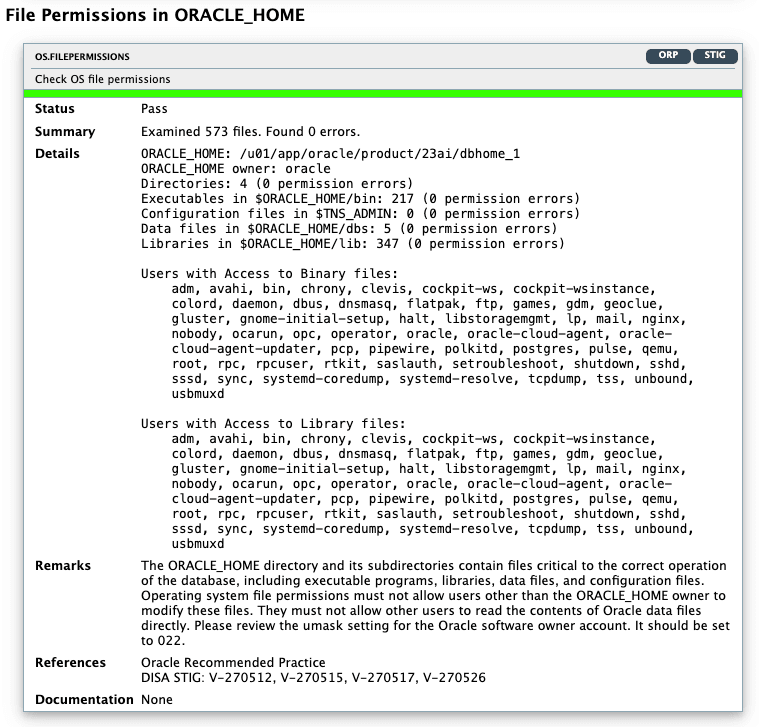
Windowsでは、DBSAT CollectorはSQL問合せからのみデータを収集します。オペレーティング・システム・コマンドからのデータがないため、DBSAT Reporterはこのデータに対してルールのサブセットを実行します。オペレーティング・システムの結果は、Windowsプラットフォームで稼働中のデータベースでは使用できません。次の図に、Oracle Database Security Assessmentレポート — オペレーティング・システム・セクションの例を示します。
図1-13 Oracle Database Security Assessmentレポート — オペレーティング・システム
オペレーティング・システム・セクションの次には、診断セクションが表示されます。
Oracle Database Security Assessmentレポート — 診断
診断セクションには、実行できなかったチェックが表示されます。
ノート:
このレポートには、Oracleデータベース・システムをセキュリティ保護するために役立つ可能性がある情報および推奨事項が表示されます。このような推奨事項は、データベース・セキュリティに関するベスト・プラクティスを反映しており、設計およびデフォルトによるデータ保護に関する戦略の一部となります。これらの実際的な情報は、EUの一般データ保護規則の25条および32条と、その他のデータ・プライバシ規則に対処する際に役立ちます。技術的な制御のみでは、コンプライアンスには不十分です。すべての結果に合格してもコンプライアンスは保証されません。
Oracle推奨プラクティスとは別に、このレポート内の結果は、DISA Oracle Database 19c STIG V1R1のグループID、Oracle Database 19c向けCISベンチマークv1.2.0の推奨事項、およびEU GDPR 2016/679の条項と詳説にマップされます。
Oracle Database Vault、Oracle Advanced Security、Oracle Label Security、Oracle Data Masking and Subsetting Packは、データベースでライセンスされるオプションです。Oracle Key VaultおよびOracle Audit Vault and Database Firewallには、別のライセンスも必要です。
このレポートには現在のステータスに関する1つの見方が示されます。表示される結果は情報目的のみで提供されるため、詳細な分析のかわりに使用したり、法律や規制に関する助言やガイダンスを含むものと解釈しないでください。
システムおよびこのレポートの生成時に収集されるデータおよび情報に対しては、お客様にすべての責任があります。また、このレポートを生成するソフトウェアの実行、そこに示されている緩和処置を実行した結果および影響に対しても、お客様にすべての責任があります。
オラクル社は、いかなる保証もせず「現状のまま」この分析を提供し、オラクル社は明示的、暗示的または法律上のすべての保証をしないことをここに明記します。
Discovererの使用
Discovererコンポーネントを使用して、Oracle Database Sensitive Data Assessmentレポートを生成できます。
Oracle Database Sensitive Data Assessmentレポート
Discovererコンポーネントを使用して、Oracle Database Sensitive Data Assessmentレポートを生成します。Discovererは、SQL問合せを実行し、構成ファイルおよびパターン・ファイルで指定された設定に基づいて評価対象となるシステムからデータを収集します。
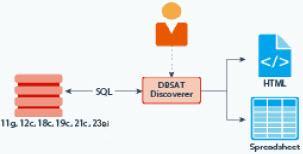
次の図に、Discovererのコンポーネントとアーキテクチャを示します。
構成設定
| セクション | キー | 値 | 説明 |
|---|---|---|---|
| [Database] | TNS_ADMIN |
|
ネットワーク・サービス名を読み取る場所 |
| - | NET_SERVICE_NAME |
|
接続に使用されるネットワーク・サービス名 |
| - | WALLET_LOCATION |
|
SSLまたはSEPSによるセキュアな接続のためのウォレットの場所(セキュアな外部パスワード・ストア) |
| - | DB_HOSTNAME |
|
ターゲット・データベース・サーバーのホスト名またはIPアドレス |
| - | DB_PORT |
デフォルトは、1521です。 |
ターゲット・データベースのリスナー・ポート番号。ポート番号を指定しないと、デフォルト・ポート1521が使用されます。 |
| - | DB_SERVICE_NAME |
|
ターゲット・データベースのサービス名 |
| - | SSL_ENABLED |
デフォルトは |
データベース・サーバーに接続するときにSSLプロトコルを有効にするか無効にするかを指定します。これはオプションの引数です。
|
| - | SSL_TRUSTSTORE |
例: |
TrustStoreおよびTrustStoreファイル名への絶対パスを指定します。
|
| - | SSL_TRUSTSTORE_TYPE |
|
TrustStoreのタイプを指定します。 Truststoreがウォレットの場合は TruststoreがJava KeyStoreの場合は Truststoreが自動ログインSSOウォレットの場合は |
| - | SSL_KEYSTORE |
例: |
KeyStoreおよびKeyStoreファイル名への絶対パスを指定します。
データベース・サーバーにクライアント認証が必要な場合は必須です。 |
| - | SSL_KEYSTORE_TYPE |
|
KeyStoreのタイプを指定します。 KeyStoreがウォレットの場合は KeyStoreがJava KeyStoreの場合は KeyStoreが自動ログインSSOウォレットの場合は |
| - | SSL_DN |
|
ターゲット・データベース・サーバーの識別名(DN)です。 サーバーのDNを確認する必要がある場合はDNを指定します。 これはオプションの引数です。 |
| - | SSL_VERSION |
デフォルトは |
データベース・サーバーへの接続時に使用するSSLプロトコルのバージョンを指定します。これはオプションの引数です。 SSLバージョン SSLバージョン SSLバージョン |
| - | SSL_CIPHER_SUITES |
例: |
使用する暗号アルゴリズムを指定します。複数のエントリをカンマ区切りリストとして指定できます。 これはオプションの引数です。 サポートされる暗号サイトの詳細は、https://docs.oracle.com/javase/8/docs/technotes/guides/security/SunProviders.htmlを参照してください。 |
| [Discovery Parameters] | SENSITIVE_PATTERN_FILES |
デフォルトは、 |
使用するパターン・ファイルを指定します。複数のファイルをカンマ区切りリストとして指定できます。上限は、10ファイルです。 機密データ・タイプ・パターン・ファイルの構成の詳細は、パターン・ファイルの構成(オプション)を参照してください。 |
| - | SCHEMA_SCOPE |
デフォルトは、 |
スキャン対象となるスキーマを指定します。複数のスキーマをカンマ区切りリストとして指定できます。 |
| - | MINROWS |
デフォルトは、 |
スキャン対象となる表について、表の最小行数を指定します。
|
| - | EXCLUSION_LIST_FILE |
|
スキーマ、表または列をスキャンから除外するのに使用するファイルを指定します。 除外リスト・ファイルの構成の詳細は、除外リスト・ファイルの構成(オプション)を参照してください。 |
| [Sensitive Categories] |
[Sensitive Categories]セクションでは、使用する機密カテゴリを定義します。有効なリスク・レベルは次のとおりです。
機密データのタイプは機密データ・タイプ・パターン・ファイルで定義します。機密データ・タイプ・パターン・ファイルの構成の詳細は、パターン・ファイルの構成(オプション)を参照してください。 |
機密タイプについて
パターン・ファイルには、検索対象となるパターンが含まれます。パターン・ファイルは、セクション見出し形式[SENSITIVE_TYPE_NAME]で定義されたセクションにグループ分けされています。各セクションが機密タイプとなります。
次の例では、FULL NAMEのサンプル機密タイプ・セクションを示します。
[FULL NAME]
COL_NAME_PATTERN = ^(?!.*(ITEM|TAX|BALANCE)).*(FULL.*NAME)|(^|[_-])(CUSTOMER|CUST|CLIENT|PATIENT|PERSON).?(NAME|NM)($|[_-])
COL_COMMENT_PATTERN = ^(?!.*(ITEM|TAX|BALANCE)).*(FULL.?NAME)|(CUSTOMER|CUST|CLIENT|PATIENT|PERSON).?NAME
SENSITIVE_CATEGORY = Identification Info - Public IDs機密タイプ名[SENSITIVE_TYPE_NAME]は、データベース機密データ・アセスメント・レポート — 機密列の詳細セクションの機密タイプ列に表示されます。「データベース機密データ・アセスメント・レポート」の詳細は、Oracle Database Sensitive Data Assessmentレポートを参照してください。
各機密タイプは、COL_NAME_PATTERN、COL_COMMENT_PATTERNおよびSENSITIVE_CATEGORYの3つのパラメータで定義します。
COL_NAME_PATTERN
COL_NAME_PATTERNパラメータは、検索するテキストをデータベース列名の正規表現(RegExp)パターンで指定します。
(^LNAME$)|((LAST|FAMILY|SUR|PATERNAL).*NAME$)前述の例では、データベース列名のRegExpパターンで次のテキストが検索されます。
-
(^LNAME$)—LNAMEという名前の列が検索されます。 -
((LAST|FAMILY|SUR|PATERNAL).*NAME$)—LAST、FAMILY、SURまたはPATERNALを含み、その後に任意の文字が続いてNAMEで終わる列名を検索します。たとえば、LAST_NAMEまたはCUSTOMER_SURNAMEです。
COL_COMMENT_PATTERN
COL_COMMENT_PATTERNパラメータは、検索するテキストをデータベース列コメントの正規表現(RegExp)パターンで指定します。
SENSITIVE_CATEGORY
SENSITIVE_CATEGORYパラメータは、機密データのタイプを指定します。機密データの公開タイプに関連付けられるリスク・レベルは、sample_dbsat.configファイルに指定します。リスク・レベルは次のとおりです。
-
Low Risk -
Medium Risk -
High Risk
sample_dbsat.configファイルの構成の詳細は、構成設定を参照してください。
パターン・ファイルのカスタマイズ
custom_dbsat.configファイルでパターン・ファイルを参照する方法の詳細は、dbsat.configの構成を参照してください。
正規表現について
検索パラメータでは正規表現を使用します。正規表現は、セット内の各文字列で共有される共通特性に基づく文字列のセットです。正規表現の複雑さは様々ですが、記述方法の基本を理解すれば、判読または記述できます。正規表現を定義するには、文字クラス、グループの検索、数量子、境界マッチャおよび論理演算子を使用します。
文字列リテラル
最も基本的なパターン一致の形式は、文字列リテラルの一致です。たとえば、正規表現がEMPで、入力文字列がEMPの場合、文字列が同一なので一致に成功します。この正規表現は、EMPLOYEE、TEMP、TEMPERATUREなどのEMPを含む文字列とも一致します。
メタ文字
パターンの照合方法に影響する特殊文字を使用することもできます。最も一般的なものの1つに、すべての文字に一致するドット(.)記号があります。たとえば、EMPLOYEE.IDは、EMPLOYEE_IDおよびEMPLOYEE-IDと一致しますが、EMPLOYEE_VERIFICATION_IDとは一致しません。ここで、ドットはマッチャによって特別な意味に解釈されるメタ文字です。
その他のメタ文字には、^ $ ? + * \ - [ ] ( ) { }などがあります。
メタ文字を文字どおりに(通常の文字として)処理する場合は、バックスラッシュ(\)を使用してエスケープします。たとえば、正規表現9\+9は9+9と一致します。
文字クラス
文字クラスは、大カッコで囲まれた一連の文字です。これは、対象の入力文字列の1文字と一致する文字を指定します。
次の表は、一般的な正規表現の構文を示しています。
| 構文 | 説明 |
|---|---|
[abc] |
大カッコ内に指定されたいずれかの文字と一致します。 例: |
[^abc] |
大カッコ内に指定された文字を除く、任意の文字と一致します。 例: |
[A-Z0-9] |
大カッコ内に指定された範囲の任意の文字と一致します。範囲を指定するには、一致する最初の文字と最後の文字の間にダッシュ・メタ文字「 例: |
グループの検索
グループの検索を使用すると、複数の文字を1つの単位として処理できます。グループの検索は、カッコ内にグループ化する文字を指定することによって作成します。たとえば、正規表現(SSN)では、文字S、SおよびNを含む単一のグループが作成されます。
関連項目:
グループの検索数量子
数量子を使用すると、一致の回数を指定できます。
次の表は、一般的な数量子を示しています。
| 数量子 | 説明 |
|---|---|
X? |
指定された文字または文字グループが0回または1回出現すると一致します。 例: |
X* |
指定された文字または文字グループが0回以上出現すると一致します。 例: |
X+ |
指定された文字または文字グループが1回以上出現すると一致します。 例: |
X{n} |
指定した文字または文字グループが 例: |
X{n,} |
指定した文字または文字グループが 例: |
X{n,m} |
指定した文字または文字グループが 例: |
文字クラスを使用する正規表現は、たとえばSSN[0-9]+のように記述し、これはSSN0、SSN1、SSN12などの文字列と一致します。ここで、[0-9]は文字クラスであり、1回以上出現すると一致します。ただし、この正規表現はSSNには一致しません。
関連項目:
数量子境界マッチャ
境界マッチャを使用すると、文字列内の一致が発生する位置を指定することによって、パターン一致をより正確に行うことができます。たとえば、特定の単語が入力文字列の先頭または末尾に出現する場合のみを検索することがあります。
次の表は、一般的な境界マッチャを示しています。
| 境界構文 | 説明 |
|---|---|
^ |
指定した文字または文字グループが文字列の先頭(検索の開始位置)にある場合に一致します。 例: |
$ |
指定した文字または文字グループが文字列の末尾(検索の終了位置)にある場合に一致します。 例: |
\b |
単語境界を示します。 例: |
境界マッチャを指定しない場合は、「次を含む」検索が実行されます。たとえば、ELECTORALは、ELECTORAL_ID、ID_ELECTORAL、ELECTORALIDなどのELECTORALを含む文字列と一致します。
完全一致検索は、^および$を一緒に使用して実行することもできます。たとえば、^ADDRESS$では、ADDRESSと完全に一致する文字列が検索されます。文字列ADDRESSと一致しますが、PRIMARY_ADDRESS、ADDRESS_HOMEなどの文字列とは一致しません。
関連項目:
境界マッチャ論理演算子
パイプまたは縦棒(|)は、パイプで区切られたいずれかの文字(または文字のグループ)と照合する場合に使用できます。たとえば、EMPLOY(EE|ER)_IDは、EMPLOYEE_IDおよびEMPLOYER_IDと一致します。
例
^JOB.*(TITLE|PROFILE|POSITION)$は、JOBで始まり、その後に任意の文字が0回以上出現し、TITLE、PROFILEまたはPOSITIONで終わる文字列と一致します。
^[A-Z]{3}[0-9]{2}[A-Z0-9]$は、3つの文字で始まり、その後に2桁の数字が続き、文字または数字で終わる文字列と一致します。
BIRTH.?(COUNTRY|PLACE)|(COUNTRY|PLACE).*BIRTHは、BIRTH COUNTRY、PATIENT_BIRTH_PLACE、PLACE_OF_BIRTH、EMPLOYEE'S COUNTRY OF BIRTHなどの文字列と一致します。
関連項目:
正規表現除外リスト・ファイルの構成(オプション)
スキャンから除外するスキーマ、表または列を除外リスト・ファイルに指定できます。
証明書とウォレットの構成(オプション)
Discovererでは、セキュアな外部パスワード・ストアを使用して、接続時にウォレットに格納されているログイン資格証明を取得できます。セキュアな外部パスワード・ストアを使用すると、ユーザー名とパスワードを入力せずにデータベースに接続できます。セキュアな外部パスワード・ストアによりセキュリティが向上し、Discovererの実行を自動化できるようになります。
セキュリティを高めるために、Oracle Databaseではクライアントとサーバー間の接続を暗号化するSecure Sockets Layer (SSL)サポートが提供されています。SSL (TLS)暗号化がデータベース・サーバーで構成されている場合、データを接続および検出するにはDiscovererを構成する必要があります。SSLの構成パラメータは、dbsat.configファイルにあります。
DiscovererとSSL接続を確立するために、データベース・サーバーは、ウォレットに格納されている自身の証明書を送信します。クライアントで証明書やウォレットが必要となるかどうかは、サーバーの構成によって決まります。
ノート:
証明書とウォレットの構成はオプションのステップで、SSLを使用してOracle Databaseサーバーに接続する場合にのみ実行する必要があります。証明書とウォレットの構成に関する詳細は、『Oracle Database JDBC開発者ガイドおよびリファレンス』のSSLのサポートを参照してください。
Oracle Database Sensitive Data Assessmentレポート
Discovererコンポーネントを使用して、Oracle Database Sensitive Data AssessmentレポートをHTML、CSVおよびJSON形式で生成します。
HTMLレポートは主要なレポートであり、ターゲット・データベース情報およびDiscovererのパラメータとともに、検出された機密データとそのカテゴリが含まれます。
CSVレポートは、Oracle Audit Vault and Database Firewallにロードして機密データ・コンテキストを新しいデータ・プライバシ・レポートに追加できます。この機能の詳細は、『Oracle Audit Vault and Database Firewall監査者ガイド』のAVDFリポジトリへの機密データのインポートを参照してください。JSON形式は、他のツールとの統合のために使用できます。
Oracle Database Sensitive Data Assessmentレポート — 概要
Oracle Database Sensitive Data Assessmentレポート - 概要セクションには、次の情報が含まれます。
表1-1 Oracle Database Sensitive Data Assessmentレポート — 概要
| セクション | 説明 |
|---|---|
| アセスメント日時 | 機密データ・アセスメント・レポートが生成された時期が表示されます。DBSAT Discovererバージョンも表示されます。 |
| データベース識別情報 | Discovererによって評価されたデータベースの詳細が表示されます。 |
| データベース・バージョン | Discovererによって評価されたデータベースのバージョンが表示されます。 |
| 検出パラメータ | 構成ファイルで指定されている検出パラメータが表示されます。Discoveryのパラメータの詳細は、構成設定を参照してください。 |
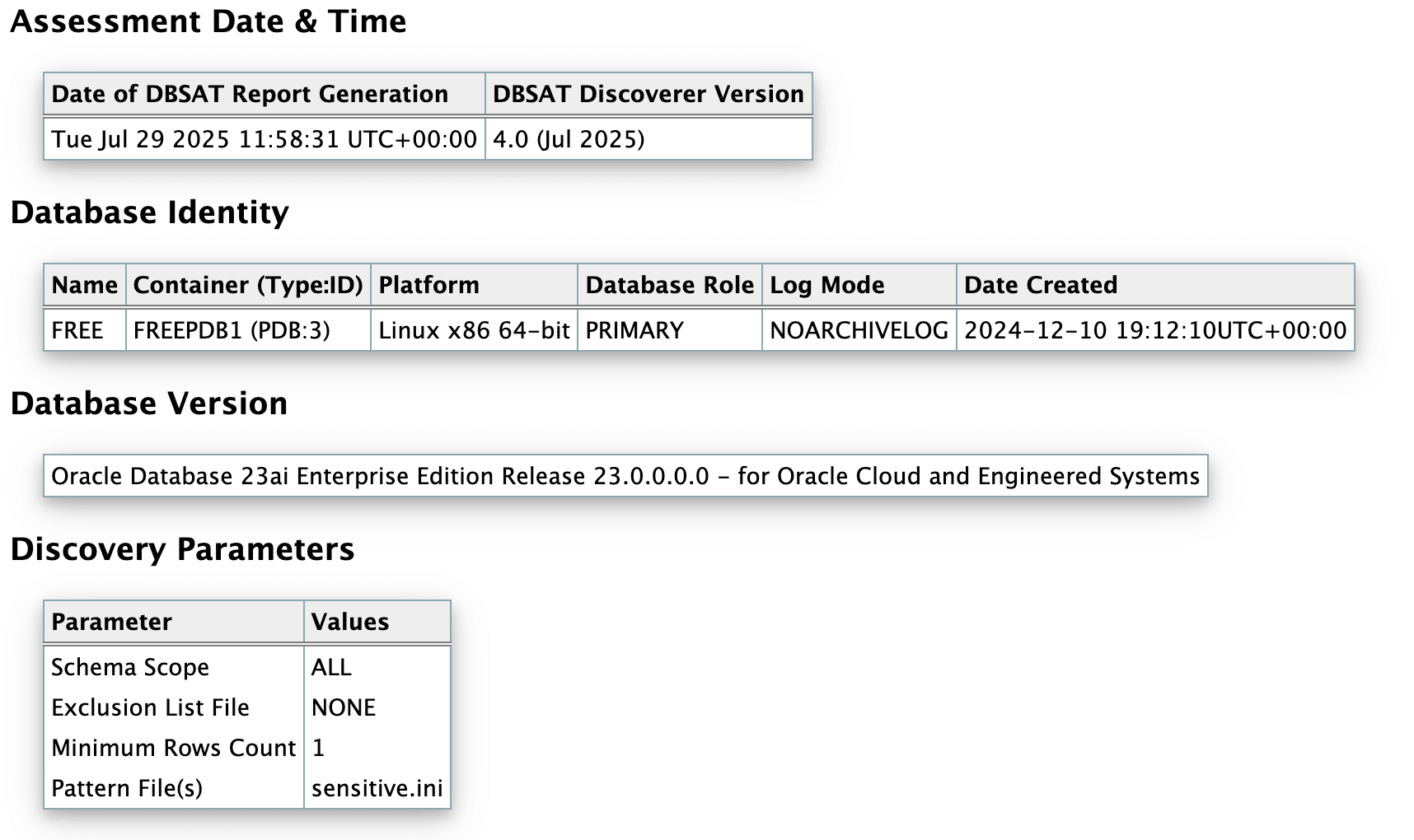
次の図に、Oracle Database Sensitive Data Assessmentレポート — 概要セクションの最初の4つの表を示します。
図1-15 Oracle Database Sensitive Data Assessmentレポート — 概要
概要セクションの次には、サマリー・セクションが表示されます。
Oracle Database Sensitive Data Assessmentレポート — サマリー
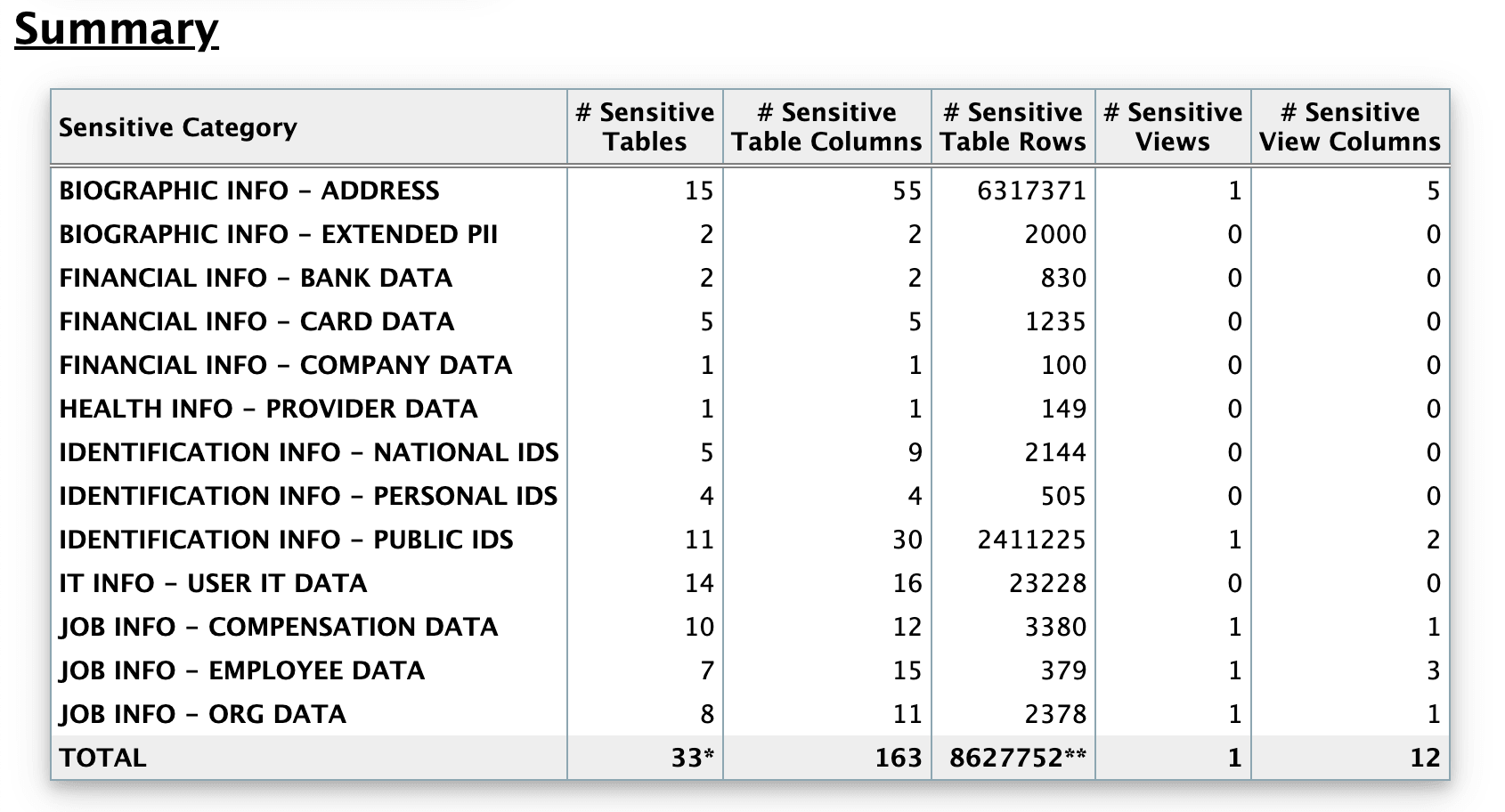
Oracle Database Sensitive Data Assessmentレポート — サマリー・セクションには、機密データとして識別された表、列および行の数に関する情報が機密カテゴリごとにグループ分けされて表示されます。
データベース機密データ・アセスメント・レポート - サマリー・セクションには、次の列が含まれます。
表1-2 Oracle Database Sensitive Data Assessmentレポート — サマリー
| 列名 | 説明 |
|---|---|
|
機密カテゴリ |
機密カテゴリの名前が表示されます。 |
|
機密表数 |
機密データが含まれていることが検出された表の数が表示されます。 |
|
機密表の列数 |
機密データが含まれている表で検出された列の数が表示されます。 |
|
機密表の行数 |
特定の機密カテゴリに分類されたデータを含む、表の行の数が表示されます |
|
機密ビュー数 |
機密データが含まれていることが検出されたビューの数が表示されます |
|
機密ビューの列数 |
機密データが含まれている、ビュー内の検出された列の数が表示されます |
次の図に、Oracle Database Sensitive Data Assessmentレポート - サマリー・セクションに表示される情報を示します。
図1-16 Oracle Database Sensitive Data Assessmentレポート — サマリー
ノート:
単一のデータベース表には、複数の機密カテゴリに合致する列または列コメントが含まれることがあり、機密表数列および「機密行数」列に表示される数が多くなります。ただし、合計行には機密データと識別された表および行の重複しない数が表示されます。
機密カテゴリの構成の詳細は、パターン・ファイルの構成(オプション)を参照してください。
サマリー・セクションの次には、機密データ・セクションが表示されます。
Oracle Database Sensitive Data Assessmentレポート — 機密データ
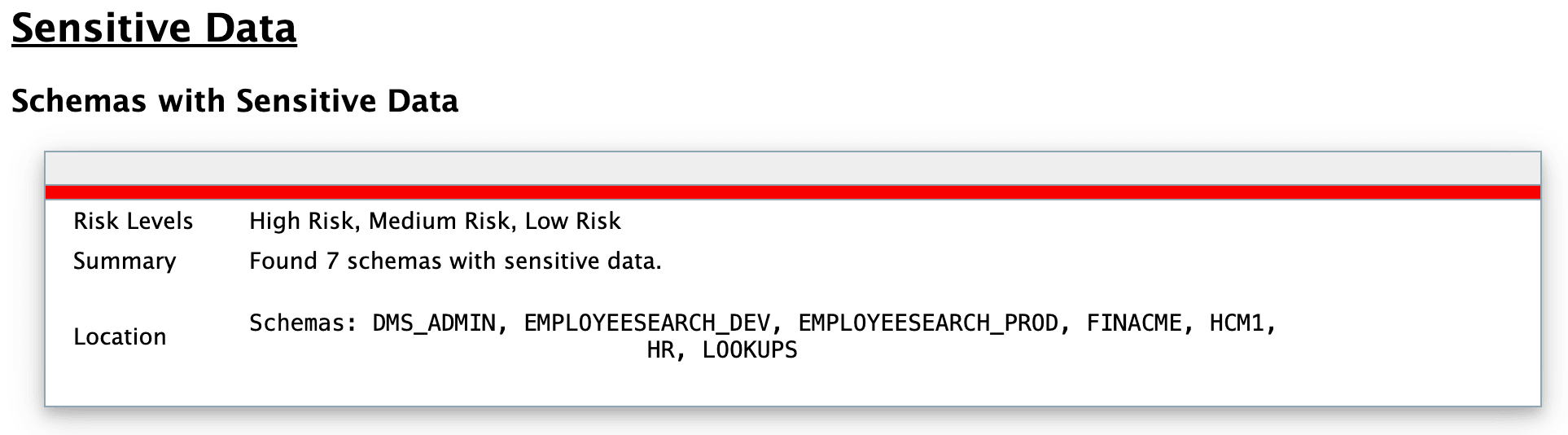
Oracle Database Sensitive Data Assessmentレポート — 機密データ・セクションには機密データが含まれるスキーマに関する情報が表示されます。
Oracle Database Sensitive Data Assessmentレポート - 機密データ・セクションには、次の情報が含まれます。
表1-3 Oracle Database Sensitive Data Assessmentレポート — 機密データ
| セクション | 説明 |
|---|---|
| リスク・レベル | Discovererによって評価されたデータベースのスキーマで識別された機密データのリスク・レベルが表示されます。 |
| サマリー | スキーマでの機密データの出現のサマリーが表示されます。 |
| 場所 | 機密データが含まれるスキーマの名前が表示されます。 |
次の図に、Oracle Database Sensitive Data Assessmentレポート — 機密データ・セクションに表示される情報を示します。
図1-17 Oracle Database Sensitive Data Assessmentレポート — 機密データ
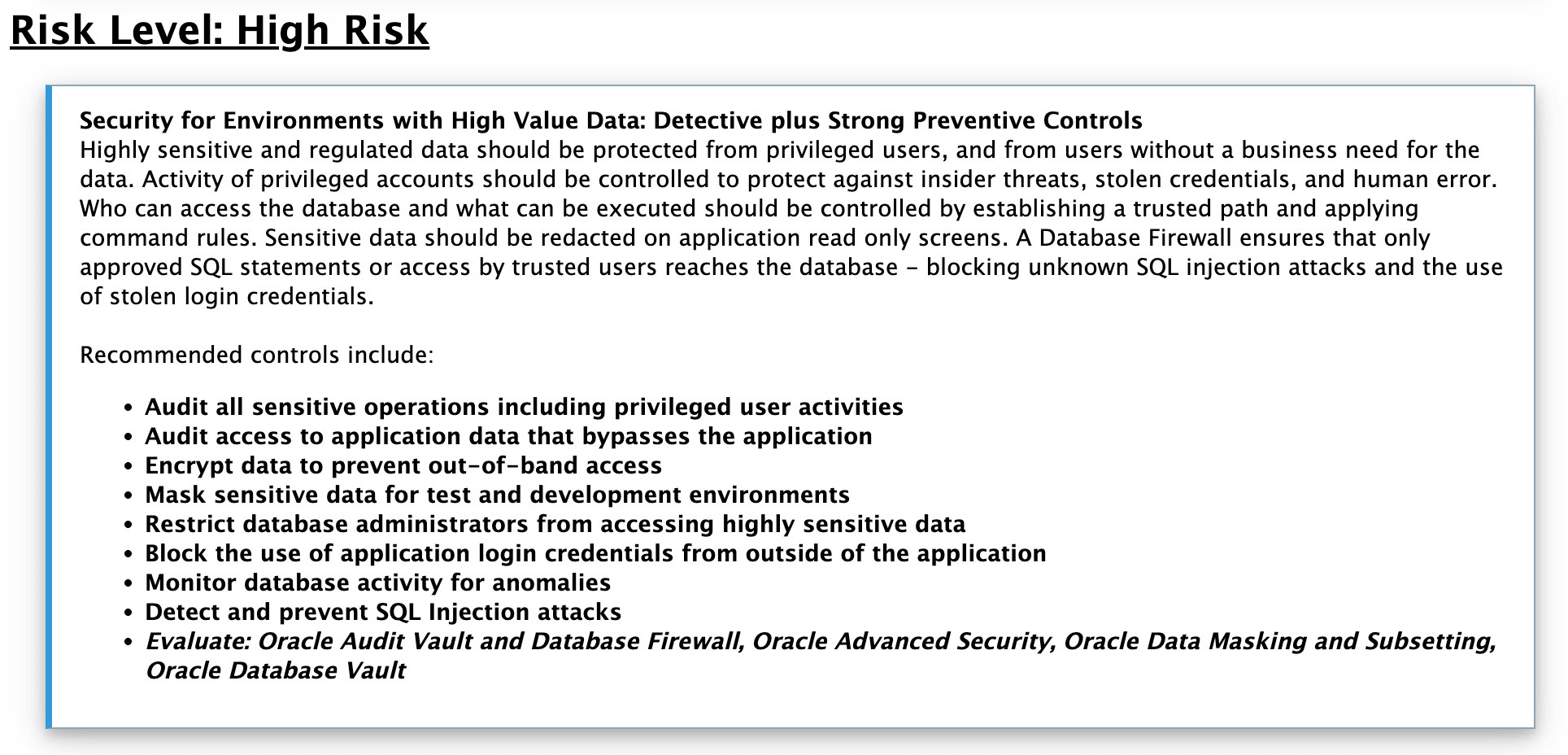
各リスク・レベルの検出内容の後に、機密データをセキュリティ保護するための一連の推奨事項が表示されます。これらの推奨事項には、リスク・レベル(高、中および低)に基づいた様々な制御方法が一覧表示されます。
次の図に、リスク・レベル: 高リスク・セクションに表示される情報を示します。
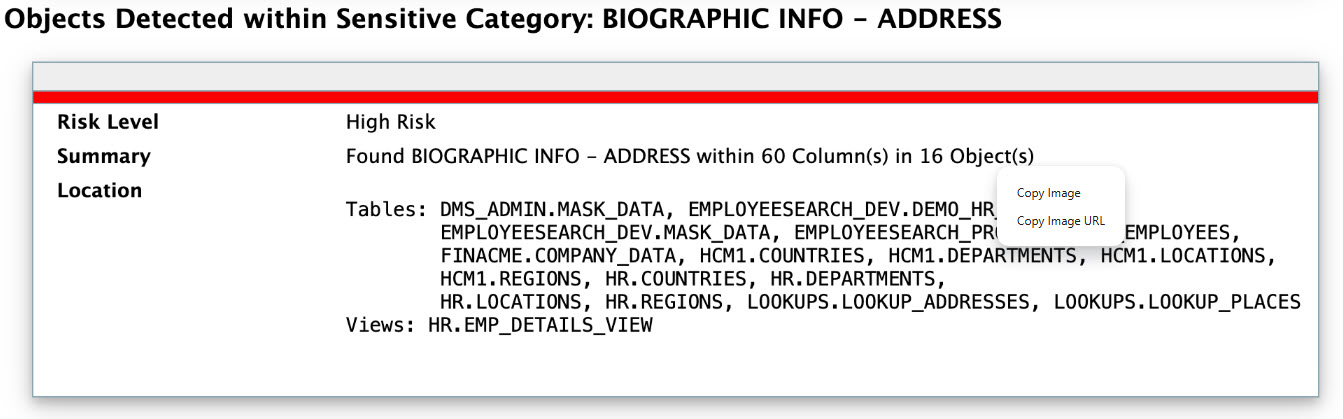
各リスク・レベル・セクションの次には、機密データを含むことが検出された表のリストが表示されます。次の情報が表示されます:
表1-4 機密カテゴリ内で検出されたオブジェクト: <機密カテゴリ名>
| 名前 | 説明 |
|---|---|
|
リスク・レベル |
リスク・レベルが表示されます。 |
|
サマリー |
検出された機密カテゴリ・データのサマリーが表示されます。 |
|
場所 |
機密データが含まれている表とビューの名前が表示されます |
次の図では、機密カテゴリ内で検出されたオブジェクト: <機密カテゴリ名>サブセクションに表示される情報を示します。
機密データ・セクションの次には、スキーマ・ビュー・セクションが表示されます。
Oracle Database Sensitive Data Assessmentレポート — スキーマ・ビュー
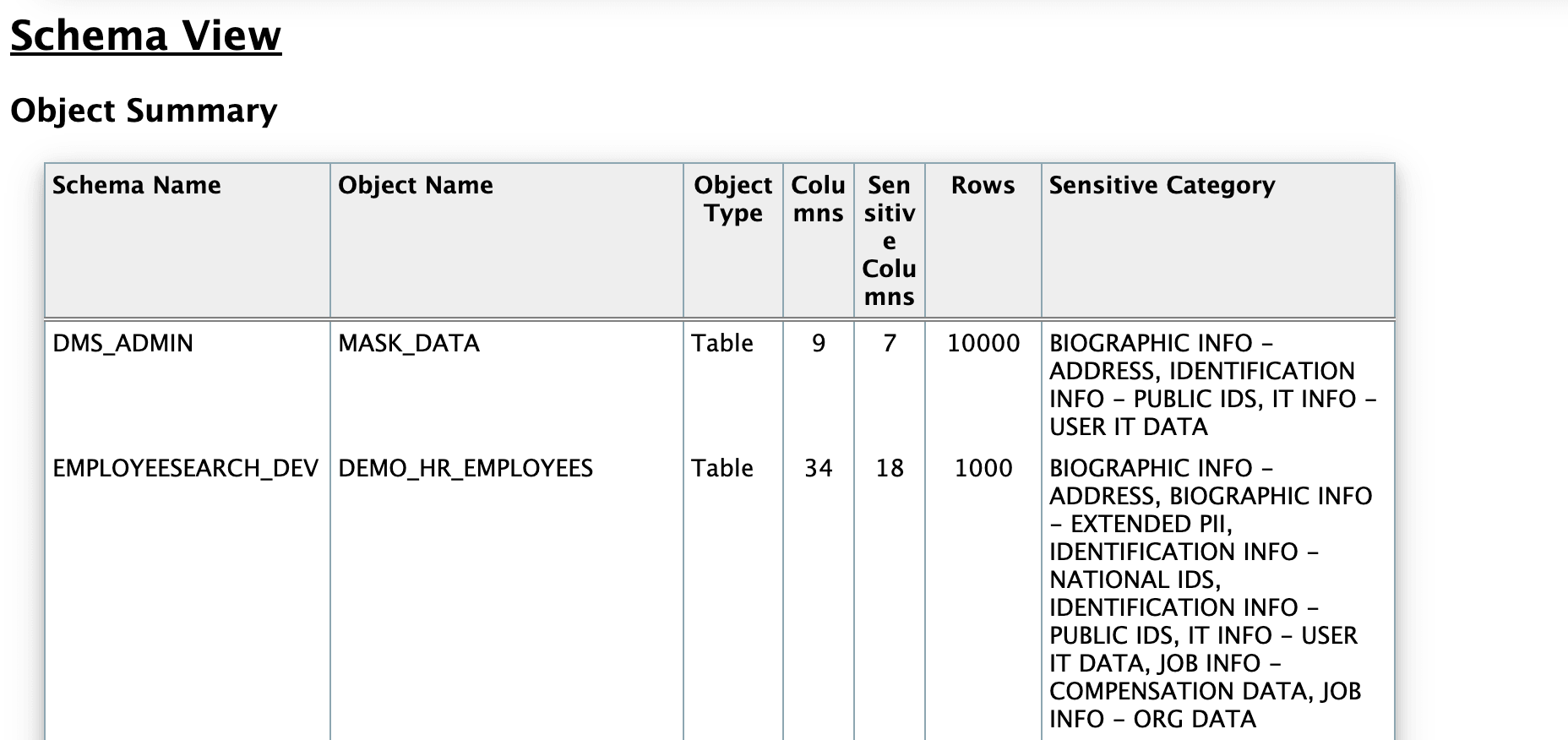
Oracle Database Sensitive Data Assessmentレポート — スキーマ・ビュー・セクションには、機密データが含まれるスキーマ、表、列および行に関する情報が表示されます。機密カテゴリも表示されます。
Oracle Database Sensitive Data Assessmentレポート - サマリー・セクションには、次の列が含まれます。
| 列名 | 説明 |
|---|---|
|
スキーマ名 |
スキーマの名前が表示されます。 |
|
オブジェクト名 |
オブジェクト名が表示されます |
|
オブジェクト・タイプ |
オブジェクト・タイプ(表/ビュー)が表示されます |
|
列 |
表内の列数が表示されます。 |
|
機密列 |
機密データが含まれていることが検出された列の数が表示されます。 |
|
行 |
表内の行数が表示されます |
|
機密カテゴリ |
各列で検出された機密データのカテゴリが表示されます。 |
次の図に、Oracle Database Sensitive Data Assessmentレポート - スキーマ・ビュー・セクションに表示される情報の概要を示します。
図1-20 Oracle Database Sensitive Data Assessmentレポート — スキーマ・ビュー
スキーマ・ビュー・セクションの次には、機密列の詳細セクションが表示されます。
Oracle Database Sensitive Data Assessmentレポート — 機密列の詳細
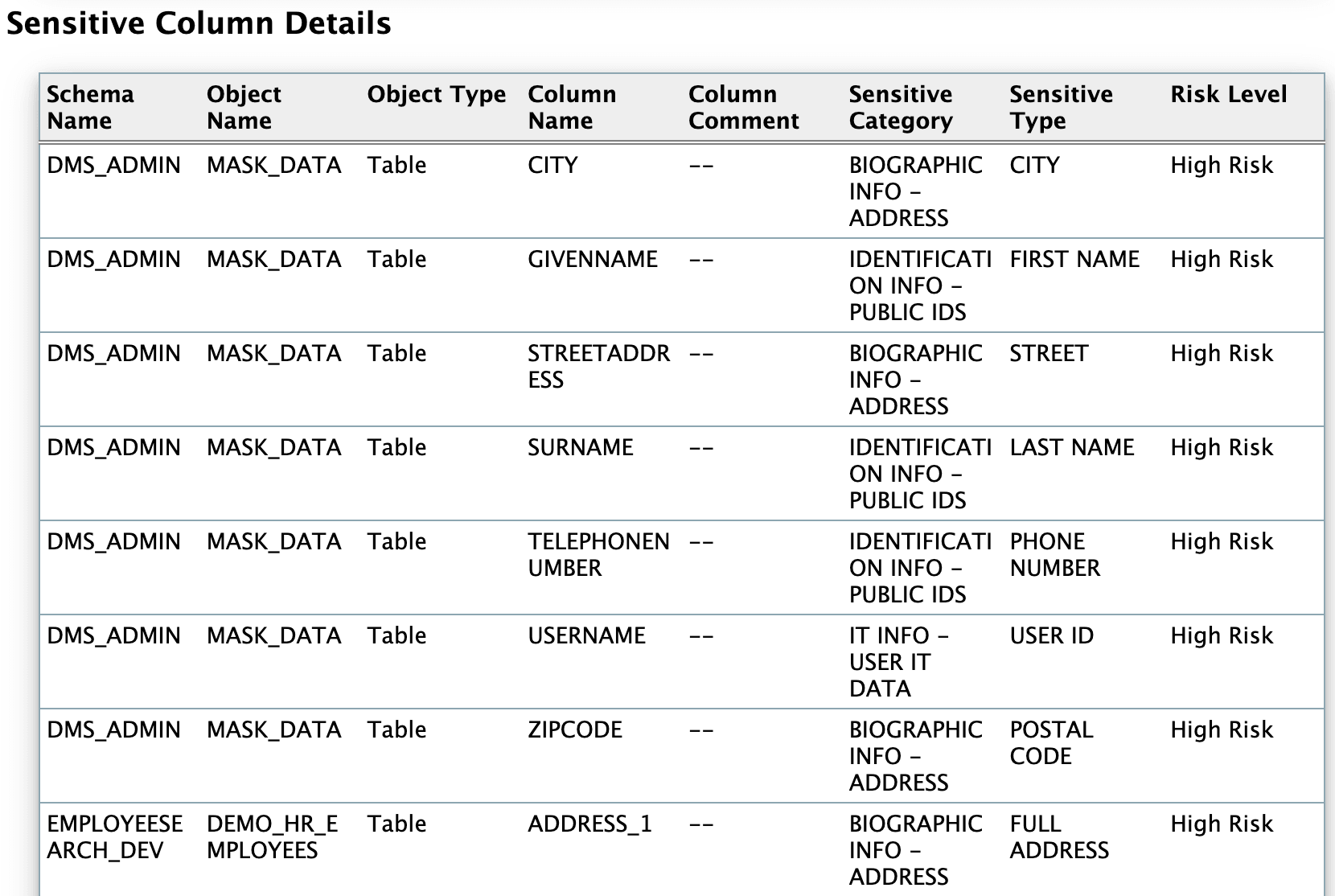
Oracle Database Sensitive Data Assessmentレポート — 機密列の詳細セクションには、機密データが含まれる列に関する情報が表示されます。機密カテゴリおよび機密タイプも表示されます。
| 列名 | 説明 |
|---|---|
|
スキーマ名 |
スキーマの名前が表示されます。 |
|
オブジェクト名 |
オブジェクト名が表示されます |
|
オブジェクト・タイプ |
オブジェクト・タイプ(表/ビュー)が表示されます |
|
列名 |
列の名前が表示されます。 |
|
列コメント |
列のコメントが表示されます。 |
|
機密カテゴリ |
各列で検出された機密データのカテゴリが表示されます。 |
|
機密タイプ |
各列で検出された機密データのタイプが表示されます。 |
|
リスク・レベル |
リスク・レベルが表示されます。 |
次の図に、Oracle Database Sensitive Data Assessmentレポート — 機密列の詳細セクションに表示される情報を示します。
図1-21 Oracle Database Sensitive Data Assessmentレポート — 機密列の詳細
ベスト・プラクティス
Collector - OSコマンド
一般的なベスト・プラクティスとして、アプリケーションまたはファイルにユーザー名とパスワードの資格証明をクリアテキストで格納しないでください。dbsat collectの実行時にコマンドラインにパスワードを指定すると、履歴の使用、ps Unixコマンドの実行、または類似するWindowsコマンドの実行によって、攻撃者が資格証明を取得できます。このため、プロンプトが表示されたときにパスワードを入力することをお薦めします。
ドキュメントのアクセシビリティについて
オラクルのアクセシビリティについての詳細情報は、Oracle Accessibility ProgramのWebサイト(http://www.oracle.com/pls/topic/lookup?ctx=acc&id=docacc)を参照してください。
Oracleサポートへのアクセス
お客様のOracleサポート・サービスへのアクセスおよびご利用は、該当するサービスの注文時に指定された利用条件に従うものとします。
付録A
DBSATターゲット固有のチェックおよび推奨事項の改善
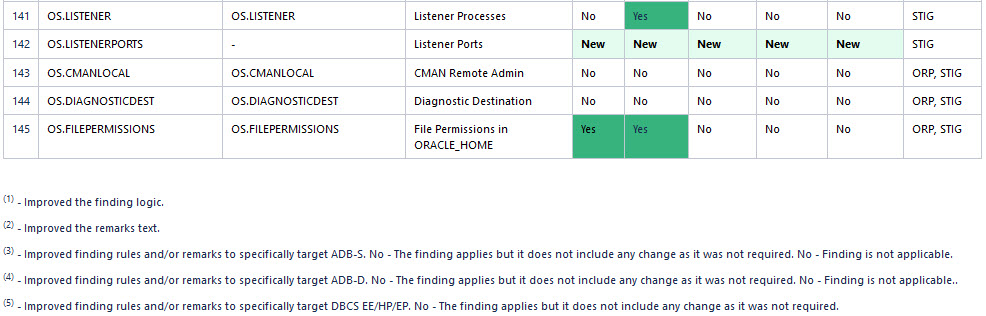
DBSATは、オンプレミス・データベース、Autonomous Database (ServerlessおよびDedicated)、Oracle Cloud DBCS (DBSystems EE/HP/EP)に対して実行できます。一部の所見では、これらのデータベースに対して様々なチェックを実行し、固有の推奨事項を提供します。次の表に、改善された所見を示します。
図1-22 DBSATターゲット固有のチェックおよび推奨事項
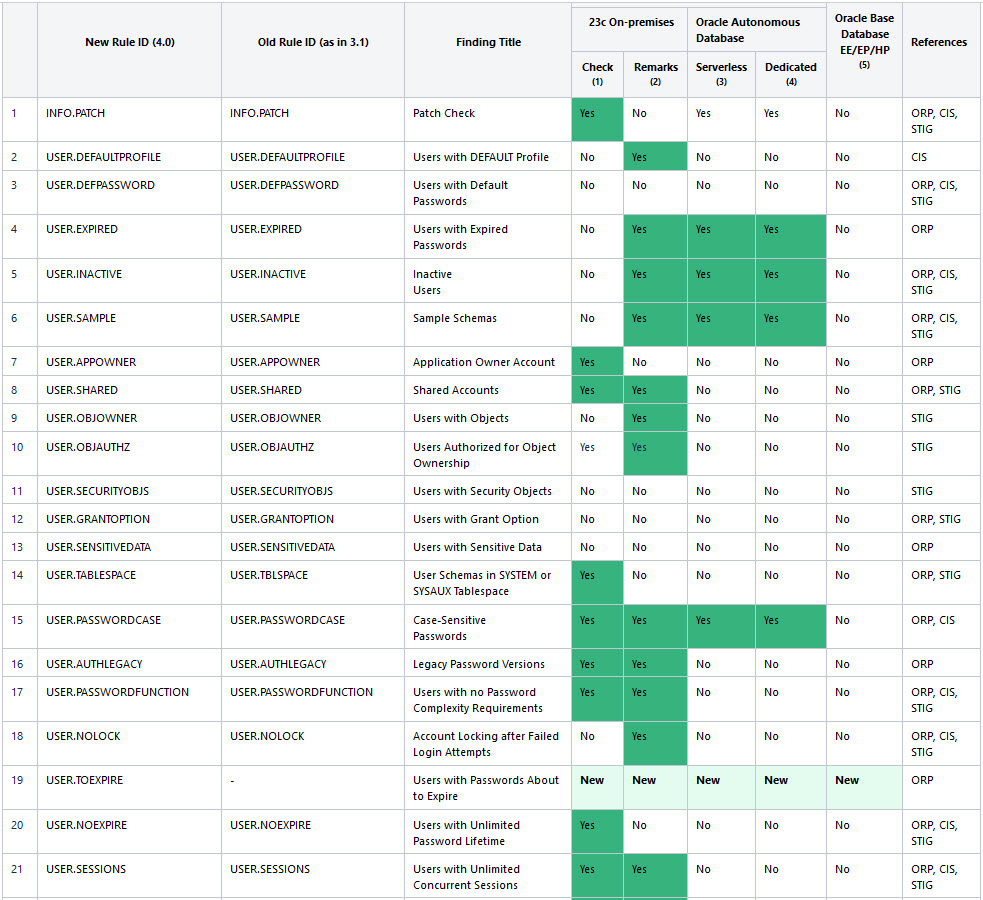
図 1-23 DBSATターゲット固有のチェックおよび推奨事項(続き)
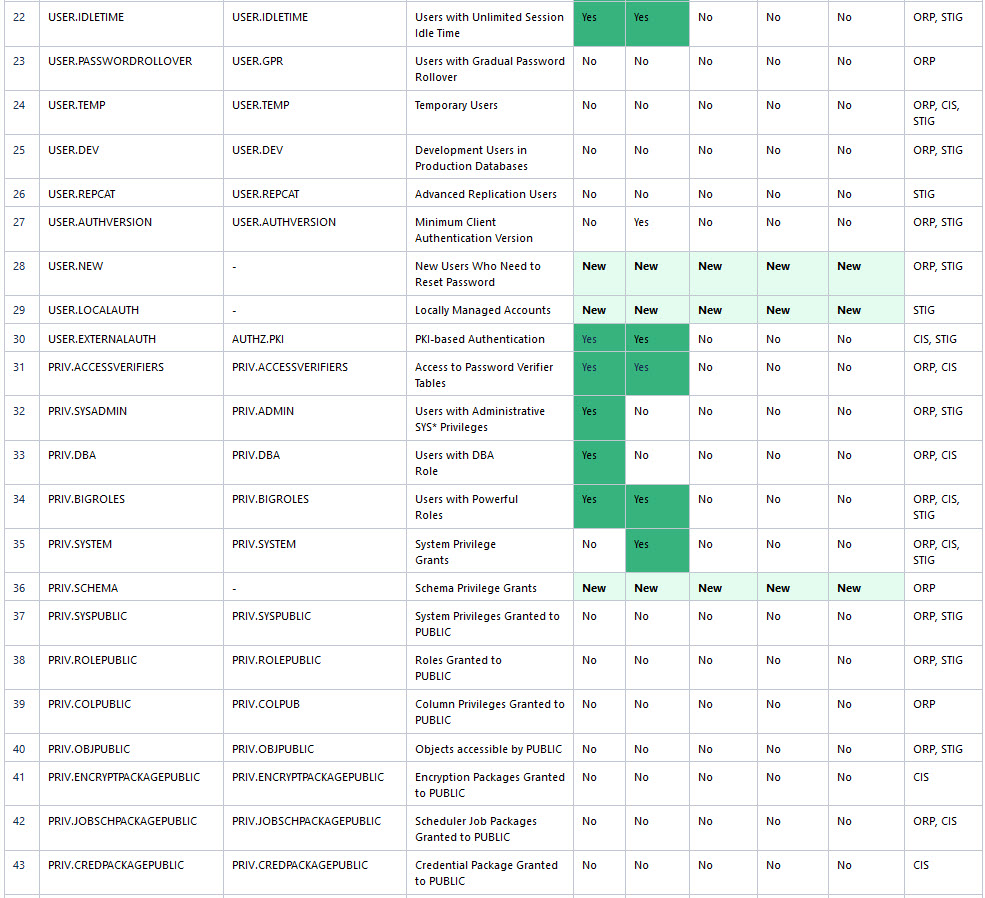
図 1-24 DBSATターゲット固有のチェックおよび推奨事項(続き)
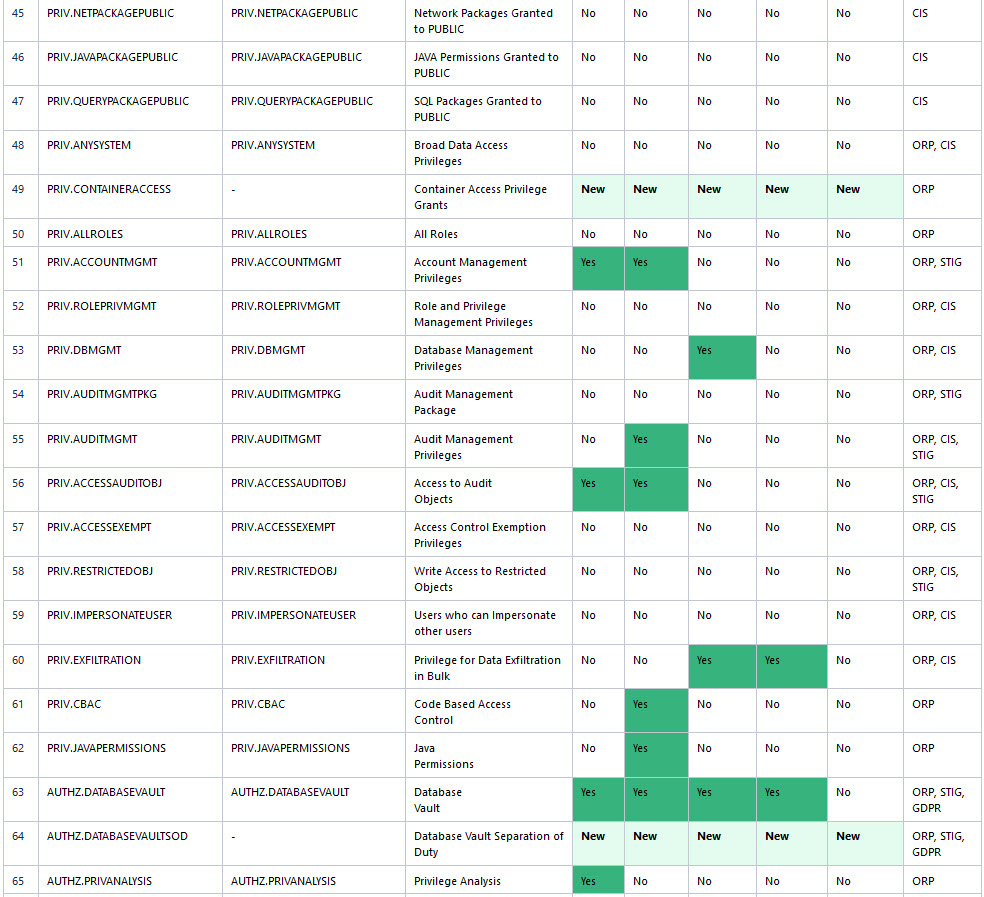
図 1-25 DBSATターゲット固有のチェックおよび推奨事項(続き)
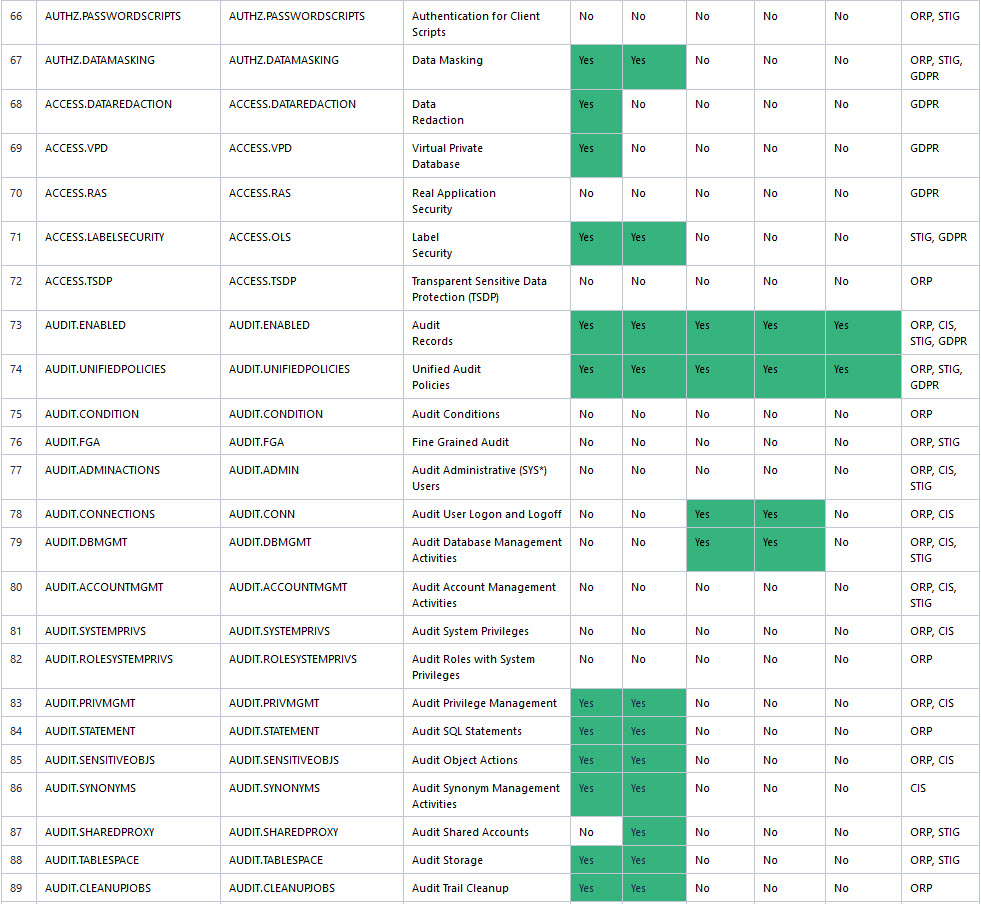
図 1-26 DBSATターゲット固有のチェックおよび推奨事項(続き)
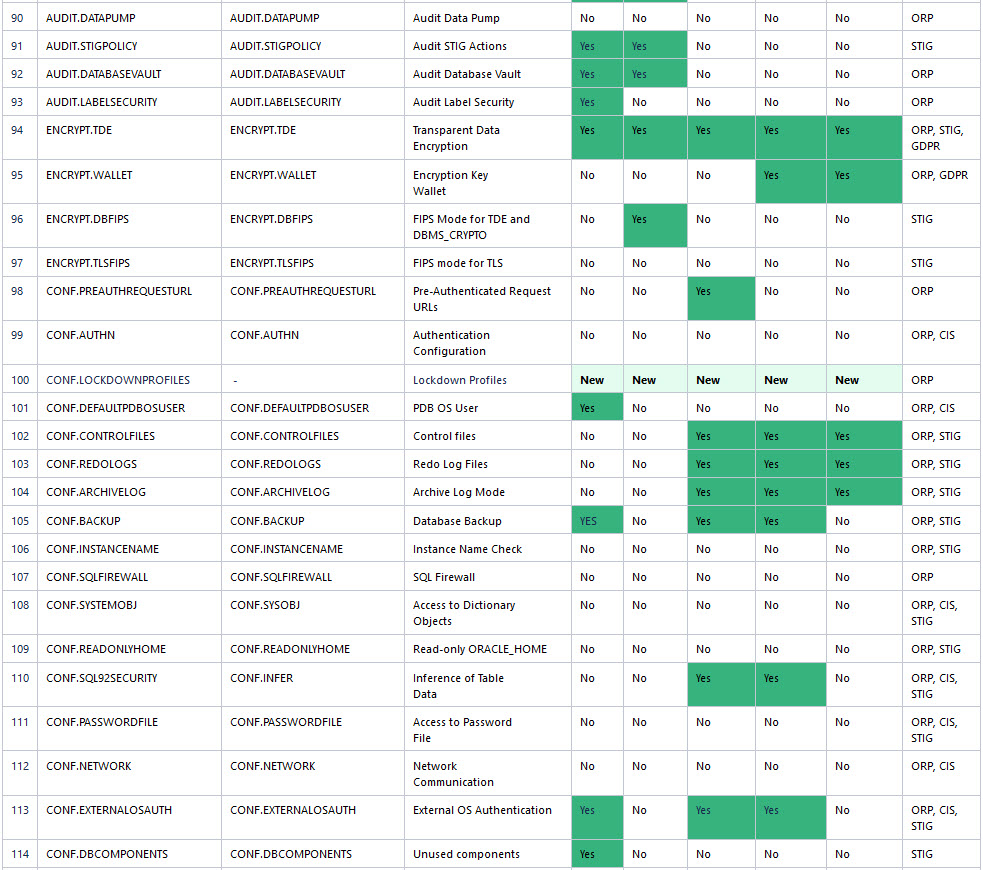
図 1-27 DBSATターゲット固有のチェックおよび推奨事項(続き)
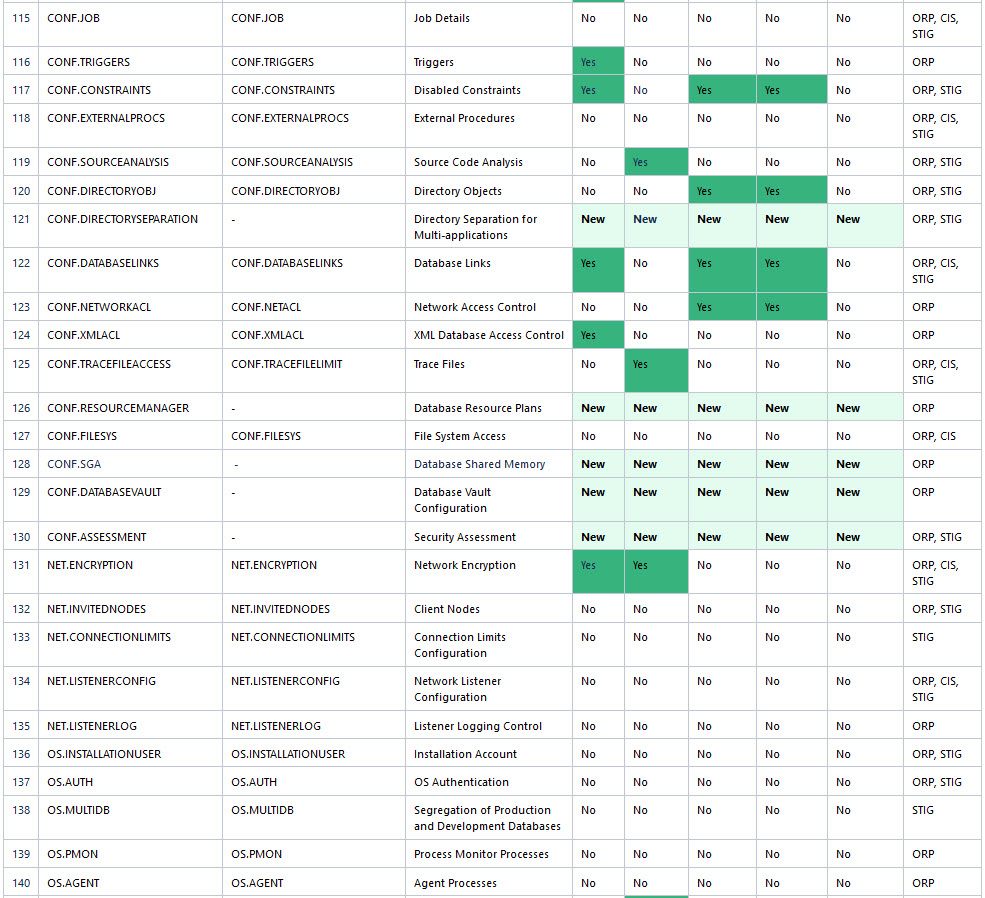
図 1-28 DBSATターゲット固有のチェックおよび推奨事項(続き)
付録B
診断およびログ・ファイルを使用して、Oracle Database Security Assessment Toolをトラブルシューティングできます。
DBSATが生成する出力診断は、エラーのデバッグに役立つ重要な情報を取得します。
デフォルトでは、DBSATはレポートの実行に影響しないエラーを抑制します。収集やレポート生成に影響を与える可能性があるエラーの詳細を確認するには、-dオプションを指定してdbsatを実行してください。
-d:を指定して実行されたdbsatレポートの例
$ ./dbsat report -n -d orcl

Database Security Assessment Tool version 3.1 (Mar 2023)

This tool is intended to assist you in securing your Oracle database system. You are solely responsible for your system and the effect and results of the execution of this tool (including, without limitation, any damage or data loss). Further, the output generated by this tool may include potentially sensitive system configuration data and information that could be used by a skilled attacker to penetrate your system. You are solely responsible for ensuring that the output of this tool, including any generated reports, is handled in accordance with your company’s policies.

Traceback (most recent call last): File “<iostream>“, line 11865, in <module> File “<iostream>“, line 1161, in sec_feature_usage IndexError: index out of range: 1

DBSAT Reporter ran successfully.
標準実行の例:
$ ./dbsat report -n orcl

Database Security Assessment Tool version 4.0

This tool is intended to assist you in securing your Oracle database system. You are solely responsible for your system and the effect and results of the execution of this tool (including, without limitation, any damage or data loss). Further, the output generated by this tool may include potentially sensitive system configuration data and information that could be used by a skilled attacker to penetrate your system. You are solely responsible for ensuring that

the output of this tool, including any generated reports, is handled in accordance with your company’s policies.

DBSAT Reporter ran successfully.パッケージSYS.DBMS_SQLに対する実行がPUBLICから取り消された場合、この問題が発生する可能性があります。
$ ./dbsat report -a -n orcl

Database Security Assessment Tool version 4.0

This tool is intended to assist in you in securing your Oracle database system. You are solely responsible for your system and the effect and results of the execution of this tool (including, without limitation, any damage or data loss). Further, the output generated by this tool may include potentially sensitive system configuration data and information that could be used by a skilled attacker to penetrate your system. You are solely responsible for ensuring that the output of this tool, including any generated reports, is handled in accordance with yourcompany's policies.

... Unable to process input file: orcl.json No JSON object could be decoded Error: Unexpected error occurred while running DBSAT Reporter.このエラーを回避するには、dbsat collect <user>@<service_name> <output-file>で使用されるDBSATデータベース・ユーザーにDBMS_SQLの実行権限を付与します(PUBLIC権限は使用しません)
SQL> grant execute on sys.dbms_sql to <user> ;dbsat collectを再度実行してデータが適切に収集されていることを確認し、レポートを実行します。
./dbsat collect <user>@<service_name> <output-file>

./dbsat report <output-file>
ノート: JSONが無効または破損していないことを確認してください。jsonファイルを確認するか、コレクタを実行します。
場合によっては、DBSATレポートの正常な実行に影響を与える問題の原因がコレクタ生成ファイル内に存在します。トラブルシューティングのステップとしては、DBSAT収集によって生成されたファイルを開き(dbsat extract <filename>)、エラーがないかそのファイルを調べます。
AIXのデフォルト・シェルは、Kornシェル(ksh)です。DBSATはbashシェルで実行する必要があります。bashに変更するか、インストールできます。DBSATは他のシェルでは実行に失敗します。たとえば、AIXにbashシェルがインストールされておらず、DBSATを実行しようとすると、次のようになります。
oraprod>./dbsat

ksh: ./dbsat: not found

oraprod>pwd

/home/oraprod/dbsat400この時点で、AIXにbashをインストールするか、DBSAT collectをリモートで実行できます。bash (linuxサーバーなど)を使用して別のサーバーからDBSATを実行し、AIXで実行されているデータベースに到達できます。
./dbsat collect <user>@<service_name> <output-file>リモート・サーバーから収集する場合、DBSATにはオペレーティング・システム関連の結果は含まれません。
DBSAT収集が完了までに時間がかかりすぎるか、まったく完了しない場合は、-rオプションを使用することで、収集する行の数を制限できます:
./dbsat collect -r <row_limit> <user>@<service_name> <output-file>付録C
サード・パーティ・ライセンスの帰属
バイナリ形式でオラクル社から入手するサード・パーティの技術で、そのバイナリのソース・コードの入手権限を付与するオープン・ソース・ライセンス下で認可されている技術の場合は、このページから該当するソース・コードのコピーを入手できます。技術のソース・コードがバイナリとともに提供されていない場合は、文書によるリクエストを次に送付すると、物理媒体でソース・コードのコピーを入手することもできます。
Oracle America, Inc.
Attn: Associate General Counsel
Development and Engineering Legal
500 Oracle Parkway, 10th Floor
Redwood Shores, CA 94065
または、次のフォームを使用してオラクル社に電子メールを送信することもできます。リクエストには、次の情報を記入してください。
The name of the component or binary file(s) for which you are requesting the source code
The name and version number of the Oracle product
The date you received the Oracle product
Your name
Your company name (if applicable)
Your return mailing address and email
A telephone number in the event we need to reach you
物理媒体と手続きの費用は無料です。リクエストを送付できるのは、(i)リクエスト対象のコンポーネントまたはバイナリ・ファイルを含むOracle製品を入手した日から3年以内、または(ii) GPL v3の下でコードが認可されている場合(ただし、オラクル社がその製品モデルのスペア・パーツまたはカスタマ・サポートを提供している場合に限る)です。
XlsxWriter、バージョン: 3.2.2
BSD 2-Clause License

Copyright (c) 2013-2025, John McNamara <jmcnamara@cpan.org>
All rights reserved.

Redistribution and use in source and binary forms, with or without
modification, are permitted provided that the following conditions are met:

1. Redistributions of source code must retain the above copyright notice, this
   list of conditions and the following disclaimer.

2. Redistributions in binary form must reproduce the above copyright notice,
   this list of conditions and the following disclaimer in the documentation
   and/or other materials provided with the distribution.

THIS SOFTWARE IS PROVIDED BY THE COPYRIGHT HOLDERS AND CONTRIBUTORS "AS IS"
AND ANY EXPRESS OR IMPLIED WARRANTIES, INCLUDING, BUT NOT LIMITED TO, THE
IMPLIED WARRANTIES OF MERCHANTABILITY AND FITNESS FOR A PARTICULAR PURPOSE ARE
DISCLAIMED. IN NO EVENT SHALL THE COPYRIGHT HOLDER OR CONTRIBUTORS BE LIABLE
FOR ANY DIRECT, INDIRECT, INCIDENTAL, SPECIAL, EXEMPLARY, OR CONSEQUENTIAL
DAMAGES (INCLUDING, BUT NOT LIMITED TO, PROCUREMENT OF SUBSTITUTE GOODS OR
SERVICES; LOSS OF USE, DATA, OR PROFITS; OR BUSINESS INTERRUPTION) HOWEVER
CAUSED AND ON ANY THEORY OF LIABILITY, WHETHER IN CONTRACT, STRICT LIABILITY,
OR TORT (INCLUDING NEGLIGENCE OR OTHERWISE) ARISING IN ANY WAY OUT OF THE USE
OF THIS SOFTWARE, EVEN IF ADVISED OF THE POSSIBILITY OF SUCH DAMAGE.
Eclipse Public License - v 2.0
THE ACCOMPANYING PROGRAM IS PROVIDED UNDER THE TERMS OF THIS ECLIPSE
    PUBLIC LICENSE ("AGREEMENT"). ANY USE, REPRODUCTION OR DISTRIBUTION
    OF THE PROGRAM CONSTITUTES RECIPIENT'S ACCEPTANCE OF THIS AGREEMENT.

1. DEFINITIONS

"Contribution" means:

  a) in the case of the initial Contributor, the initial content
     Distributed under this Agreement, and

  b) in the case of each subsequent Contributor:
     i) changes to the Program, and
     ii) additions to the Program;
  where such changes and/or additions to the Program originate from
  and are Distributed by that particular Contributor. A Contribution
  "originates" from a Contributor if it was added to the Program by
  such Contributor itself or anyone acting on such Contributor's behalf.
  Contributions do not include changes or additions to the Program that
  are not Modified Works.

"Contributor" means any person or entity that Distributes the Program.

"Licensed Patents" mean patent claims licensable by a Contributor which
are necessarily infringed by the use or sale of its Contribution alone
or when combined with the Program.

"Program" means the Contributions Distributed in accordance with this
Agreement.

"Recipient" means anyone who receives the Program under this Agreement
or any Secondary License (as applicable), including Contributors.

"Derivative Works" shall mean any work, whether in Source Code or other
form, that is based on (or derived from) the Program and for which the
editorial revisions, annotations, elaborations, or other modifications
represent, as a whole, an original work of authorship.

"Modified Works" shall mean any work in Source Code or other form that
results from an addition to, deletion from, or modification of the
contents of the Program, including, for purposes of clarity any new file
in Source Code form that contains any contents of the Program. Modified
Works shall not include works that contain only declarations,
interfaces, types, classes, structures, or files of the Program solely
in each case in order to link to, bind by name, or subclass the Program
or Modified Works thereof.

"Distribute" means the acts of a) distributing or b) making available
in any manner that enables the transfer of a copy.

"Source Code" means the form of a Program preferred for making
modifications, including but not limited to software source code,
documentation source, and configuration files.

"Secondary License" means either the GNU General Public License,
Version 2.0, or any later versions of that license, including any
exceptions or additional permissions as identified by the initial
Contributor.

2. GRANT OF RIGHTS

  a) Subject to the terms of this Agreement, each Contributor hereby
  grants Recipient a non-exclusive, worldwide, royalty-free copyright
  license to reproduce, prepare Derivative Works of, publicly display,
  publicly perform, Distribute and sublicense the Contribution of such
  Contributor, if any, and such Derivative Works.

  b) Subject to the terms of this Agreement, each Contributor hereby
  grants Recipient a non-exclusive, worldwide, royalty-free patent
  license under Licensed Patents to make, use, sell, offer to sell,
  import and otherwise transfer the Contribution of such Contributor,
  if any, in Source Code or other form. This patent license shall
  apply to the combination of the Contribution and the Program if, at
  the time the Contribution is added by the Contributor, such addition
  of the Contribution causes such combination to be covered by the
  Licensed Patents. The patent license shall not apply to any other
  combinations which include the Contribution. No hardware per se is
  licensed hereunder.

  c) Recipient understands that although each Contributor grants the
  licenses to its Contributions set forth herein, no assurances are
  provided by any Contributor that the Program does not infringe the
  patent or other intellectual property rights of any other entity.
  Each Contributor disclaims any liability to Recipient for claims
  brought by any other entity based on infringement of intellectual
  property rights or otherwise. As a condition to exercising the
  rights and licenses granted hereunder, each Recipient hereby
  assumes sole responsibility to secure any other intellectual
  property rights needed, if any. For example, if a third party
  patent license is required to allow Recipient to Distribute the
  Program, it is Recipient's responsibility to acquire that license
  before distributing the Program.

  d) Each Contributor represents that to its knowledge it has
  sufficient copyright rights in its Contribution, if any, to grant
  the copyright license set forth in this Agreement.

  e) Notwithstanding the terms of any Secondary License, no
  Contributor makes additional grants to any Recipient (other than
  those set forth in this Agreement) as a result of such Recipient's
  receipt of the Program under the terms of a Secondary License
  (if permitted under the terms of Section 3).

3. REQUIREMENTS

3.1 If a Contributor Distributes the Program in any form, then:

  a) the Program must also be made available as Source Code, in
  accordance with section 3.2, and the Contributor must accompany
  the Program with a statement that the Source Code for the Program
  is available under this Agreement, and informs Recipients how to
  obtain it in a reasonable manner on or through a medium customarily
  used for software exchange; and

  b) the Contributor may Distribute the Program under a license
  different than this Agreement, provided that such license:
     i) effectively disclaims on behalf of all other Contributors all
     warranties and conditions, express and implied, including
     warranties or conditions of title and non-infringement, and
     implied warranties or conditions of merchantability and fitness
     for a particular purpose;

     ii) effectively excludes on behalf of all other Contributors all
     liability for damages, including direct, indirect, special,
     incidental and consequential damages, such as lost profits;

     iii) does not attempt to limit or alter the recipients' rights
     in the Source Code under section 3.2; and

     iv) requires any subsequent distribution of the Program by any
     party to be under a license that satisfies the requirements
     of this section 3.

3.2 When the Program is Distributed as Source Code:

  a) it must be made available under this Agreement, or if the
  Program (i) is combined with other material in a separate file or
  files made available under a Secondary License, and (ii) the initial
  Contributor attached to the Source Code the notice described in
  Exhibit A of this Agreement, then the Program may be made available
  under the terms of such Secondary Licenses, and

  b) a copy of this Agreement must be included with each copy of
  the Program.

3.3 Contributors may not remove or alter any copyright, patent,
trademark, attribution notices, disclaimers of warranty, or limitations
of liability ("notices") contained within the Program from any copy of
the Program which they Distribute, provided that Contributors may add
their own appropriate notices.

4. COMMERCIAL DISTRIBUTION

Commercial distributors of software may accept certain responsibilities
with respect to end users, business partners and the like. While this
license is intended to facilitate the commercial use of the Program,
the Contributor who includes the Program in a commercial product
offering should do so in a manner which does not create potential
liability for other Contributors. Therefore, if a Contributor includes
the Program in a commercial product offering, such Contributor
("Commercial Contributor") hereby agrees to defend and indemnify every
other Contributor ("Indemnified Contributor") against any losses,
damages and costs (collectively "Losses") arising from claims, lawsuits
and other legal actions brought by a third party against the Indemnified
Contributor to the extent caused by the acts or omissions of such
Commercial Contributor in connection with its distribution of the Program
in a commercial product offering. The obligations in this section do not
apply to any claims or Losses relating to any actual or alleged
intellectual property infringement. In order to qualify, an Indemnified
Contributor must: a) promptly notify the Commercial Contributor in
writing of such claim, and b) allow the Commercial Contributor to control,
and cooperate with the Commercial Contributor in, the defense and any
related settlement negotiations. The Indemnified Contributor may
participate in any such claim at its own expense.

For example, a Contributor might include the Program in a commercial
product offering, Product X. That Contributor is then a Commercial
Contributor. If that Commercial Contributor then makes performance
claims, or offers warranties related to Product X, those performance
claims and warranties are such Commercial Contributor's responsibility
alone. Under this section, the Commercial Contributor would have to
defend claims against the other Contributors related to those performance
claims and warranties, and if a court requires any other Contributor to
pay any damages as a result, the Commercial Contributor must pay
those damages.

5. NO WARRANTY

EXCEPT AS EXPRESSLY SET FORTH IN THIS AGREEMENT, AND TO THE EXTENT
PERMITTED BY APPLICABLE LAW, THE PROGRAM IS PROVIDED ON AN "AS IS"
BASIS, WITHOUT WARRANTIES OR CONDITIONS OF ANY KIND, EITHER EXPRESS OR
IMPLIED INCLUDING, WITHOUT LIMITATION, ANY WARRANTIES OR CONDITIONS OF
TITLE, NON-INFRINGEMENT, MERCHANTABILITY OR FITNESS FOR A PARTICULAR
PURPOSE. Each Recipient is solely responsible for determining the
appropriateness of using and distributing the Program and assumes all
risks associated with its exercise of rights under this Agreement,
including but not limited to the risks and costs of program errors,
compliance with applicable laws, damage to or loss of data, programs
or equipment, and unavailability or interruption of operations.

6. DISCLAIMER OF LIABILITY

EXCEPT AS EXPRESSLY SET FORTH IN THIS AGREEMENT, AND TO THE EXTENT
PERMITTED BY APPLICABLE LAW, NEITHER RECIPIENT NOR ANY CONTRIBUTORS
SHALL HAVE ANY LIABILITY FOR ANY DIRECT, INDIRECT, INCIDENTAL, SPECIAL,
EXEMPLARY, OR CONSEQUENTIAL DAMAGES (INCLUDING WITHOUT LIMITATION LOST
PROFITS), HOWEVER CAUSED AND ON ANY THEORY OF LIABILITY, WHETHER IN
CONTRACT, STRICT LIABILITY, OR TORT (INCLUDING NEGLIGENCE OR OTHERWISE)
ARISING IN ANY WAY OUT OF THE USE OR DISTRIBUTION OF THE PROGRAM OR THE
EXERCISE OF ANY RIGHTS GRANTED HEREUNDER, EVEN IF ADVISED OF THE
POSSIBILITY OF SUCH DAMAGES.

7. GENERAL

If any provision of this Agreement is invalid or unenforceable under
applicable law, it shall not affect the validity or enforceability of
the remainder of the terms of this Agreement, and without further
action by the parties hereto, such provision shall be reformed to the
minimum extent necessary to make such provision valid and enforceable.

If Recipient institutes patent litigation against any entity
(including a cross-claim or counterclaim in a lawsuit) alleging that the
Program itself (excluding combinations of the Program with other software
or hardware) infringes such Recipient's patent(s), then such Recipient's
rights granted under Section 2(b) shall terminate as of the date such
litigation is filed.

All Recipient's rights under this Agreement shall terminate if it
fails to comply with any of the material terms or conditions of this
Agreement and does not cure such failure in a reasonable period of
time after becoming aware of such noncompliance. If all Recipient's
rights under this Agreement terminate, Recipient agrees to cease use
and distribution of the Program as soon as reasonably practicable.
However, Recipient's obligations under this Agreement and any licenses
granted by Recipient relating to the Program shall continue and survive.

Everyone is permitted to copy and distribute copies of this Agreement,
but in order to avoid inconsistency the Agreement is copyrighted and
may only be modified in the following manner. The Agreement Steward
reserves the right to publish new versions (including revisions) of
this Agreement from time to time. No one other than the Agreement
Steward has the right to modify this Agreement. The Eclipse Foundation
is the initial Agreement Steward. The Eclipse Foundation may assign the
responsibility to serve as the Agreement Steward to a suitable separate
entity. Each new version of the Agreement will be given a distinguishing
version number. The Program (including Contributions) may always be
Distributed subject to the version of the Agreement under which it was
received. In addition, after a new version of the Agreement is published,
Contributor may elect to Distribute the Program (including its
Contributions) under the new version.

Except as expressly stated in Sections 2(a) and 2(b) above, Recipient
receives no rights or licenses to the intellectual property of any
Contributor under this Agreement, whether expressly, by implication,
estoppel or otherwise. All rights in the Program not expressly granted
under this Agreement are reserved. Nothing in this Agreement is intended
to be enforceable by any entity that is not a Contributor or Recipient.
No third-party beneficiary rights are created under this Agreement.

Exhibit A - Form of Secondary Licenses Notice

"This Source Code may also be made available under the following
Secondary Licenses when the conditions for such availability set forth
in the Eclipse Public License, v. 2.0 are satisfied: {name license(s),
version(s), and exceptions or additional permissions here}."

  Simply including a copy of this Agreement, including this Exhibit A
  is not sufficient to license the Source Code under Secondary Licenses.

  If it is not possible or desirable to put the notice in a particular
  file, then You may include the notice in a location (such as a LICENSE
  file in a relevant directory) where a recipient would be likely to
  look for such a notice.

  You may add additional accurate notices of copyright ownership.
GNU General Public License(GPL)バージョン2、1991年6月
Copyright (C) 1989, 1991 Free Software Foundation, Inc.
51 Franklin Street, Fifth Floor
Boston, MA 02110-1335
USA

Everyone is permitted to copy and distribute verbatim copies
of this license document, but changing it is not allowed.

Preamble

The licenses for most software are designed to take away your freedom to
share and change it. By contrast, the GNU General Public License is
intended to guarantee your freedom to share and change free software--to
make sure the software is free for all its users. This General Public
License applies to most of the Free Software Foundation's software and
to any other program whose authors commit to using it. (Some other Free
Software Foundation software is covered by the GNU Library General
Public License instead.) You can apply it to your programs, too.

When we speak of free software, we are referring to freedom, not price.
Our General Public Licenses are designed to make sure that you have the
freedom to distribute copies of free software (and charge for this
service if you wish), that you receive source code or can get it if you
want it, that you can change the software or use pieces of it in new
free programs; and that you know you can do these things.

To protect your rights, we need to make restrictions that forbid anyone
to deny you these rights or to ask you to surrender the rights. These
restrictions translate to certain responsibilities for you if you
distribute copies of the software, or if you modify it.

For example, if you distribute copies of such a program, whether gratis
or for a fee, you must give the recipients all the rights that you have.
You must make sure that they, too, receive or can get the source code.
And you must show them these terms so they know their rights.

We protect your rights with two steps: (1) copyright the software, and
(2) offer you this license which gives you legal permission to copy,
distribute and/or modify the software.

Also, for each author's protection and ours, we want to make certain
that everyone understands that there is no warranty for this free
software. If the software is modified by someone else and passed on, we
want its recipients to know that what they have is not the original, so
that any problems introduced by others will not reflect on the original
authors' reputations.

Finally, any free program is threatened constantly by software patents.
We wish to avoid the danger that redistributors of a free program will
individually obtain patent licenses, in effect making the program
proprietary. To prevent this, we have made it clear that any patent must
be licensed for everyone's free use or not licensed at all.

The precise terms and conditions for copying, distribution and
modification follow.

TERMS AND CONDITIONS FOR COPYING, DISTRIBUTION AND MODIFICATION

0. This License applies to any program or other work which contains a
notice placed by the copyright holder saying it may be distributed under
the terms of this General Public License. The "Program", below, refers
to any such program or work, and a "work based on the Program" means
either the Program or any derivative work under copyright law: that is
to say, a work containing the Program or a portion of it, either
verbatim or with modifications and/or translated into another language.
(Hereinafter, translation is included without limitation in the term
"modification".) Each licensee is addressed as "you".

Activities other than copying, distribution and modification are not
covered by this License; they are outside its scope. The act of running
the Program is not restricted, and the output from the Program is
covered only if its contents constitute a work based on the Program
(independent of having been made by running the Program). Whether that
is true depends on what the Program does.

1. You may copy and distribute verbatim copies of the Program's source
code as you receive it, in any medium, provided that you conspicuously
and appropriately publish on each copy an appropriate copyright notice
and disclaimer of warranty; keep intact all the notices that refer to
this License and to the absence of any warranty; and give any other
recipients of the Program a copy of this License along with the Program.

You may charge a fee for the physical act of transferring a copy, and
you may at your option offer warranty protection in exchange for a fee.

2. You may modify your copy or copies of the Program or any portion of
it, thus forming a work based on the Program, and copy and distribute
such modifications or work under the terms of Section 1 above, provided
that you also meet all of these conditions:

    a) You must cause the modified files to carry prominent notices
    stating that you changed the files and the date of any change.

    b) You must cause any work that you distribute or publish, that in
    whole or in part contains or is derived from the Program or any part
    thereof, to be licensed as a whole at no charge to all third parties
    under the terms of this License.

    c) If the modified program normally reads commands interactively
    when run, you must cause it, when started running for such
    interactive use in the most ordinary way, to print or display an
    announcement including an appropriate copyright notice and a notice
    that there is no warranty (or else, saying that you provide a
    warranty) and that users may redistribute the program under these
    conditions, and telling the user how to view a copy of this License.
    (Exception: if the Program itself is interactive but does not
    normally print such an announcement, your work based on the Program
    is not required to print an announcement.)

These requirements apply to the modified work as a whole. If
identifiable sections of that work are not derived from the Program, and
can be reasonably considered independent and separate works in
themselves, then this License, and its terms, do not apply to those
sections when you distribute them as separate works. But when you
distribute the same sections as part of a whole which is a work based on
the Program, the distribution of the whole must be on the terms of this
License, whose permissions for other licensees extend to the entire
whole, and thus to each and every part regardless of who wrote it.

Thus, it is not the intent of this section to claim rights or contest
your rights to work written entirely by you; rather, the intent is to
exercise the right to control the distribution of derivative or
collective works based on the Program.

In addition, mere aggregation of another work not based on the Program
with the Program (or with a work based on the Program) on a volume of a
storage or distribution medium does not bring the other work under the
scope of this License.

3. You may copy and distribute the Program (or a work based on it,
under Section 2) in object code or executable form under the terms of
Sections 1 and 2 above provided that you also do one of the following:

    a) Accompany it with the complete corresponding machine-readable
    source code, which must be distributed under the terms of Sections 1
    and 2 above on a medium customarily used for software interchange; or,

    b) Accompany it with a written offer, valid for at least three
    years, to give any third party, for a charge no more than your cost
    of physically performing source distribution, a complete
    machine-readable copy of the corresponding source code, to be
    distributed under the terms of Sections 1 and 2 above on a medium
    customarily used for software interchange; or,

    c) Accompany it with the information you received as to the offer to
    distribute corresponding source code. (This alternative is allowed
    only for noncommercial distribution and only if you received the
    program in object code or executable form with such an offer, in
    accord with Subsection b above.)

The source code for a work means the preferred form of the work for
making modifications to it. For an executable work, complete source code
means all the source code for all modules it contains, plus any
associated interface definition files, plus the scripts used to control
compilation and installation of the executable. However, as a special
exception, the source code distributed need not include anything that is
normally distributed (in either source or binary form) with the major
components (compiler, kernel, and so on) of the operating system on
which the executable runs, unless that component itself accompanies the
executable.

If distribution of executable or object code is made by offering access
to copy from a designated place, then offering equivalent access to copy
the source code from the same place counts as distribution of the source
code, even though third parties are not compelled to copy the source
along with the object code.

4. You may not copy, modify, sublicense, or distribute the Program
except as expressly provided under this License. Any attempt otherwise
to copy, modify, sublicense or distribute the Program is void, and will
automatically terminate your rights under this License. However, parties
who have received copies, or rights, from you under this License will
not have their licenses terminated so long as such parties remain in
full compliance.

5. You are not required to accept this License, since you have not
signed it. However, nothing else grants you permission to modify or
distribute the Program or its derivative works. These actions are
prohibited by law if you do not accept this License. Therefore, by
modifying or distributing the Program (or any work based on the
Program), you indicate your acceptance of this License to do so, and all
its terms and conditions for copying, distributing or modifying the
Program or works based on it.

6. Each time you redistribute the Program (or any work based on the
Program), the recipient automatically receives a license from the
original licensor to copy, distribute or modify the Program subject to
these terms and conditions. You may not impose any further restrictions
on the recipients' exercise of the rights granted herein. You are not
responsible for enforcing compliance by third parties to this License.

7. If, as a consequence of a court judgment or allegation of patent
infringement or for any other reason (not limited to patent issues),
conditions are imposed on you (whether by court order, agreement or
otherwise) that contradict the conditions of this License, they do not
excuse you from the conditions of this License. If you cannot distribute
so as to satisfy simultaneously your obligations under this License and
any other pertinent obligations, then as a consequence you may not
distribute the Program at all. For example, if a patent license would
not permit royalty-free redistribution of the Program by all those who
receive copies directly or indirectly through you, then the only way you
could satisfy both it and this License would be to refrain entirely from
distribution of the Program.

If any portion of this section is held invalid or unenforceable under
any particular circumstance, the balance of the section is intended to
apply and the section as a whole is intended to apply in other
circumstances.

It is not the purpose of this section to induce you to infringe any
patents or other property right claims or to contest validity of any
such claims; this section has the sole purpose of protecting the
integrity of the free software distribution system, which is implemented
by public license practices. Many people have made generous
contributions to the wide range of software distributed through that
system in reliance on consistent application of that system; it is up to
the author/donor to decide if he or she is willing to distribute
software through any other system and a licensee cannot impose that choice.

This section is intended to make thoroughly clear what is believed to be
a consequence of the rest of this License.

8. If the distribution and/or use of the Program is restricted in
certain countries either by patents or by copyrighted interfaces, the
original copyright holder who places the Program under this License may
add an explicit geographical distribution limitation excluding those
countries, so that distribution is permitted only in or among countries
not thus excluded. In such case, this License incorporates the
limitation as if written in the body of this License.

9. The Free Software Foundation may publish revised and/or new
versions of the General Public License from time to time. Such new
versions will be similar in spirit to the present version, but may
differ in detail to address new problems or concerns.

Each version is given a distinguishing version number. If the Program
specifies a version number of this License which applies to it and "any
later version", you have the option of following the terms and
conditions either of that version or of any later version published by
the Free Software Foundation. If the Program does not specify a version
number of this License, you may choose any version ever published by the
Free Software Foundation.

10. If you wish to incorporate parts of the Program into other free
programs whose distribution conditions are different, write to the
author to ask for permission. For software which is copyrighted by the
Free Software Foundation, write to the Free Software Foundation; we
sometimes make exceptions for this. Our decision will be guided by the
two goals of preserving the free status of all derivatives of our free
software and of promoting the sharing and reuse of software generally.

NO WARRANTY

11. BECAUSE THE PROGRAM IS LICENSED FREE OF CHARGE, THERE IS NO
WARRANTY FOR THE PROGRAM, TO THE EXTENT PERMITTED BY APPLICABLE LAW.
EXCEPT WHEN OTHERWISE STATED IN WRITING THE COPYRIGHT HOLDERS AND/OR
OTHER PARTIES PROVIDE THE PROGRAM "AS IS" WITHOUT WARRANTY OF ANY KIND,
EITHER EXPRESSED OR IMPLIED, INCLUDING, BUT NOT LIMITED TO, THE IMPLIED
WARRANTIES OF MERCHANTABILITY AND FITNESS FOR A PARTICULAR PURPOSE. THE
ENTIRE RISK AS TO THE QUALITY AND PERFORMANCE OF THE PROGRAM IS WITH
YOU. SHOULD THE PROGRAM PROVE DEFECTIVE, YOU ASSUME THE COST OF ALL
NECESSARY SERVICING, REPAIR OR CORRECTION.

12. IN NO EVENT UNLESS REQUIRED BY APPLICABLE LAW OR AGREED TO IN
WRITING WILL ANY COPYRIGHT HOLDER, OR ANY OTHER PARTY WHO MAY MODIFY
AND/OR REDISTRIBUTE THE PROGRAM AS PERMITTED ABOVE, BE LIABLE TO YOU FOR
DAMAGES, INCLUDING ANY GENERAL, SPECIAL, INCIDENTAL OR CONSEQUENTIAL
DAMAGES ARISING OUT OF THE USE OR INABILITY TO USE THE PROGRAM
(INCLUDING BUT NOT LIMITED TO LOSS OF DATA OR DATA BEING RENDERED
INACCURATE OR LOSSES SUSTAINED BY YOU OR THIRD PARTIES OR A FAILURE OF
THE PROGRAM TO OPERATE WITH ANY OTHER PROGRAMS), EVEN IF SUCH HOLDER OR
OTHER PARTY HAS BEEN ADVISED OF THE POSSIBILITY OF SUCH DAMAGES.

END OF TERMS AND CONDITIONS

How to Apply These Terms to Your New Programs

If you develop a new program, and you want it to be of the greatest
possible use to the public, the best way to achieve this is to make it
free software which everyone can redistribute and change under these terms.

To do so, attach the following notices to the program. It is safest to
attach them to the start of each source file to most effectively convey
the exclusion of warranty; and each file should have at least the
"copyright" line and a pointer to where the full notice is found.

    One line to give the program's name and a brief idea of what it does.
    Copyright (C) <year> <name of author>

    This program is free software; you can redistribute it and/or modify
    it under the terms of the GNU General Public License as published by
    the Free Software Foundation; either version 2 of the License, or
    (at your option) any later version.

    This program is distributed in the hope that it will be useful, but
    WITHOUT ANY WARRANTY; without even the implied warranty of
    MERCHANTABILITY or FITNESS FOR A PARTICULAR PURPOSE. See the GNU
    General Public License for more details.

    You should have received a copy of the GNU General Public License
    along with this program; if not, write to the Free Software
    Foundation, Inc., 51 Franklin Street, Fifth Floor, Boston, MA 02110-1335 USA

Also add information on how to contact you by electronic and paper mail.

If the program is interactive, make it output a short notice like this
when it starts in an interactive mode:

    Gnomovision version 69, Copyright (C) year name of author
    Gnomovision comes with ABSOLUTELY NO WARRANTY; for details type
    `show w'. This is free software, and you are welcome to redistribute
    it under certain conditions; type `show c' for details.

The hypothetical commands `show w' and `show c' should show the
appropriate parts of the General Public License. Of course, the commands
you use may be called something other than `show w' and `show c'; they
could even be mouse-clicks or menu items--whatever suits your program.

You should also get your employer (if you work as a programmer) or your
school, if any, to sign a "copyright disclaimer" for the program, if
necessary. Here is a sample; alter the names:

    Yoyodyne, Inc., hereby disclaims all copyright interest in the
    program `Gnomovision' (which makes passes at compilers) written by
    James Hacker.

    signature of Ty Coon, 1 April 1989
    Ty Coon, President of Vice

This General Public License does not permit incorporating your program
into proprietary programs. If your program is a subroutine library, you
may consider it more useful to permit linking proprietary applications
with the library. If this is what you want to do, use the GNU Library
General Public License instead of this License.

CLASSPATH EXCEPTION
Linking this library statically or dynamically with other modules is
making a combined work based on this library.  Thus, the terms and
conditions of the GNU General Public License version 2 cover the whole
combination.

As a special exception, the copyright holders of this library give you
permission to link this library with independent modules to produce an
executable, regardless of the license terms of these independent
modules, and to copy and distribute the resulting executable under
terms of your choice, provided that you also meet, for each linked
independent module, the terms and conditions of the license of that
module.  An independent module is a module which is not derived from or
based on this library.  If you modify this library, you may extend this
exception to your version of the library, but you are not obligated to
do so.  If you do not wish to do so, delete this exception statement
from your version.
Eclipse Public License - v 2.0
THE ACCOMPANYING PROGRAM IS PROVIDED UNDER THE TERMS OF THIS ECLIPSE
    PUBLIC LICENSE ("AGREEMENT"). ANY USE, REPRODUCTION OR DISTRIBUTION
    OF THE PROGRAM CONSTITUTES RECIPIENT'S ACCEPTANCE OF THIS AGREEMENT.

1. DEFINITIONS

"Contribution" means:

  a) in the case of the initial Contributor, the initial content
     Distributed under this Agreement, and

  b) in the case of each subsequent Contributor:
     i) changes to the Program, and
     ii) additions to the Program;
  where such changes and/or additions to the Program originate from
  and are Distributed by that particular Contributor. A Contribution
  "originates" from a Contributor if it was added to the Program by
  such Contributor itself or anyone acting on such Contributor's behalf.
  Contributions do not include changes or additions to the Program that
  are not Modified Works.

"Contributor" means any person or entity that Distributes the Program.

"Licensed Patents" mean patent claims licensable by a Contributor which
are necessarily infringed by the use or sale of its Contribution alone
or when combined with the Program.

"Program" means the Contributions Distributed in accordance with this
Agreement.

"Recipient" means anyone who receives the Program under this Agreement
or any Secondary License (as applicable), including Contributors.

"Derivative Works" shall mean any work, whether in Source Code or other
form, that is based on (or derived from) the Program and for which the
editorial revisions, annotations, elaborations, or other modifications
represent, as a whole, an original work of authorship.

"Modified Works" shall mean any work in Source Code or other form that
results from an addition to, deletion from, or modification of the
contents of the Program, including, for purposes of clarity any new file
in Source Code form that contains any contents of the Program. Modified
Works shall not include works that contain only declarations,
interfaces, types, classes, structures, or files of the Program solely
in each case in order to link to, bind by name, or subclass the Program
or Modified Works thereof.

"Distribute" means the acts of a) distributing or b) making available
in any manner that enables the transfer of a copy.

"Source Code" means the form of a Program preferred for making
modifications, including but not limited to software source code,
documentation source, and configuration files.

"Secondary License" means either the GNU General Public License,
Version 2.0, or any later versions of that license, including any
exceptions or additional permissions as identified by the initial
Contributor.

2. GRANT OF RIGHTS

  a) Subject to the terms of this Agreement, each Contributor hereby
  grants Recipient a non-exclusive, worldwide, royalty-free copyright
  license to reproduce, prepare Derivative Works of, publicly display,
  publicly perform, Distribute and sublicense the Contribution of such
  Contributor, if any, and such Derivative Works.

  b) Subject to the terms of this Agreement, each Contributor hereby
  grants Recipient a non-exclusive, worldwide, royalty-free patent
  license under Licensed Patents to make, use, sell, offer to sell,
  import and otherwise transfer the Contribution of such Contributor,
  if any, in Source Code or other form. This patent license shall
  apply to the combination of the Contribution and the Program if, at
  the time the Contribution is added by the Contributor, such addition
  of the Contribution causes such combination to be covered by the
  Licensed Patents. The patent license shall not apply to any other
  combinations which include the Contribution. No hardware per se is
  licensed hereunder.

  c) Recipient understands that although each Contributor grants the
  licenses to its Contributions set forth herein, no assurances are
  provided by any Contributor that the Program does not infringe the
  patent or other intellectual property rights of any other entity.
  Each Contributor disclaims any liability to Recipient for claims
  brought by any other entity based on infringement of intellectual
  property rights or otherwise. As a condition to exercising the
  rights and licenses granted hereunder, each Recipient hereby
  assumes sole responsibility to secure any other intellectual
  property rights needed, if any. For example, if a third party
  patent license is required to allow Recipient to Distribute the
  Program, it is Recipient's responsibility to acquire that license
  before distributing the Program.

  d) Each Contributor represents that to its knowledge it has
  sufficient copyright rights in its Contribution, if any, to grant
  the copyright license set forth in this Agreement.

  e) Notwithstanding the terms of any Secondary License, no
  Contributor makes additional grants to any Recipient (other than
  those set forth in this Agreement) as a result of such Recipient's
  receipt of the Program under the terms of a Secondary License
  (if permitted under the terms of Section 3).

3. REQUIREMENTS

3.1 If a Contributor Distributes the Program in any form, then:

  a) the Program must also be made available as Source Code, in
  accordance with section 3.2, and the Contributor must accompany
  the Program with a statement that the Source Code for the Program
  is available under this Agreement, and informs Recipients how to
  obtain it in a reasonable manner on or through a medium customarily
  used for software exchange; and

  b) the Contributor may Distribute the Program under a license
  different than this Agreement, provided that such license:
     i) effectively disclaims on behalf of all other Contributors all
     warranties and conditions, express and implied, including
     warranties or conditions of title and non-infringement, and
     implied warranties or conditions of merchantability and fitness
     for a particular purpose;

     ii) effectively excludes on behalf of all other Contributors all
     liability for damages, including direct, indirect, special,
     incidental and consequential damages, such as lost profits;

     iii) does not attempt to limit or alter the recipients' rights
     in the Source Code under section 3.2; and

     iv) requires any subsequent distribution of the Program by any
     party to be under a license that satisfies the requirements
     of this section 3.

3.2 When the Program is Distributed as Source Code:

  a) it must be made available under this Agreement, or if the
  Program (i) is combined with other material in a separate file or
  files made available under a Secondary License, and (ii) the initial
  Contributor attached to the Source Code the notice described in
  Exhibit A of this Agreement, then the Program may be made available
  under the terms of such Secondary Licenses, and

  b) a copy of this Agreement must be included with each copy of
  the Program.

3.3 Contributors may not remove or alter any copyright, patent,
trademark, attribution notices, disclaimers of warranty, or limitations
of liability ("notices") contained within the Program from any copy of
the Program which they Distribute, provided that Contributors may add
their own appropriate notices.

4. COMMERCIAL DISTRIBUTION

Commercial distributors of software may accept certain responsibilities
with respect to end users, business partners and the like. While this
license is intended to facilitate the commercial use of the Program,
the Contributor who includes the Program in a commercial product
offering should do so in a manner which does not create potential
liability for other Contributors. Therefore, if a Contributor includes
the Program in a commercial product offering, such Contributor
("Commercial Contributor") hereby agrees to defend and indemnify every
other Contributor ("Indemnified Contributor") against any losses,
damages and costs (collectively "Losses") arising from claims, lawsuits
and other legal actions brought by a third party against the Indemnified
Contributor to the extent caused by the acts or omissions of such
Commercial Contributor in connection with its distribution of the Program
in a commercial product offering. The obligations in this section do not
apply to any claims or Losses relating to any actual or alleged
intellectual property infringement. In order to qualify, an Indemnified
Contributor must: a) promptly notify the Commercial Contributor in
writing of such claim, and b) allow the Commercial Contributor to control,
and cooperate with the Commercial Contributor in, the defense and any
related settlement negotiations. The Indemnified Contributor may
participate in any such claim at its own expense.

For example, a Contributor might include the Program in a commercial
product offering, Product X. That Contributor is then a Commercial
Contributor. If that Commercial Contributor then makes performance
claims, or offers warranties related to Product X, those performance
claims and warranties are such Commercial Contributor's responsibility
alone. Under this section, the Commercial Contributor would have to
defend claims against the other Contributors related to those performance
claims and warranties, and if a court requires any other Contributor to
pay any damages as a result, the Commercial Contributor must pay
those damages.

5. NO WARRANTY

EXCEPT AS EXPRESSLY SET FORTH IN THIS AGREEMENT, AND TO THE EXTENT
PERMITTED BY APPLICABLE LAW, THE PROGRAM IS PROVIDED ON AN "AS IS"
BASIS, WITHOUT WARRANTIES OR CONDITIONS OF ANY KIND, EITHER EXPRESS OR
IMPLIED INCLUDING, WITHOUT LIMITATION, ANY WARRANTIES OR CONDITIONS OF
TITLE, NON-INFRINGEMENT, MERCHANTABILITY OR FITNESS FOR A PARTICULAR
PURPOSE. Each Recipient is solely responsible for determining the
appropriateness of using and distributing the Program and assumes all
risks associated with its exercise of rights under this Agreement,
including but not limited to the risks and costs of program errors,
compliance with applicable laws, damage to or loss of data, programs
or equipment, and unavailability or interruption of operations.

6. DISCLAIMER OF LIABILITY

EXCEPT AS EXPRESSLY SET FORTH IN THIS AGREEMENT, AND TO THE EXTENT
PERMITTED BY APPLICABLE LAW, NEITHER RECIPIENT NOR ANY CONTRIBUTORS
SHALL HAVE ANY LIABILITY FOR ANY DIRECT, INDIRECT, INCIDENTAL, SPECIAL,
EXEMPLARY, OR CONSEQUENTIAL DAMAGES (INCLUDING WITHOUT LIMITATION LOST
PROFITS), HOWEVER CAUSED AND ON ANY THEORY OF LIABILITY, WHETHER IN
CONTRACT, STRICT LIABILITY, OR TORT (INCLUDING NEGLIGENCE OR OTHERWISE)
ARISING IN ANY WAY OUT OF THE USE OR DISTRIBUTION OF THE PROGRAM OR THE
EXERCISE OF ANY RIGHTS GRANTED HEREUNDER, EVEN IF ADVISED OF THE
POSSIBILITY OF SUCH DAMAGES.

7. GENERAL

If any provision of this Agreement is invalid or unenforceable under
applicable law, it shall not affect the validity or enforceability of
the remainder of the terms of this Agreement, and without further
action by the parties hereto, such provision shall be reformed to the
minimum extent necessary to make such provision valid and enforceable.

If Recipient institutes patent litigation against any entity
(including a cross-claim or counterclaim in a lawsuit) alleging that the
Program itself (excluding combinations of the Program with other software
or hardware) infringes such Recipient's patent(s), then such Recipient's
rights granted under Section 2(b) shall terminate as of the date such
litigation is filed.

All Recipient's rights under this Agreement shall terminate if it
fails to comply with any of the material terms or conditions of this
Agreement and does not cure such failure in a reasonable period of
time after becoming aware of such noncompliance. If all Recipient's
rights under this Agreement terminate, Recipient agrees to cease use
and distribution of the Program as soon as reasonably practicable.
However, Recipient's obligations under this Agreement and any licenses
granted by Recipient relating to the Program shall continue and survive.

Everyone is permitted to copy and distribute copies of this Agreement,
but in order to avoid inconsistency the Agreement is copyrighted and
may only be modified in the following manner. The Agreement Steward
reserves the right to publish new versions (including revisions) of
this Agreement from time to time. No one other than the Agreement
Steward has the right to modify this Agreement. The Eclipse Foundation
is the initial Agreement Steward. The Eclipse Foundation may assign the
responsibility to serve as the Agreement Steward to a suitable separate
entity. Each new version of the Agreement will be given a distinguishing
version number. The Program (including Contributions) may always be
Distributed subject to the version of the Agreement under which it was
received. In addition, after a new version of the Agreement is published,
Contributor may elect to Distribute the Program (including its
Contributions) under the new version.

Except as expressly stated in Sections 2(a) and 2(b) above, Recipient
receives no rights or licenses to the intellectual property of any
Contributor under this Agreement, whether expressly, by implication,
estoppel or otherwise. All rights in the Program not expressly granted
under this Agreement are reserved. Nothing in this Agreement is intended
to be enforceable by any entity that is not a Contributor or Recipient.
No third-party beneficiary rights are created under this Agreement.

Exhibit A - Form of Secondary Licenses Notice

"This Source Code may also be made available under the following
Secondary Licenses when the conditions for such availability set forth
in the Eclipse Public License, v. 2.0 are satisfied: {name license(s),
version(s), and exceptions or additional permissions here}."

  Simply including a copy of this Agreement, including this Exhibit A
  is not sufficient to license the Source Code under Secondary Licenses.

  If it is not possible or desirable to put the notice in a particular
  file, then You may include the notice in a location (such as a LICENSE
  file in a relevant directory) where a recipient would be likely to
  look for such a notice.

  You may add additional accurate notices of copyright ownership.
ライセンス情報ユーザー・マニュアル Oracle GraalVM for JDK 23
Oracle Database Database Security Assessment Toolユーザー・ガイド, リリース4.0.0
G42629-01
原本著者: Jim Womack
原本協力著者: Pedro Lopes
原本協力者: Anant Bhasu、Anurag Barman、Gopal Mulagund、Chetankumar Vithlani、Scott Rotondo、Shyamsundar KG、Vishnu Priya Matha、Vivek PV、Usha Krishnamurthy