Tip Modules
Tip modules present actionable energy savings tips for customers to follow. They vary by report type as well as available customer and utility data.
Requirements
Utility Requirements
| Category | Description |
|---|---|
| Required Cloud Service | Energy Efficiency Cloud Service |
| Scale | There is no limit on the number of customers per utility. |
Customer Requirements
| Category | Description |
|---|---|
| Billing Frequency | Not applicable |
| Data Delivery Frequency | Not applicable |
| Data Requirements |
To show tips related to customers' appliances or top end uses, the Oracle UtilitiesOpower platform requires disaggregation data. The minimum requirement for disaggregation data is having average energy use data for households in a utility's region. This data is typically obtained from public data sources and is used as a baseline for the Home Energy Analysis survey. Responses to the survey can then be used to determine what appliances customers have, or how customers' energy breaks down into specific categories, so that tips can be more effectively targeted. Recommended: The recommended approach is to use Oracle UtilitiesOpower data science models to generate more accurate appliance and disaggregation data. In this case, the data requirements include a combination of billed usage data, daily or subdaily AMI data, and weather data. Your Delivery Team will work with you to understand the specific requirements and help you identify the best approach for your situation. |
| Data History | Not applicable |
| Data Coverage | Not applicable |
| Supported Fuels | Electric-only, gas-only, and dual fuel. |
Limitations
- Promotion Tips: The Promotion Tips module is only offered as part of the Promotion Report. See Promotion Report for report requirements.
User Experience
This section describes the user experience for tips in the different report types.
Progress Report Tips
Appears in: Progress Report
The Progress Report includes a single tip module on the back of the report which highlights personalized aspects of the tip experience.
This image shows an example of the progress report tip design.
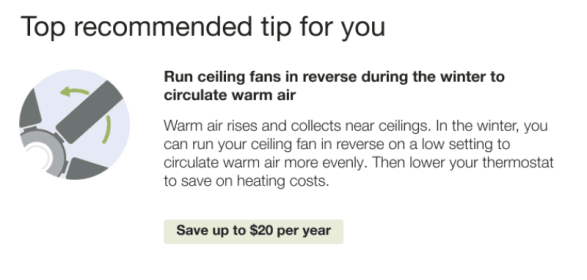
Heading: Indicates that the tip has been personalized for the customer.
Context: Provides additional information to help the customer understand why the tip was selected. Contexts are typically shown at random, except for the "recent HEA completion" context, which appears immediately after a Home Energy Analysis is completed. Availability depends on the customer's AMI data and whether they have completed the Home Energy Analysis. See Home Energy Analysis.
Tip Title: Emphasizes future savings to motivate customer action.
Image: Includes an illustration that aligns with the tip content.
Tip Body: Provides guidance to help customers save energy.
Savings Estimate: Gives a clear estimate of potential cost savings, reinforcing the value of taking action.
Call to Action: The "Get more savings tips" button directs customers to the web portal for additional energy-saving recommendations.
Promotion Report Tips
Appears in: Promotion Report
The back of the Promotion report includes two tip modules. The tips use disaggregation or Home Energy Analysis data to provide customers with low or no-cost actions.
This image shows an example of the promotion report tip design.
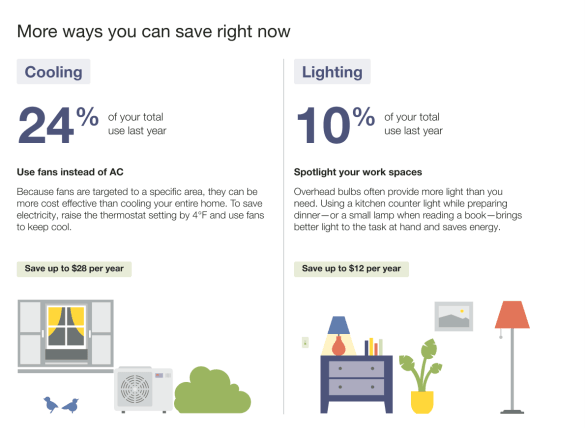
Heading: "More ways you can save right now" builds on the front-of-report message ("X could help you save"). The language is state-agnostic and applies regardless of how categories appear in the customer's disaggregation.
End Use Category 1:Highlights one of the customer's top energy uses (based on the promotion use case).
End Use Category 2: Highlights a second top energy use (based on the promotion use case).
Usage Insight: Pairs each tip with an insight showing the percentage of the customer's total energy use for that category.
Insight Label: Indicates the insight reflects annual usage (all insights are annual).
Tip Title: Emphasizes future savings to motivate customer action.
Tip Body: Provides clear, actionable guidance to help customers reduce energy use.
Savings Estimate: Calculates a personalized estimate of potential savings based on the customer's energy usage data..
Welcome Report Tips
Appears in: Welcome and Announcement Report, Time of Use Welcome Report, Limited Income Welcome Report, Solar Welcome Report
The Welcome tip module includes two tips that highlight the personalized aspects of the tip experience.
This image shows an example of the welcome and announcement report tip design.
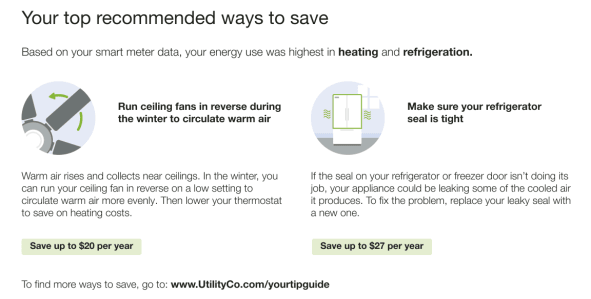
Header: Indicates that the tips have been personalized for the customer.
Context: Provides additional information to help the customer understand why the tips were selected. Contexts are typically shown at random, except for the "recent HEA completion" context, which appears immediately after a Home Energy Analysis is completed. Availability depends on the customer's AMI data and whether they have completed the Home Energy Analysis. See Home Energy Analysis.
Tip Title: Emphasizes future savings to motivate customer action.
Tip Image: Includes an illustration that aligns with the tip content.
Tip Body: Provides guidance to help customers save energy.
Savings Estimate: Offers a clear estimate of potential cost savings, reinforcing the value of taking action.
Call to action: Links to the web-based tips experience, encouraging further engagement with additional tools and recommendations.
Seasonal Report Tips
Appears in: Seasonal Report
The Seasonal Report includes two seasonally relevant tips designed to help customers reduce their energy use and encourages them to explore additional energy-saving tips on the web. The first tip focuses on ways to save on cooling during the summer season, while the second highlights savings opportunities for another targeted end use.
This image shows an example of the Seasonal Report tip design.
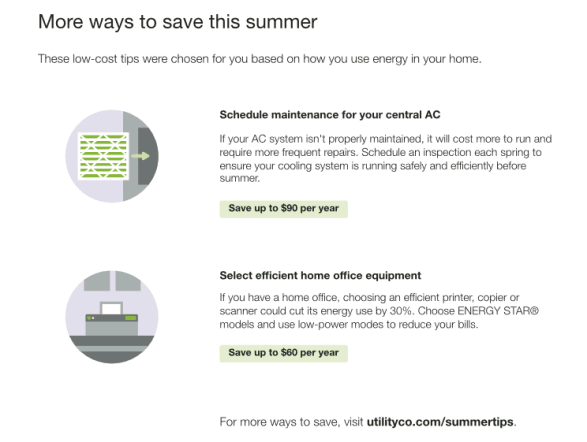
Header: Indicates that the tips are selected to help the customer reduce summer energy use.
Context: Explains why the tips were selected for the customer.
Tip 1: TA seasonally focused tip to help reduce cooling-related energy use during summer. This tip does not include thermostat adjustments to avoid overlap with the Thermostat Adjustment module.
- Title: Seasonally focused to motivate action.
- Body: Provides relevant, actionable summer energy-saving guidance.
- Savings Estimate: Personalized estimate based on the customer's energy usage.
Tip 2: Targets another area of energy use to help the customer save.
- Title: Seasonally focused to motivate action.
- Body: Provides relevant, actionable guidance.
- Savings Estimate: Personalized estimate based on the customer's energy usage.
Call to Action: Encourages customers to explore more tips online, linking to a seasonal tip guide when available.
Solar Progress Report Tips
Appears in: Solar Report
The Solar Progress Report tip presents a single tip module on the back of the report which highlights personalized aspects of the tip experience .
Note:
The welcome version of the Solar Report includes a welcome report tip. See Welcome Report Tips for more information.The following image is an example of the Solar Tip design for a Solar Progress Report.
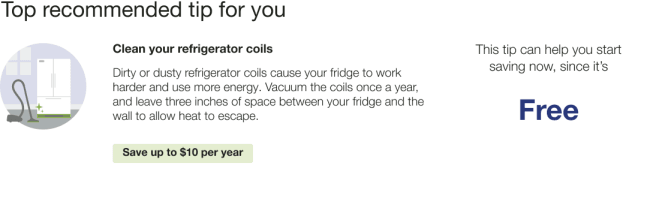
Header: Indicates that the tip has been personalized for the customer.
Context: Explains why the tip was selected. Possible solar-related contexts include low-cost, free, great investment, Home Energy Analysis, and recent Home Energy Analysis.
Tip Title: Emphasizes future savings to motivate customer action.
Image: Includes an illustration that aligns with the tip content.
Tip Body: Provides guidance to help customers save energy.
Savings Estimate: Offers a clear estimate of potential cost savings, reinforcing the value of taking action.
Time of Use Report Tips
The Time of Use Report includes three rotating tip modules that highlight personalized aspects of the tip experience that can help customers on time of use plans save energy and money.
Disaggregation Tip Module
Appears in: Time of Use Report
The Disaggregation and Tip module highlights the customer's highest electricity end-use category and provides a single tip related to that end-use. The tip shown is determined by the customer's top energy use category.
The following image is an example of the Disaggregation tip for a cooling top category.
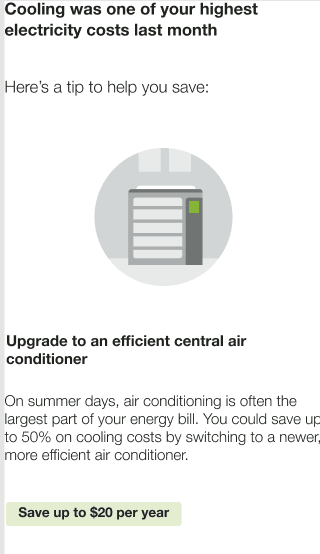
Headline: Highlights the cost category where the customer spent the most in the previous month. Updates dynamically based on their highest electricity use.
Tip Lead-in: Introduces how the customer can save energy and reduce future bills.
Illustration: Supports the tip with a relevant visual.
Tip: Selected based on the customer's top energy use category.
Tip Savings Estimate: Provides a personalized estimate of potential savings using the customer's energy data and Tip Manager insights.
Large Appliance Tip Module
Appears in: Time of Use Report
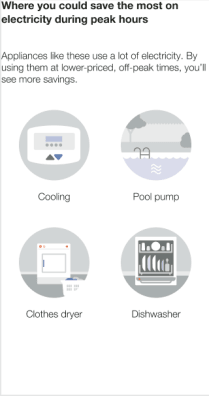
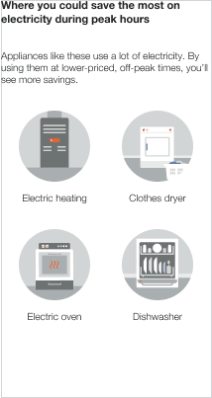
The Large Appliance Tip module highlights four appliances that typically consume significant electricity and provides a link where customers can learn more about saving energy. It is designed to educate customers on time-of-use rate plans about which appliances to avoid using during peak hours, when electricity demand and costs are highest. The module has two season-specific states:
- Hot weather: Covers the spring and summer seasons.
- Cold weather: Covers the fall and winter seasons.
These images are examples of the Large Appliance Tip design for the hot and cold weather seasons.
| Hot Weather | Cold Weather |
|
|
Heading: Prepares the customer to learn where they can save the most electricity during peak hours.
Body Text: Reinforces that customers can save the most energy and money by using the featured appliances during off-peak hours.
Appliance Images: Displays four seasonally relevant appliances that customers should avoid using during peak hours.
Two Tip Module
Appears in: Time of Use Report
The Two Tip module presents customers with both a peak-savings tip and an anytime-savings tip. The peak-savings tip is clearly labeled to indicate when the customer should act, while the anytime tip offers general energy-efficiency guidance and may apply to any end-use category.
This image is an example of the Two Tip design.
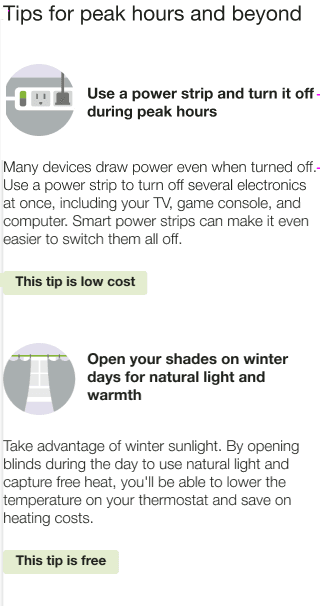
Heading: Indicates that the tips are selected to help the customer save energy during both peak and off-peak hours.
Tip Titles: The first tip focuses on peak usage and is selected from available peak-specific tips. The second tip follows standard targeting logic to present a general savings tip relevant to the customer's household.
Illustration: Displays a visual from the tip illustration library that complements each tip.
Body: Uses existing copy from Tip Manager, tailored to the selected tips.
Cost Category: Shown in a green highlight below the illustration to convey the financial impact (for example, free, smart purchase, great investment).
Paired Tips
Appears in: Limited Income Report, Electric Vehicle Report
Note:
This image is an example of an air leak tip selected to pair with a top energy use highlighted in the What Uses Most module.
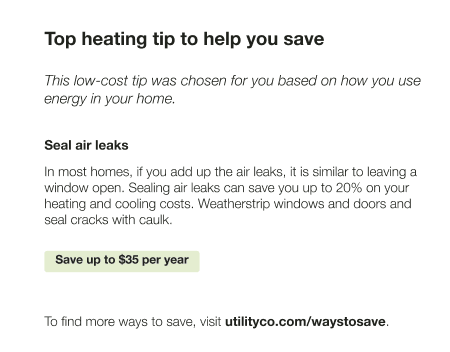
Heading: Indicates that the tip has been personalized for the customer.
Tip Title: Emphasizes future savings to motivate action and aligns with the customer's highlighted energy use in the What Uses Most module.
Tip Body:Provides guidance to help customers save energy.
Savings Estimate: Offers a clear estimate of potential cost savings, reinforcing the value of taking action.
Call to Action: Directs customers to the web portal, where they can explore additional energy-saving tips.
Energy Literacy and Tip
Appears in: Peak Focused Report
The Energy Literacy and Tip module educates customers about why they are consuming energy during the high cost peak period, and provides guidance on what they can do to make a difference in their energy consumption. The module includes a list of two or three appliance categories that were detected during the high cost period, and a tip related to one of the categories that the customer can use to help reduce their energy consumption.
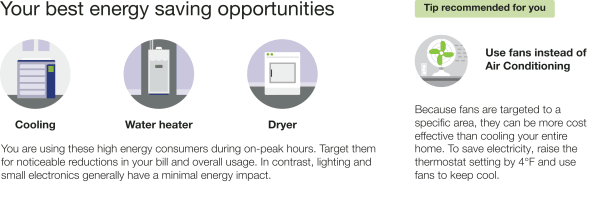
Heading: Invites customers to explore their best opportunities to save energy.
Disaggregation: Shows which appliance categories consume the most energy during peak hours.
- Category images and label: Displays labeled illustrations of the top three appliances used during the highest-cost period, ordered from highest to lowest energy consumption. Categories may include heating, cooling, dishwasher, dryer, electric vehicle, oven, pool pump, refrigerator, and water heater.
- Disaggregation education: Explains that these categories are highlighted because they are heavily used during peak hours, and reducing their usage can lead to noticeable bill savings.
Tip: Provides a specific action the customer can take to reduce energy use, tied directly to one of the highlighted categories (e.g., using fans instead of air conditioning when cooling is a top driver).
- Tip label:Draws attention to the recommended action.
- Tip title: Clearly states the suggested change.
- Tip body: Explains the benefit and provides clear, actionable guidance.
User Experience Variations
AMI and Appliance Detection and Disaggregation
If AMI, appliance detection, and disaggregation data are available, the tip is tailored to the customer's highest energy-use category. For example, if heating is the largest contributor to energy use, the tip will focus on heating.
Completed Home Energy Analysis
If the customer has previously completed a Home Energy Analysis and survey data is available, the tip copy notes that the recommendations are personalized based on their survey results.
Promotion Report Tip User Experience Variations
Promotional Report Tip - Utility Selects One End Use
Tips are displayed for the top two end uses (excluding the promotion end use).
Promotional Report Tip - Utility Selects Heating and Cooling Combined
Tips provide free and low-cost ways to save for heating and cooling as an alternative to the promotion on the front, which is likely a larger investment.
Seasonal Report Tips
Seasonal Report Tip - Winter Seasonal Report Tips
The Winter Seasonal Report tips are focused on actions that the customer can take to save energy and reduce their heating costs.
Seasonal Report Tip - No Savings
If there is not sufficient data to generate personalized savings estimates, the savings estimates do not appear in the tips module.
Seasonal Report Tip - Context
The tip context underneath the header has two states:
- No Information: The no information context is the most common user experience. The context informs the customer that the presented tips are low-cost. "These low-cost tips were chosen for you based on how you use energy in your home."
- Recent Home Energy Analysis Completion: The context informs the customer that the tips were selected based on the information that the customer provided in their recently.
Seasonal Report Tip - Heat Pump: Customers with heat pumps receive a season-specific version of this module that encourages them to keep their thermostat at a consistent temperature instead of making frequent adjustments. The module explains that heat pumps operate most efficiently when maintaining a steady temperature, helping customers understand how a "set it and forget it" approach can improve both comfort and energy efficiency.
The following image is an example of the module sent to a a customer with heat pump in the summer season.
Solar Report Tips
Solar Welcome Report Tip - Completed Home Energy Analysis
If the customer has completed their Home Energy Analysis, the tip context indicates that the tips are personalized based on the results of the customer's survey.
Time of Use Report Tips
Time of Use Report Large Appliance Tip - Seasonal Variations
- Cold weather: Combines the fall and winter seasons. By default, includes Heating (furnace), clothes dryer, oven, and dishwasher.
- Hot weather: Combines the spring and summer seasons. By default, includes Cooling (thermostat), pool pump, clothes dryer, and dishwasher.
Energy Literacy and Tip
Two Appliances Detected
If two appliances are detected in use during the highest cost period, they are ordered by the highest energy consumers.
Electric Vehicle Detected
If an electric vehicle is detected as one of the two or three highest energy consumers during the highest cost period it is included in the list of appliances.
Monthly Fallback
If on-peak data is not available, the module includes a list of the customer's top energy uses for the billing period. The disaggregation education text does not mention on-peak hours.